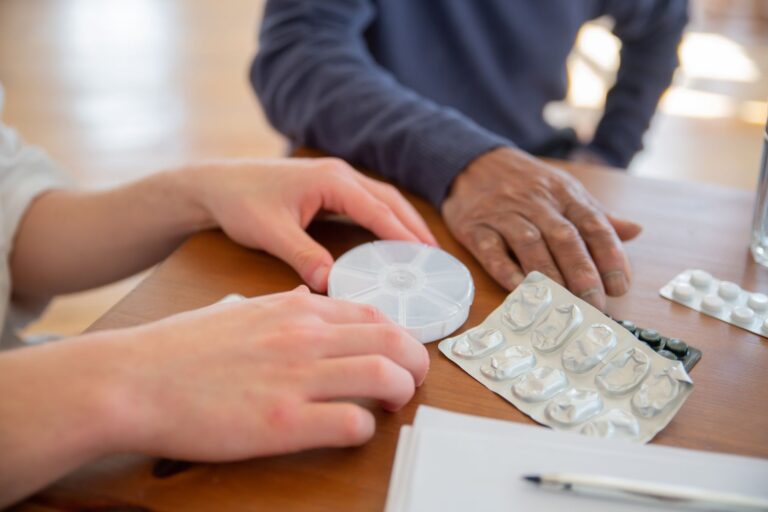
A care-home move does not relax Parkinson's medication timing. NICE requires levodopa within 30 minutes of the prescribed time, not on routine drug rounds, as explained in NICE quality statement on levodopa timing.
Parkinson's dementia means dementia that develops during Parkinson's disease. The NHS Health Research Authority summary says up to four in five people with Parkinson's develop dementia during their illness. Memory problems, hallucinations and weight loss are common.
Medical information disclaimer: This article is for general educational purposes only and does not provide medical advice, diagnosis, or treatment. Always consult a physician or other qualified health professional about symptoms, medications, tests, or treatment decisions.
Table of Contents
- Why does timing matter so much?
- What should happen during the move?
- How does dementia change self-medication?
- Which other medicines need a check?
- What helps homes stay on time?
Why does timing matter so much?
Levodopa keeps movement, swallowing and alertness working for a limited window. When a dose comes late, that window closes and stiffness, freezing and swallowing problems can return.
The Irish Medication Safety Network warns that missed or delayed doses can cause immobility, falls and fractures. It also links late doses to poor swallowing and higher aspiration risk. At worst, it can progress to neuroleptic malignant syndrome leading to coma or death, per the Parkinson's safety alert.
What should happen during the move?
Keep the home on the person's own times. NICE Guideline NG71 says people in hospital or care homes should receive antiparkinsonian medicines at appropriate times, with changes only after specialist discussion.
Bring these items and confirm them at admission: Ask staff to show where those times appear on the chart. If the chart uses standard drug-round times, ask for it to be corrected before the first night.
- pre-admission levodopa schedule with exact times
- accurate medicines chart that copies those times
- named person responsible for each timed dose
- limited reliance on self-medication when dementia impairs it
How does dementia change self-medication?
Dementia can make self-medication unsafe. Memory problems disrupt dose timing, while hallucinations and low alertness disrupt safe handling and swallowing.
NICE Guideline NG71 supports self-medication only where suitable. For Parkinson's dementia, NICE Quality Standard QS164 points toward staff-given doses on the individual schedule. Families can help by stating clearly that prompting or full administration is needed.
Which other medicines need a check?
Some common medicines block dopamine and can worsen Parkinson's symptoms, confusion and agitation. NHS Dorset guidance lists metoclopramide, prochlorperazine, haloperidol and risperidone, and says they should generally be avoided.
Bring a full medicines list to the move, including anti-nausea drugs, antipsychotics and sleep medicines. Ask the prescriber or pharmacist to review any dopamine-blocking medicine and suggest a safer option when treatment is still needed.
What helps homes stay on time?
Parkinson's UK's Get It On Time campaign, reported by a Royal College of Nursing blog, promotes staff training, visual stickers, pill timers, flagged notes and specialist alerts. These tools make individual times visible during busy shifts and handovers.
A Royal College of Nursing blog reports a nine-care-home, six-month programme tracked by electronic records. It found 88% of Parkinson's medicines were given within 15 minutes of the prescribed time, described in the Royal College of Nursing blog on the nursing-home programme. Bring the schedule on moving day and ask who signs for each timed dose.