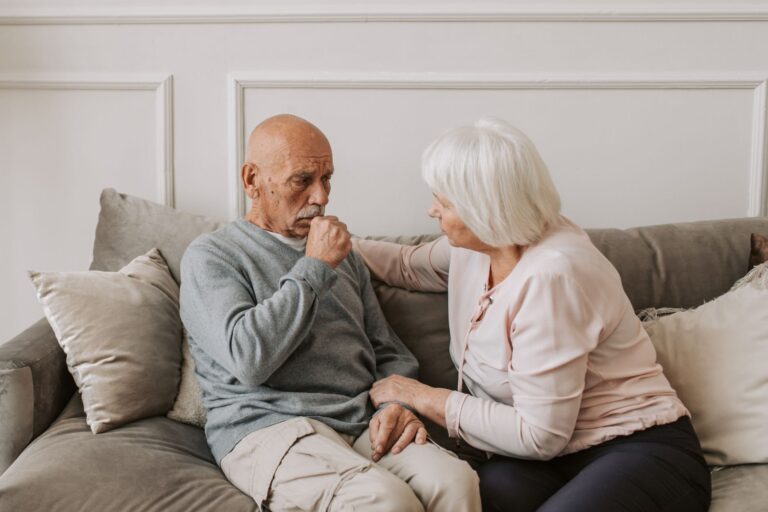
Occasionally forgetting a name is almost always normal aging, not Alzheimer’s. If you walk into a room and blank on a coworker’s name, then recall it an hour later in the parking lot, that is the ordinary friction of a busy brain, not a warning sign. Names are among the hardest things for any human memory to retrieve because they are arbitrary labels with no logical hook, and this kind of slip is common across the entire adult lifespan, including in people in their twenties and thirties. The forgetting that signals concern looks different.
It is not the momentary blank that resolves on its own, but the loss of the memory itself: forgetting the name of a person you see every week and having no sense of ever having known it, or forgetting the entire conversation in which you were introduced. A woman who cannot recall her new neighbor’s name is likely fine. A woman who repeatedly asks her daughter’s name, or introduces her spouse of forty years to guests as a stranger, is showing something well outside normal aging. The distinction that matters is not whether you forget, but what you forget, how often, whether it worsens over months, and whether it disrupts daily life. This article walks through where the line falls, what actually separates ordinary lapses from early dementia, and when a pattern is worth raising with a doctor.
Medical information disclaimer: This article is for general educational purposes only and does not provide medical advice, diagnosis, or treatment. Always consult a physician or other qualified health professional about symptoms, medications, tests, or treatment decisions.
Table of Contents
- Is Forgetting Names Really a Warning Sign for Alzheimer’s?
- How Normal Age-Related Memory Change Differs from Early Alzheimer’s
- What Kinds of Forgetting Should Actually Raise Concern
- Practical Steps to Take If You Are Worried About Memory
- The Limits of Self-Assessment and Online Memory Tests
- Why Names Are Uniquely Hard for the Brain to Recall
- What Family Members Tend to Notice First
- Frequently Asked Questions
Is Forgetting Names Really a Warning Sign for Alzheimer’s?
For most people, forgetting a name is a retrieval problem, not a storage problem. The information is still there; the brain simply cannot reach it in the moment. This is why the “tip of the tongue” feeling is so specific: you know the person, you may know their job, their spouse, the first letter of their name, yet the word will not come. When it surfaces unprompted later, that is proof the memory was intact all along. This pattern is a normal feature of aging and becomes modestly more frequent from middle age onward. Alzheimer’s disease attacks memory differently. Early on, it damages the brain’s ability to form and hold new memories, so the problem is not reaching a stored name but the fact that the name was never durably stored, or has been erased.
The telling sign is not that someone forgets a name, but that they forget they were told it at all. Consider two people at a party who both fail to recall a new acquaintance’s name. The first says, “I know we met, it will come to me.” The second has no recollection of the introduction happening. The second pattern is the one worth watching. Context matters too. A single stressful, sleep-deprived, or over-scheduled week can make anyone’s name recall fall apart temporarily. What separates normal lapses from concerning ones is consistency over time and whether other cognitive functions are slipping alongside the names.
How Normal Age-Related Memory Change Differs from Early Alzheimer’s
Normal aging does slow the machinery of memory. Processing speed declines, retrieval takes longer, and it becomes easier to lose a train of thought when interrupted. But the underlying capacity to learn and retain stays largely intact. An older adult may take longer to recall an actor’s name or misplace their keys, then retrace their steps and find them. Crucially, they remain independent, aware of their lapses, and able to compensate with lists, calendars, and routines. Early Alzheimer’s produces a different signature.
Memory loss reaches into recent events, not just names: repeating the same question within minutes, forgetting important appointments entirely, relying increasingly on family to fill gaps the person does not notice. Judgment, planning, word-finding in full sentences, and spatial navigation often erode alongside memory. The person may get lost on a familiar route or struggle to follow a recipe they have cooked for decades. The important limitation here is that this distinction cannot be made from a single moment or a single symptom. Anxiety, depression, thyroid problems, vitamin B12 deficiency, sleep apnea, and many medications can all mimic early dementia by clouding memory and attention. Some of these causes are fully reversible. Assuming that forgetfulness equals Alzheimer’s can cause both needless fear and a missed diagnosis of something treatable, which is why self-diagnosis is unreliable.
What Kinds of Forgetting Should Actually Raise Concern
The forgetting that warrants attention tends to be about recent, personally significant information rather than trivia. Forgetting the plot of a movie you saw last year is unremarkable. Forgetting that you saw a movie last week with your daughter, an outing that mattered, is more concerning. The pattern to watch is not the difficulty of the fact but its recency and importance, combined with a total absence of the memory rather than a delayed recall. Repetition is one of the clearest early flags family members notice.
A man in his seventies who tells the same story twice in one conversation, unaware he has already told it, or who asks “what time is the appointment?” four times in an hour despite being answered each time, is showing a storage failure, not a retrieval delay. Getting lost in a familiar place, losing the thread of how to complete an everyday task, or putting objects in illogical places such as keys in the freezer are also patterns that go beyond ordinary aging. It helps to notice trajectory. Normal age-related change is relatively stable year to year; you are roughly as forgetful this year as last. A concerning pattern gets noticeably worse over six to twelve months, with family members increasingly stepping in. That downward slope over time is more informative than any single lapse.
Practical Steps to Take If You Are Worried About Memory
The most useful first step is to track patterns rather than react to isolated moments. Keeping a simple log for a few weeks, noting what was forgotten, how often, and whether it disrupted anything, gives a doctor far more to work with than “I’ve been forgetful.” Note whether lapses are names only or extend to recent events, appointments, and familiar tasks. This record also guards against the recency bias that makes one scary moment feel like a trend. When you do see a doctor, there is a tradeoff between starting with a primary care physician and going straight to a specialist. A primary care visit is faster to schedule and can order the basic bloodwork and reviews that catch reversible causes like B12 deficiency, thyroid issues, or medication interactions.
A neurologist or memory clinic offers deeper cognitive testing and imaging but often involves long waits and higher cost. For most people, starting with primary care and being referred onward if needed is the practical route, though a strong family history or rapid decline can justify pushing for a specialist sooner. Bring someone who knows you well to the appointment. People with early cognitive change often underestimate their own lapses, and a spouse or adult child frequently provides the most accurate account. That outside perspective is one of the more reliable pieces of information a clinician can get, and its absence is a common reason early concerns get dismissed.
The Limits of Self-Assessment and Online Memory Tests
Online memory quizzes and symptom checklists are easy to find and can prompt a useful conversation, but they carry real limitations. They cannot distinguish a bad week from a genuine decline, they cannot rule out reversible medical causes, and they generate both false alarms and false reassurance. A person worried enough to take the test may score poorly from anxiety alone, while someone with early impairment may lack the insight to answer honestly. There is also a specific warning worth stating plainly: awareness of the problem is itself diagnostically meaningful, and it cuts in a counterintuitive direction. People who complain loudly about their own memory are often the ones whose memory is relatively fine, because worrying about it requires noticing it.
In many cases of progressing dementia, insight fades, so the person least concerned may be the one others should watch most closely. This is why family observation frequently matters more than self-report. None of this means self-monitoring is worthless. It means the tools have a ceiling. A quiz result, good or bad, is a reason to talk to a professional, not a diagnosis, and treating an app’s green checkmark as an all-clear can delay evaluation of a treatable condition by months.
Why Names Are Uniquely Hard for the Brain to Recall
Names are a special case even within normal memory. Unlike a job title or a hobby, a name carries no meaning that connects to the rest of what you know about a person. “Baker” as a profession conjures bread, ovens, and flour; “Mr. Baker” as a surname connects to nothing, so the brain has no web of associations to pull it back.
Researchers describe names as arbitrary, low-frequency labels, which makes them the first thing to slip and the last to return. This is why forgetting names, on its own, is the weakest possible evidence for Alzheimer’s. A person who can describe exactly what a forgotten acquaintance does for a living, where they met, and what they talked about, but cannot produce the name, is demonstrating that their memory system is working well. The name gap is the expected weak link, not the alarm.
What Family Members Tend to Notice First
In practice, the earliest reliable signals of dementia are rarely forgotten names. Families more often report a person repeating questions, struggling to manage finances or medications they once handled easily, withdrawing from hobbies, or becoming unusually confused by changes in plans. A daughter may notice her father, once meticulous with bills, now has stacks of unpaid or double-paid invoices, a shift in a practiced skill that says more than any single memory lapse.
Changes in mood and personality frequently accompany these early cognitive shifts: increased irritability, suspicion, apathy, or anxiety that seems out of character. A person who used to enjoy hosting may start avoiding social gatherings because keeping up with conversation has become effortful. These functional and behavioral changes, tracked over months and corroborated by more than one family member, carry far more diagnostic weight than the moment someone blanks on a name at a dinner party.
Frequently Asked Questions
Is forgetting names a normal part of getting older?
Yes. Names are arbitrary labels with few mental hooks, so they are among the first things to slip. Forgetting a name and recalling it later points to normal age-related retrieval delay, not disease.
What memory changes are more worrying than forgetting names?
Forgetting recent important events entirely, repeating the same question within minutes, getting lost on familiar routes, and struggling with tasks you have done for years. These suggest a failure to store memories, not just retrieve them.
Can something other than Alzheimer’s cause memory problems?
Yes. Depression, anxiety, thyroid disorders, vitamin B12 deficiency, sleep apnea, and certain medications can all impair memory, and several are reversible with treatment. This is why a medical evaluation matters before assuming the worst.
Should I trust an online memory test?
Use it only as a prompt to talk to a doctor, not as a diagnosis. These tests cannot rule out reversible causes and produce both false alarms and false reassurance.
If I am worried about my own memory, is that a bad sign?
Often it is reassuring. Insight tends to fade as dementia progresses, so people who actively worry about their memory frequently have intact memory. Concern reported by family often matters more than self-report.