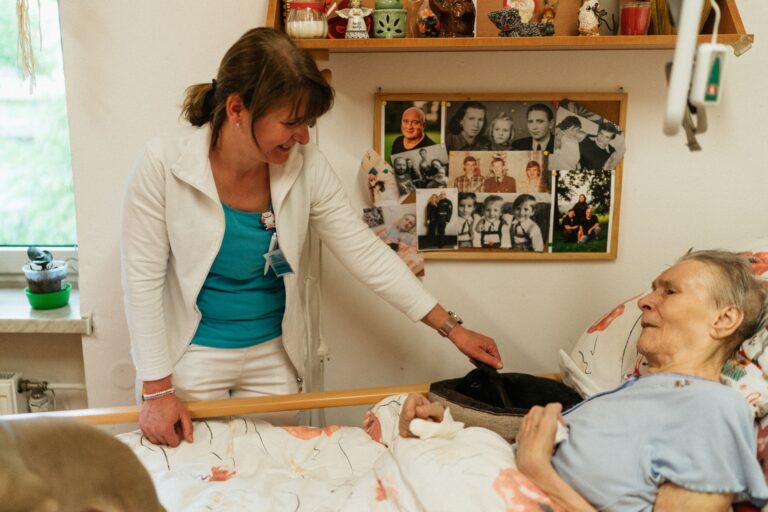
To talk to someone with dementia in a way that calms rather than confuses, use short sentences, acknowledge the emotion behind the person’s words, offer one simple choice or action, and allow extra time for a response. If someone anxiously says, “I need to go home,” correcting them with “You live here now” may increase distress. A calmer response is, “You miss home. What do you miss most?” followed by a familiar activity or a walk to another room.
The goal is not to produce a perfectly accurate conversation. It is to help the person feel heard, safe, and respected. Speak in an adult tone, approach from the front, reduce background noise, and pause after each thought. Dementia affects people differently, so no phrase works every time; a response that reassures one person may irritate another, especially when pain, fatigue, fear, or sensory loss is involved.
Medical information disclaimer: This article is for general educational purposes only and does not provide medical advice, diagnosis, or treatment. Always consult a physician or other qualified health professional about symptoms, medications, tests, or treatment decisions.
Table of Contents
- How Do You Talk to Someone With Dementia Without Confusing Them?
- Why Validation Calms Dementia-Related Distress
- Five Phrases for Fear, Sadness, and Overwhelm
- Five Practical Phrases for Everyday Care
- Five Phrases for Repetition, Refusal, and Mistaken Beliefs
- Supporting Words With Nonverbal Communication
- When Communication Problems May Signal a Medical Need
How Do You Talk to Someone With Dementia Without Confusing Them?
Begin by getting the person’s attention before giving information. Say their name, make comfortable eye contact, and speak at a natural volume unless they have hearing loss. One idea per sentence is easier to process than a chain of instructions. “Please put on your coat” is clearer than “Get ready, find your shoes, put on your coat, and wait by the door.” Questions also require careful handling. Broad prompts such as “What do you want to do today?” demand planning, memory, and decision-making.
Two concrete options—such as choosing between a walk and listening to music—reduce the mental load while preserving some control. Too many choices can feel less like freedom and more like a test. Allow a generous pause after speaking. Repeating the question immediately, changing the wording several times, or answering for the person can add pressure just as they are trying to form a response. If there is no answer, show the objects, use a gentle gesture, or demonstrate the next step rather than filling the silence with more words.
Why Validation Calms Dementia-Related Distress
A person‘s facts may be mistaken while the emotion is entirely real. someone who believes a long-deceased parent is waiting may be expressing loneliness, attachment, or a need for security. Arguing over the date rarely addresses that need. Validation means recognizing the feeling without necessarily confirming every detail of the belief. Tone often matters more than the literal wording. A hurried “You’re fine” can sound dismissive, while a slower response that names the fear can communicate attention and safety.
Facial expression, posture, and physical distance matter too. Standing over a seated person, blocking a doorway, or reaching without warning may feel threatening even when the caregiver’s words are gentle. Validation has limits. It should not be used to conceal injury, ignore abuse, or reinforce a dangerous belief. If a person thinks an intruder is inside, for example, acknowledge that they feel frightened and calmly check the environment rather than insisting that the intruder is real. Persistent hallucinations, escalating paranoia, or abrupt behavioral changes deserve medical assessment.
Five Phrases for Fear, Sadness, and Overwhelm
.
- *1. “You’re safe. I’m here with you.”** This can ground someone who is frightened, provided the environment truly is safe. Pair it with a calm presence instead of repeating it from across the room. **2. “That sounds upsetting. Tell me about it.”** This recognizes distress without arguing about its cause. If the invitation produces more agitation, stop asking questions and offer quiet companionship instead.
- *3. “You miss home. What do you miss most?”** This shifts the conversation from a factual dispute to a meaningful memory. “Home” may represent a childhood house, a former neighborhood, or simply a time when life felt familiar. **4. “Let’s take this one step at a time.”** Use it when dressing, bathing, or leaving the house feels overwhelming, then present only the first step. For example, hand the person one sock rather than pointing toward an entire outfit.
- *5. “We don’t have to decide right now.”** Removing urgency can lower the pressure created by a difficult choice. It is useful for nonessential decisions, such as selecting clothes for tomorrow, but not when delaying would create an immediate safety or medical risk.
Five Practical Phrases for Everyday Care
.
- *6. “Would you like tea or water?”** Two visible, suitable choices are usually easier than an open-ended request. Avoid offering an option that is not actually available. **7. “Let’s put on your blue sweater.”** A direct, friendly invitation can be clearer than asking whether the person wants to get dressed when getting dressed is necessary. This trades some open-ended choice for less confusion, so preserve autonomy through smaller choices such as color, location, or timing.
- *8. “It’s time for lunch; come with me.”** This combines a concrete cue with an immediate action. Pointing toward the dining area or walking beside the person can make the message easier to follow. **9. “Here is your toothbrush. I’ll start mine too.”** Demonstration often succeeds when verbal instructions do not. It also turns personal care into a shared routine instead of a correction.
- *10. “Let’s sit here for a minute.”** A small, present-focused suggestion can interrupt pacing or rising frustration without demanding an explanation. Do not force the person into a chair or block their path. If pacing appears purposeful, check for needs such as the toilet, pain, hunger, uncomfortable clothing, or a desire for movement.
Five Phrases for Repetition, Refusal, and Mistaken Beliefs
.
- *11. “You’re looking for your mother. She sounds very important to you.”** This acknowledges the relationship without bluntly announcing a death the person may experience as new grief each time. Some people want accurate information, however, so follow their established preferences and emotional response rather than applying one rule to everyone. **12. “I don’t know, but I’ll find out.”** An honest, calm answer is better than inventing certainty. Follow through when the question concerns something that can actually be checked.
- *13. “That’s okay; we can try again later.”** This can defuse refusal during bathing, dressing, or eating when the task is not urgent. A short break may allow fear or fatigue to settle. Repeated refusal of food, fluids, medication, or essential care requires investigation rather than endless postponement. **14. “What would help you feel comfortable?”** Even when the person cannot provide a detailed answer, the question communicates respect and may reveal a practical problem such as cold water, embarrassment, noise, or pain.
- *15. “Let’s check together.”** This is useful when an item seems lost, a door seems unlocked, or someone believes a room is unsafe. A brief check can reassure without launching an argument. Repeated checking can also strengthen a cycle of anxiety, so after one calm inspection, redirect attention to a familiar task. If the person is threatening harm, trying to leave into danger, or becoming physically aggressive, prioritize distance and immediate safety over conversational technique.
Supporting Words With Nonverbal Communication
Words are easier to understand when the surroundings support them. Turn off the television, move into the person’s field of vision, keep your hands visible, and approach at an unhurried pace.
Touch should never be assumed to be reassuring; a hand on the shoulder may comfort one person and startle another. For example, if someone cannot follow a request to sit at the kitchen table, pull out the chair, place a familiar cup on the table, and sit nearby. The visual sequence provides information that a longer verbal explanation may not convey.
When Communication Problems May Signal a Medical Need
A sudden change in speech, attention, alertness, or behavior should not automatically be attributed to dementia. Pain, dehydration, constipation, infection, medication effects, poor sleep, hearing problems, and delirium can all change how a person communicates.
Note when the change began, what medications were recently started or adjusted, and whether eating, drinking, walking, or toileting has changed. Seek urgent medical help for new facial drooping, one-sided weakness, severe breathing difficulty, loss of consciousness, or a sudden inability to speak or understand speech. If a normally talkative person becomes unusually drowsy and confused over the course of a morning, document the timing and accompanying symptoms while arranging prompt medical assessment.