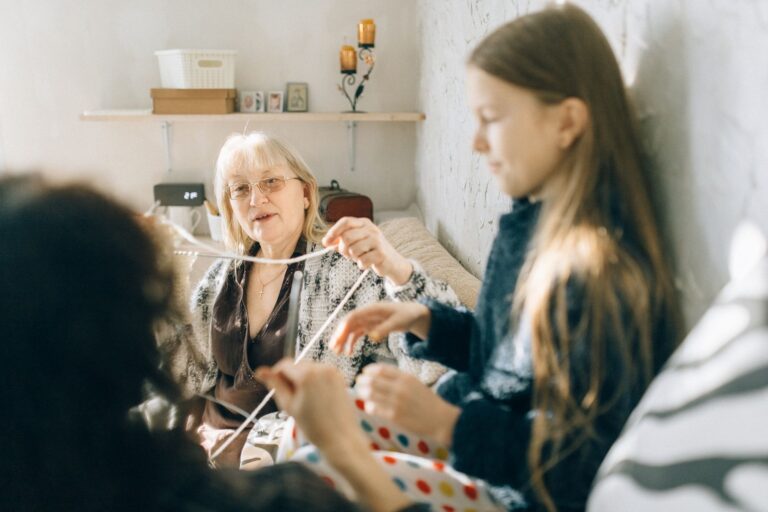
To simplify simple knitting for early-stage dementia, switch to thick, bright yarn, large needles, and one repeated stitch such as garter stitch. Set up a calm, well-lit space, give one step at a time, and keep sessions short. Early-stage dementia means memory, attention, or dexterity are changing while the person can still take part with minimal help. Simple patterns with easy-to-follow instructions permit independent or minimal-assistance knitting, while larger tools and thicker yarn make stitches easier to see, hold, and manipulate.
Medical information disclaimer: This article is for general educational purposes only and does not provide medical advice, diagnosis, or treatment. Always consult a physician or other qualified health professional about symptoms, medications, tests, or treatment decisions.
Table of Contents
- What does the evidence support?
- How should you set up for success?
- What materials and patterns work best?
- How do you guide without frustration?
What does the evidence support?
Geda and colleagues found that late-life crafts such as knitting and quilting, plus computer use, games, and reading, were associated with decreased odds of mild cognitive impairment in 1,321 adults ages 70-89, as reported in the Journal of Neuropsychiatry study. Mild cognitive impairment often precedes dementia, so active leisure in later life matters for brain-health discussions. PhillyVoice health reporting described a separate finding in 20,811 adults ages 35-64: each extra daily hour of mentally active sitting such as reading, knitting, or puzzles was linked with about 4% lower dementia risk.
Swapping one passive TV hour for active sitting was linked with about 7% lower risk. These are associations and quality-of-life benefits, not proof that knitting prevents dementia, according to Hovi Care. Knitting also does not reverse Alzheimer's disease progression.
How should you set up for success?
Match the project to current ability, help the person start, and repeat an enjoyed activity at a similar time daily. The National Institute on Aging gives this caregiver guidance for adapting activities, detailed in its dementia activities guide.
Use a quiet, calm, well-lit space with supplies ready before you begin. The National Council of Certified Dementia Practitioners advises one instruction at a time, short sessions, and simpler steps when attention fades.
- Lay out only the yarn, needles, and pattern for this session.
- Reduce background noise, clutter, and interruptions.
- Offer one short step, praise completion, then give the next step.
- Stop or simplify further if the person tires, withdraws, or becomes frustrated.
What materials and patterns work best?
Move from complex to simple patterns and then to block colours or plain knit as dementia progresses, with a helper threading needles and casting on and off. The Alzheimer's Society UK describes this step-down approach for wool crafts in its wool-crafts activity ideas. Keeping Busy notes that larger needles and thicker yarn help stitches stay visible and easier to grip.
Choose smooth chunky yarn in a bright colour that contrasts with the needles. DailyCaring suggests large-gauge needles or hooks with thick yarn and only one repeated stitch. A short garter-stitch scarf, dishcloth, or simple rectangle gives quick visible progress and supports reduced dexterity, vision, and attention.
How do you guide without frustration?
Break knitting into small steps and praise each step. Cast on for the person, knit the first few rows, then invite them to continue the same stitch. Demonstrate slowly, hand over hand only if welcome, then let the person try alone.
Keep language concrete: pick up yarn, wrap, pull through, slide off. Watch for fatigue, rubbing eyes, sighing, missed stitches, or pushing materials away. Repeat the same stitch, shorten the session, switch to holding or winding yarn, or stop for the day and try again later.