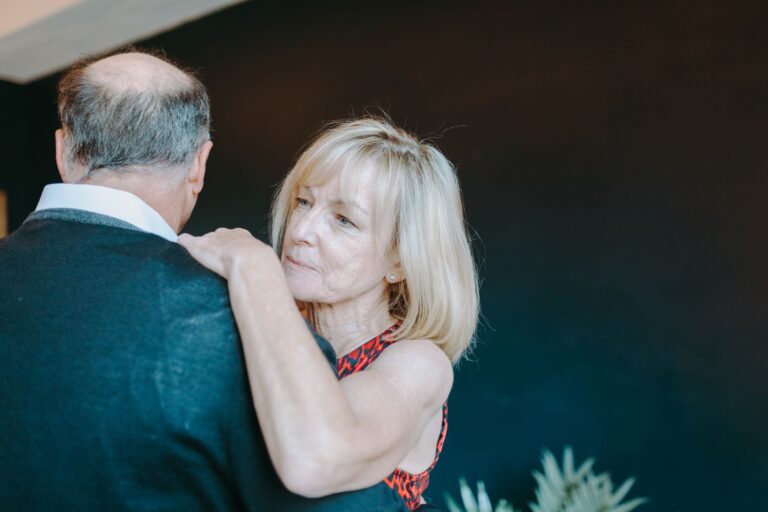
Simplify dancing for early-stage dementia by keeping a familiar dance, cutting it to two to four repeated steps, and doing it at the same time and place each day with sturdy support nearby. Early-stage dementia means memory and thinking changes are mild but routines need to stay simple and predictable. Short sessions work. A few minutes of swaying, stepping side to side, or marching to music counts as movement and keeps practice calm and repeatable.
Medical information disclaimer: This article is for general educational purposes only and does not provide medical advice, diagnosis, or treatment. Always consult a physician or other qualified health professional about symptoms, medications, tests, or treatment decisions.
Table of Contents
- Keep steps they already know
- Give dancing a fixed daily slot
- How do you keep the body safe?
- What can dance improve?
Keep steps they already know
Keep a dance the person knows rather than teaching a wholly new one. The Alzheimer's Association advises caregivers to keep familiar daily activities and adapt routines with creativity and flexibility, according to Alzheimer's Association daily care guidance.
Pick one chorus or verse as the whole dance. Use two to four moves, such as step-touch, side sway, gentle march, or seated arm waves. Repeat the same order each time and let the person sit, watch, or clap when tired.
Give dancing a fixed daily slot
Place dancing in the same morning, afternoon, or evening block each day. The Alzheimer's Association organizes early-to-middle-stage care into predictable morning, afternoon, and evening blocks, so a short dance fits best as a same-time, same-place routine slot.
A living-room session after lunch works well. Play the same two songs, move for five to ten minutes, then stop. Keep lights on, clear cords and rugs, and keep a chair or counter within reach.
How do you keep the body safe?
Start easy and build slowly. NIH MedlinePlus Magazine advises talking with a doctor about activities to avoid, starting gradually with low-intensity movement such as walking, and drinking water before, during, and after activity, as explained in the NIH MedlinePlus exercise guide.
That guide lists four needed types: endurance, strength, balance such as standing on one foot, and flexibility such as yoga. For simplified dance, skip unguarded single-leg turns and spins.
- Ask the doctor what to avoid, especially for balance, joints, and heart.
- Begin with two to five minutes at low effort.
- Dance beside support and wear steady shoes.
- Offer water before, during, and after.
- Count brief bouts toward the weekly goal of at least 150 minutes of moderate activity or 75 minutes vigorous, plus muscle-strengthening at least two days weekly.
What can dance improve?
A Hong Kong Baptist University review of 29 dance studies with 1,708 older adults with mild cognitive impairment, Alzheimer's, or dementia found dance significantly improved global cognition, memory, and balance and reduced depression in pooled randomized trials, reported in the Hong Kong Baptist University review summary. A separate 55-person German DiADEM randomized trial gave older adults with mild cognitive impairment two 90-minute sportive dance sessions weekly for six months focused on learning movement patterns, preserving maximal oxygen uptake while controls declined, described in the University of Münster trial record.
The gains were specific. The same review found no significant effect on executive function, and strength gains in DiADEM were non-significant. Plan dance for memory, mood, fitness, and balance, and add separate strength practice if needed.