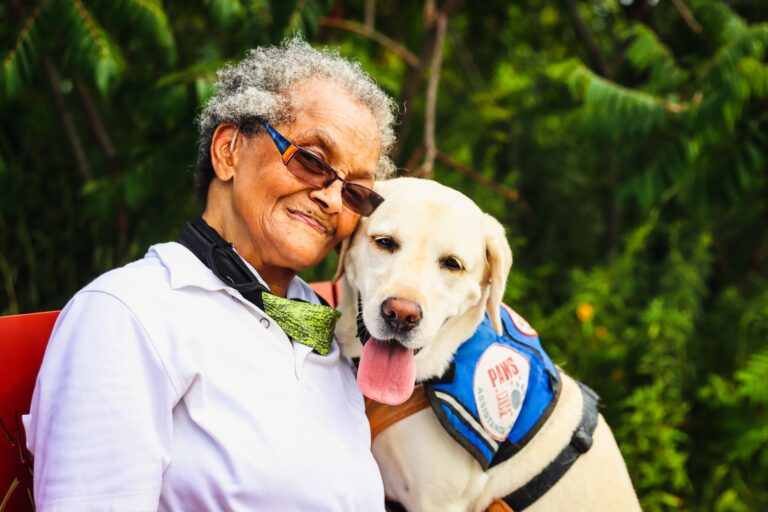
Start by checking a handler's registration with a recognized body — Pet Partners or the Alliance of Therapy Dogs — and confirming the facility's own visiting-animal policy before any team sets foot in a dementia unit. These two steps catch the vast majority of problems, because the terms "therapy dog" and "pet therapy" carry no legal standard on their own. That gap matters for dementia care specifically.
Therapy animals are not service animals under federal law, so there's no baseline credential a facility is required to check. The screening work falls to the family or the care setting, and the two major U.S. registries make that screening straightforward if you know what to ask for.
Medical information disclaimer: This article is for general educational purposes only and does not provide medical advice, diagnosis, or treatment. Always consult a physician or other qualified health professional about symptoms, medications, tests, or treatment decisions.
Table of Contents
- What "Qualified" Actually Means
- Animal Eligibility Standards to Verify
- Why Federal Law Doesn't Set the Bar
- What the Evidence Says About Benefits and Limits
- What a Dementia Unit Actually Needs From a Session
- Frequently Asked Questions
What "Qualified" Actually Means
A qualified pet therapy provider is a handler-animal team that has passed a formal evaluation process run by a recognized registry, not simply someone who owns a friendly, well-behaved pet. Pet Partners, the largest U.S. therapy-animal registry, requires handlers to complete its Handler Course, pass a veterinary health screening, and pass a mock-visit team evaluation with a licensed evaluator. A "Not Appropriate" rating at that evaluation blocks registration outright.
The Alliance of Therapy Dogs (ATD) runs a comparable but distinct process. Under its 2025 Rules and Regulations, a dog-handler team must first pass a handling and manners test, then complete three supervised visits — at least two of them at medical facilities — observed by a Tester/Observer. The dog also needs a negative fecal exam every 12 months to stay certified. Either credential tells you the same basic thing: an independent evaluator has watched this specific team work in a real or simulated care setting and signed off on it. A pet that's calm at home hasn't been tested against wandering, raised voices, wheelchairs, or sudden movements — the conditions a dementia unit actually presents.
Animal Eligibility Standards to Verify
Before accepting a team, confirm the animal itself meets baseline readiness standards, not just the handler's paperwork. Pet Partners sets specific minimums: the animal must be at least 1 year old (6 months for smaller species), must have lived with the handler for 6 months or longer, must have basic obedience training, and must carry a current rabies certificate along with a clean physical exam, according to Pet Partners' own FAQ.
Ask to see proof of these items directly rather than taking a verbal assurance: Registered Pet Partners teams also carry the organization's liability insurance during sanctioned visits, per the same FAQ. A facility or family can ask to verify that coverage before admitting a volunteer team, which shifts liability away from the individual household or care home.
- Current registration or certification card from Pet Partners or ATD
- Veterinary health clearance within the last year
- Rabies certificate that hasn't lapsed
- Evidence the team has completed supervised facility visits, not just training classes
Why Federal Law Doesn't Set the Bar
Therapy animals occupy a different legal category than service animals, and that distinction shapes how much vetting falls on you. The U.S. Department of Justice's ADA guidance states plainly that therapy, emotional-support, comfort, and companion animals do not qualify as service animals, because they aren't trained to perform a specific disability-related task. They carry no federal public-access right.
That means a dementia care facility isn't legally required to admit any particular animal, and it sets its own visiting-animal policy. The same DOJ guidance advises families to confirm a handler's current registration status with a recognized body and check the facility's policy directly, rather than assuming a self-described "therapy dog" qualifies for entry. In practice, this puts the burden of verification on the family and the facility together. Ask the facility administrator what documentation they require before a team can visit a resident with dementia, and ask the handler for the registry credential that satisfies it.
What the Evidence Says About Benefits and Limits
The case for pet therapy in dementia care rests on a modest but real evidence base, and it's worth knowing both what supports it and where it falls short. A randomized controlled trial of 65 nursing-home residents with dementia, who received 10 weekly animal-assisted therapy sessions, found that agitation and aggression symptoms stayed stable in the treatment group while they worsened in the control group. The study's authors described it as a promising adjunct treatment.
A broader systematic review published in BJPsych Open tempers that finding. It concluded the evidence base for animal-assisted interventions in dementia remains limited by small sample sizes and inconsistent study methods, and it called for more rigorous controlled trials before effectiveness can be firmly established. That limitation matters if a family is weighing pet therapy as a primary treatment rather than one supportive piece of a broader care plan.
What a Dementia Unit Actually Needs From a Session
Once a team is certified, the practical work shifts to managing the visit itself. A memory-care director at Cascade Creek Memory Care, an ATD-affiliated facility, reports that the main operational concern on a dementia unit is keeping the visit calm and keeping other pets out of the space during sessions.
That's a useful detail to raise with any provider you're considering. Ask how the handler plans to manage the environment around a session — limiting distractions, pacing the visit to the resident's energy, and coordinating with staff so the animal isn't competing with other activity on the unit. A team with facility-visit experience, rather than only general obedience training, will usually have a ready answer.
Frequently Asked Questions
Can a facility legally refuse a therapy animal visit?
Yes. The DOJ's ADA guidance confirms therapy animals have no federal public-access right, so each facility sets its own visiting-animal policy.
How long does it take for a team to become certified?
The research packet doesn't specify a timeline, but ATD's process requires three supervised visits after an initial manners test, and Pet Partners requires a course, vet screening, and a mock-visit evaluation — each a separate step completed in sequence.
Does pet therapy replace standard dementia treatment?
No. The BJPsych Open systematic review notes the evidence base is still limited, and the available trial describes animal-assisted therapy as a promising adjunct, not a primary treatment.