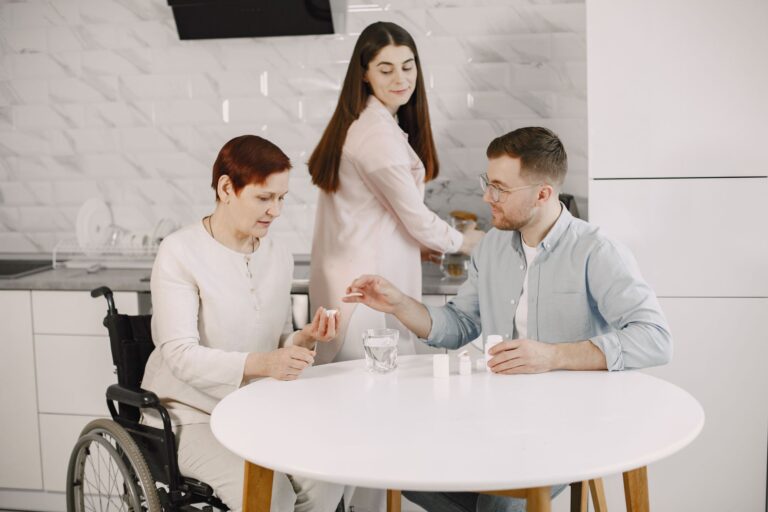
Dementia stage changes forgetting to drink from a memory problem into a physical one. In early stages, a caregiver's spoken reminder is usually enough; by late stages, the person can no longer recognize thirst or swallow safely, so the approach has to shift from prompting to directly managing fluids. Dehydration can show up within hours of low intake, and the right response depends entirely on what the person's brain and body can still do at that point in the disease. Matching the strategy to the stage — rather than using one fix at every stage — is what keeps a workable habit from quietly failing as the disease progresses.
Medical information disclaimer: This article is for general educational purposes only and does not provide medical advice, diagnosis, or treatment. Always consult a physician or other qualified health professional about symptoms, medications, tests, or treatment decisions.
Table of Contents
- Early Stage — The Problem Is Tracking, Not Doing
- Moderate Stage — The Problem Is the Sequence
- Advanced Stage — The Problem Is Capacity Itself
- Swallowing Risk Can Start Earlier Than Expected
- Recognizing Dehydration Early, at Any Stage
- Practical Steps That Work Across Stages
- Frequently Asked Questions
Early Stage — The Problem Is Tracking, Not Doing
In early-stage dementia, a person can still pick up a glass, carry it to the sink, and drink without help. What slips is the running count: they lose track of how much they've already had that day. A caregiving column in the Santa Ynez Valley News recommends caregivers give verbal reminders to eat or drink at regular intervals, since the physical skill is intact but the memory of having already done it is not. This is also the stage where thirst itself can start to misfire.
Dementia can blunt the body's own thirst signal, so Alberta Health Services, citing the Alzheimer's Association of New York City, notes that a person can be dehydrated without feeling or recognizing any urge to drink. That means waiting for the person to say they're thirsty is already an unreliable plan, even before memory loss becomes the dominant issue. A simple hourly offer works well here. A caregiving guide from Guideposts recommends offering a drink roughly once per hour while the person is awake, rather than waiting to be asked, precisely because thirst can't be trusted to show up on schedule.
Moderate Stage — The Problem Is the Sequence
As dementia progresses to the moderate stage, reminders stop working because the person can lose the physical sequence of drinking itself. The Santa Ynez Valley News column describes people forgetting how to turn on a faucet, where the cups are kept, or how to pour water — not because they don't want to drink, but because the multi-step task has broken down. The fix changes accordingly: instead of a verbal cue, caregivers need to pre-pour a drink and hand over an already-filled cup.
Telling someone to "go get some water" assumes they can still execute every step between the reminder and the glass reaching their mouth; at this stage, that assumption often no longer holds. This stage also calls for closer verification, not just offering. The Caregiver Action Network advises physically checking that a drink was actually swallowed rather than assuming an empty cup means it was consumed, since spilling becomes more common as motor coordination declines.
Advanced Stage — The Problem Is Capacity Itself
In advanced dementia, the issue is no longer memory or sequencing — it's that the person loses the ability to communicate thirst and to drink independently at all. Senior Services of America notes that care plans at this stage may need to add feeding tubes or IV fluids, along with frequent mouth moistening performed by caregivers, because self-directed drinking is no longer a realistic option. Swallowing difficulty, known as dysphagia, becomes especially common at this point.
A peer-reviewed review cited by PMC/NCBI reports prevalence estimates for oropharyngeal dysphagia as high as roughly 80–86% in advanced cognitive impairment. That changes what "helping someone drink" even means: fluids sometimes need to be thickened or delivered through assisted methods rather than simply offered in a cup. This is a meaningful shift from the earlier stages. A reminder or a pre-poured cup assumes the person can still swallow safely on their own terms; at advanced stages, the risk of choking or aspiration from an unmodified liquid becomes a real factor in how fluids are given.
Swallowing Risk Can Start Earlier Than Expected
It's worth noting that swallowing problems aren't strictly confined to the advanced stage. A study of a mostly mild-stage dementia cohort, cited in the dysphagia literature via Frontiers in Neurology, found that 23 of 68 patients — 34% — failed a bedside water-swallow test.
That's a substantial share of people still in the earlier stages of the disease. This matters for planning: an assumption that swallowing safety is purely a "late-stage problem" can mean precautions get introduced later than they should. If a person at an earlier stage shows new coughing, throat-clearing, or wet-sounding speech while drinking, that's worth raising with a doctor or speech-language therapist regardless of how early their dementia otherwise seems.
Recognizing Dehydration Early, at Any Stage
Across all stages, watching for warning signs matters because symptoms can appear within just a few hours of inadequate fluid intake. According to Senior Services of America and Alberta Health Services, signs include: Because confusion itself is both a symptom of dehydration and a feature of dementia, a sudden worsening in alertness or orientation is easy to misread as "just the disease" rather than a fluid problem that can often be corrected quickly.
- Dark or low-volume urine
- Dry mouth or cracked lips
- Dizziness or new confusion
- Fatigue
- Constipation
Practical Steps That Work Across Stages
Several strategies help regardless of which stage a person is in, according to the Caregiver Action Network: A professional swallow evaluation is especially worth pursuing once there's any sign that the issue has moved from "forgetting to drink" to "struggling to drink safely," since that distinction determines whether the solution is a reminder, a pre-poured cup, or a modified-texture fluid plan.
- Make drinks visually appealing — flavored water or a favorite cup can increase willingness to drink
- Add high-water foods such as watermelon, broth, yogurt, and gelatin to meals
- Limit caffeine and alcohol, which work against hydration
- Seek a professional evaluation — doctor, nurse, or speech/swallow therapist — if intake stays low despite these steps
Frequently Asked Questions
Can a person with dementia be dehydrated even if they say they're not thirsty?
Yes. Dementia can blunt the body's own thirst signal, so someone can be dehydrated without feeling or recognizing an urge to drink, according to Alberta Health Services.
How often should caregivers offer fluids instead of waiting to be asked?
Roughly once per hour while the person is awake, according to Guideposts, since relying on the person to ask isn't dependable.
Is swallowing difficulty only a late-stage dementia issue?
No. A study cited via Frontiers in Neurology found 34% of a mostly mild-stage group failed a bedside swallow test, so it can appear earlier than assumed.