Reviewed by the Help Dementia Editorial Team — our editors review every article for accuracy against guidance from the National Institute on Aging, the Alzheimer’s Association, and peer-reviewed sources.
Making daily care easier for someone with dementia begins with understanding that communication isn’t just about words—it’s about meeting them where they are. Dementia affects over 6.9 million Americans, and while the disease progressively impacts memory and cognitive function, caregivers can adapt their communication approach to reduce frustration, improve care quality, and maintain meaningful connection. The goal is simple: use clearer, simpler messages combined with patience, nonverbal cues, and a willingness to repeat information without judgment. When your loved one doesn’t remember breakfast, the response isn’t to correct them or express frustration, but to calmly confirm it happened, perhaps over a cup of coffee together. Effective dementia communication relies on proven strategies from recent research and clinical guidelines. The Alzheimer’s Association released updated clinical practice guidelines in 2025 based on a review of over 7,300 publications, emphasizing that simplified language, clear articulation, and repetition—combined with appropriate body language and a warm tone—work best.
These aren’t complex techniques requiring special training. They’re practical adjustments that any caregiver can learn and apply immediately, whether helping someone get dressed, manage medications, or navigate a confusing moment. The challenge is that communication difficulties multiply when other conditions are present. About 87% of dementia care recipients experience hearing loss, making communication even more complex. Adding to this, roughly 30% of caregivers provide simultaneous care to individuals with both dementia and hearing loss. Yet many families manage these dual challenges without specialized support or resources, particularly in underserved communities where access to caregiving education and resources remains limited.
Table of Contents
- Why Do Communication Problems Happen in Dementia?
- The Foundation of Effective Dementia Communication: Simplified Language
- Navigating Dementia Communication When Hearing Loss Is Present
- Body Language, Tone, and Nonverbal Communication That Actually Works
- The Hidden Burden: Communication Challenges in Underserved Communities
- When Words Stop Working: Late-Stage Dementia Communication
- Building Sustainable Communication: From Daily Practice to Future Care
- Conclusion
- Frequently Asked Questions
Why Do Communication Problems Happen in Dementia?
dementia damages the brain regions responsible for language processing, memory retrieval, and the ability to follow instructions—so communication breaks down naturally as the disease progresses. Early-stage dementia may involve occasional word-finding difficulties or repeated questions, while later stages can involve difficulty understanding simple sentences or expressing basic needs. The person isn’t being difficult; their brain is literally struggling to process language the way it once did. Understanding this distinction helps caregivers shift from frustration to compassion, which itself improves how the person with dementia responds. The relationship between communication challenges and care quality is direct and measurable. Research shows that poor communication leads to behavioral issues, resistance to care, anxiety, and reduced quality of life for both the care recipient and caregiver.
When caregivers use simplified language and clear messages, care recipients are more likely to cooperate with daily activities, express their needs accurately, and experience lower stress levels. In one study examining home care interactions, care recipients’ engaging body language occurred most frequently after caregivers used facilitative body language and simplified messages—demonstrating that the caregiver’s approach directly shapes the interaction. Without effective communication strategies, even routine tasks become exhausting. Getting someone with dementia to shower, eat, or take medication can turn into a conflict when instructions are complex or the person feels confused and frightened. With proper communication techniques, these same tasks often proceed smoothly. The difference isn’t medication or equipment; it’s strategy.

The Foundation of Effective Dementia Communication: Simplified Language
The most effective communication starts with simplicity. Use short sentences with one idea per sentence, plain everyday language, and concrete nouns rather than pronouns or vague references. Instead of saying “We need to go to the place where the doctor is,” say “Let’s go see Dr. Smith.” Instead of “Did you take your pills yet?”, say “Here are your pills with water.” This isn’t condescending; it’s practical accommodation for how dementia affects language processing. Repetition without frustration is equally important. Your loved one may ask the same question five times in an hour—where they are, what time it is, when someone is coming to visit. Each time, answer the question completely and calmly as if it’s the first time they’ve asked.
Don’t say “I already told you that” or sigh with exasperation. research confirms that when caregivers respond with patience and clear, consistent answers, anxiety decreases and communication improves. One limitation worth noting: repetition works best when combined with other strategies. Repeating the same complex sentence slowly won’t help; repeating a simplified message does. Rephrasing is your recovery tool when someone doesn’t understand. If they don’t respond to “Would you like to have lunch now?”, try “Here’s your sandwich and soup. Let’s eat.” Use different words, shorter constructions, and more concrete language. testing different phrasings—and noting which ones work—builds your personalized communication toolkit for that specific person.
Navigating Dementia Communication When Hearing Loss Is Present
The overlap between dementia and hearing loss creates compounded communication barriers that many caregivers navigate alone. When 87% of dementia care recipients have hearing loss, and 30% of caregivers manage both conditions simultaneously, this isn’t a rare edge case—it’s a widespread reality. Speaking louder is the instinctive response but often the wrong one. Shouting distorts speech and can feel aggressive, making the person with dementia more anxious rather than more understanding. Instead, face the person directly so they can see your lips and facial expressions, reduce background noise before speaking, and speak clearly at a normal pace without exaggerating. If they have hearing aids, ensure the devices are in, turned on, and functioning.
Many people with dementia forget they’re wearing them or remove them, and some caregivers don’t realize this is happening. Check hearing aid batteries regularly and have backup aids available if possible. The reality is that managing both conditions requires vigilance, but the payoff is significant communication improvement. One downside to acknowledge: even with perfect technique, hearing loss and dementia together can make some conversations impossible. In late-stage dementia with severe hearing impairment, verbal communication may become limited. This is where nonverbal connection—touch, music, familiar activities—becomes the primary communication channel. Accepting this transition rather than fighting it reduces caregiver stress and helps maintain emotional connection.

Body Language, Tone, and Nonverbal Communication That Actually Works
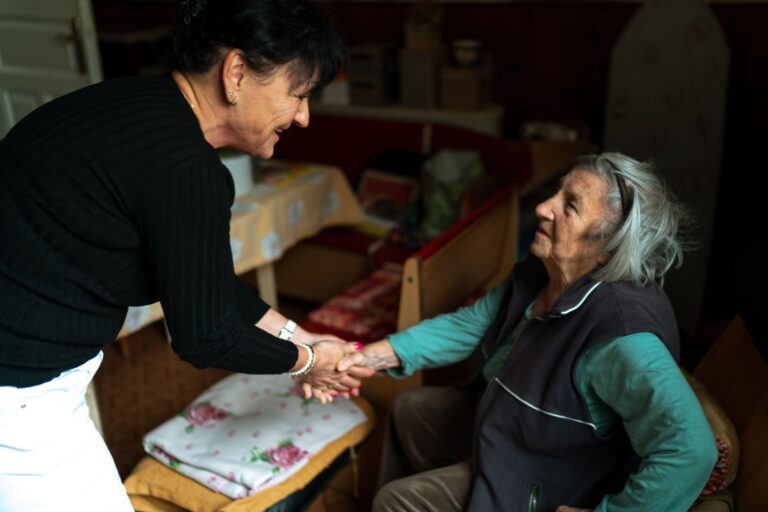
What you do often matters more than what you say. Research on home care interactions shows that care recipients respond most positively when caregivers use facilitative body language—approaching calmly, maintaining open posture, making eye contact, and using gentle gestures. A warm facial expression and calm tone signal safety; a tense body or worried expression signals something is wrong, even if the words are reassuring. The specific nonverbal techniques that work include maintaining eye contact to show engagement and trust, using appropriate gestures to reinforce your words, practicing active listening by pausing and letting them speak even if it takes longer, employing a warm and patient tone of voice, offering gentle touch on the arm or hand when appropriate, and using hand gestures to illustrate simple actions. For example, if you’re suggesting a shower, you might smile, gesture toward the bathroom, and act out a quick washing motion with your hands.
This multimodal approach reaches the person even when words alone fail. Tone deserves special attention because it often contradicts the literal meaning of words. If you say “Let’s have a nice bath” with impatience or tension in your voice, the person may react to the tone rather than the words. They sense your frustration even when you’re using kind language. Practicing a genuinely patient, warm tone—even when internally frustrated—takes effort but produces measurably better outcomes. This isn’t about faking it; it’s about managing your own emotional state so your genuine warmth comes through.
The Hidden Burden: Communication Challenges in Underserved Communities
Dementia doesn’t discriminate, but access to caregiving support and communication education does. Underserved communities face disproportionately higher caregiving burden, with family members and care partners often lacking access to resources, training, and support that would help them communicate more effectively. Research examining communication strategies in underserved populations shows that caregivers in these communities report feeling isolated, unprepared, and overwhelmed—not because the strategies are complicated, but because they never learned them. The result is that many families reinvent the wheel, developing communication approaches through trial and error rather than evidence-based guidance. They may not know that simplified language works better than normal speech, that body language matters, or that there are specific techniques for managing hearing loss alongside dementia.
This knowledge gap isn’t their fault; it reflects healthcare inequities where dementia education and caregiver support are distributed unevenly. A caregiver in an underserved area may be managing dementia care with less information, fewer resources, and more stress than caregivers in well-resourced communities. This disparity becomes more urgent given the scale: one in five people with dementia globally receive no care at all, according to research from Yale School of Public Health. The absence of care is often linked to the absence of education and support, creating a cycle where the hardest-to-reach patients receive the least guidance. Breaking this cycle requires intentional outreach and accessible education about communication strategies.

When Words Stop Working: Late-Stage Dementia Communication
As dementia progresses to later stages, verbal communication becomes less reliable and eventually less important than emotional and physical connection. Someone in late-stage dementia may not recognize family members by name but may respond to a familiar voice or a beloved song. They may not understand words but respond to a gentle hand on their shoulder. This transition can feel like loss to caregivers, but it’s actually a shift to a different communication language.
At this stage, focus shifts to comfort and presence. Research on nonverbal communication strategies emphasizes that touch, music, familiar activities, facial expressions, and emotional tone become the primary channels. Playing soft music your loved one enjoyed, sitting quietly together, or gently holding their hand communicates care more effectively than explaining who you are or why you’re there. One real challenge caregivers face is grief—mourning the loss of verbal communication can make it hard to embrace this new phase. Acknowledging that grief while adapting to the reality helps caregivers remain present rather than distant.
Building Sustainable Communication: From Daily Practice to Future Care
Effective dementia communication isn’t something you perfect once and then maintain unchanged. As the disease progresses, you’ll need to continuously adjust your approach, simplify further, and shift strategies. This requires patience with yourself as much as with your loved one. Many caregivers succeed by keeping a simple notebook of what works—which phrases, routines, topics, and times of day produce the best interactions. Over weeks and months, patterns emerge that inform your personalized communication approach.
Looking forward, the field of dementia care is evolving rapidly. The 2025 Alzheimer’s Association clinical practice guidelines represent the latest evidence-based recommendations, and blood-based biomarker testing for early diagnosis offers hope for earlier intervention. As detection and treatment options improve, communication strategies will remain fundamental to care quality. Healthcare costs for dementia care are projected to reach nearly $1 trillion by 2050, underscoring how widespread this challenge will become. Investing in communication education now—for yourself, your family, and your community—is an investment in better care at scale.
Conclusion
Dementia communication strategies are learnable, practical skills that make daily care dramatically easier. Simplified language, clear articulation, repetition, and adaptive nonverbal communication—combined with patience and a warm tone—address the core communication challenges that most caregivers face. These aren’t advanced techniques; they’re evidence-based adjustments that any family caregiver can implement immediately, even while managing the additional complexity of hearing loss or other conditions. The broader goal is recognizing that communication is how you maintain dignity, connection, and quality of life for someone with dementia.
Every interaction—getting dressed, eating a meal, taking medication, or simply sitting together—is an opportunity to communicate in a way that reduces confusion and builds trust. Start with one or two strategies, practice them consistently, and notice what works for your loved one. Your willingness to adapt your communication style isn’t just easier for them; it’s more sustainable for you as a caregiver. When you stop fighting against the disease and start working with how dementia changes the brain, care becomes easier, relationship deepens, and the day-to-day experience improves for everyone involved.
Frequently Asked Questions
What should I do if my loved one keeps asking the same question repeatedly?
Answer the question fully and calmly each time, as if it’s the first time they’ve asked. Don’t say “I already told you that.” Use the same simplified answer consistently, which reinforces routine and reduces anxiety. If the repeated question reflects anxiety about a specific concern (like when someone will visit), address the underlying worry with reassurance.
How do I communicate when someone with dementia can’t find the words for what they need?
Watch for nonverbal cues—pointing, gestures, facial expressions, or body language. Help them by offering choices: “Are you thirsty or hungry?” or “Do you need the bathroom or to rest?” Sometimes rephrasing your question using simpler words helps. If they’re frustrated, acknowledge their emotion: “I can see this is frustrating. Let’s figure it out together.”
My loved one becomes aggressive when I try to help with personal care. What should I do?
Aggression in dementia often signals fear, confusion, or pain rather than genuine anger. Check whether they understand what you’re about to do—if not, explain simply and calmly. Give them a moment to process. Try a different time of day when they’re calmer. Use gentle, confident body language. If a particular caregiver consistently triggers aggression, try having someone else take the lead for certain tasks.
Should I correct someone with dementia when they remember events incorrectly?
No. Correcting can trigger defensiveness, argument, or distress. Instead, gently redirect: if they think it’s 1980 and they need to go to work, acknowledge their feeling (“You’re thinking about work”) and then redirect to the present reality in a calm way (“It’s Saturday today, and you’re at home with me”). Accepting their perception while gently guiding behavior is more effective than arguing about facts.
How can I tell if hearing loss is part of the communication problem?
If someone doesn’t respond to your voice but does respond to other sounds, check their hearing. Schedule an audiological evaluation if you suspect hearing loss. Watch whether they respond better when you face them directly or when background noise is reduced. Many people with dementia also don’t remember to wear or maintain hearing aids, so checking regularly is important.
What do I do if I lose patience and communicate poorly—will it damage our relationship?
One difficult interaction won’t damage the relationship. However, the person with dementia may remain upset for hours or days, so it’s worth repairing by being especially patient and warm afterward. More importantly, recognize your own caregiver burnout signals—if you’re frequently losing patience, you likely need more support, respite, or outside help. Caregiver stress is real and understandable. Asking for help isn’t failure; it’s necessary.
You Might Also Like
- Dementia Care at Home: Safety Tools That May Help Caregivers
- Dementia Care Planning: What to Do After the First Warning Signs
- Caring for a Loved One With Dementia: Practical Communication Tips
For more, see Alzheimer’s Association — medical tests.