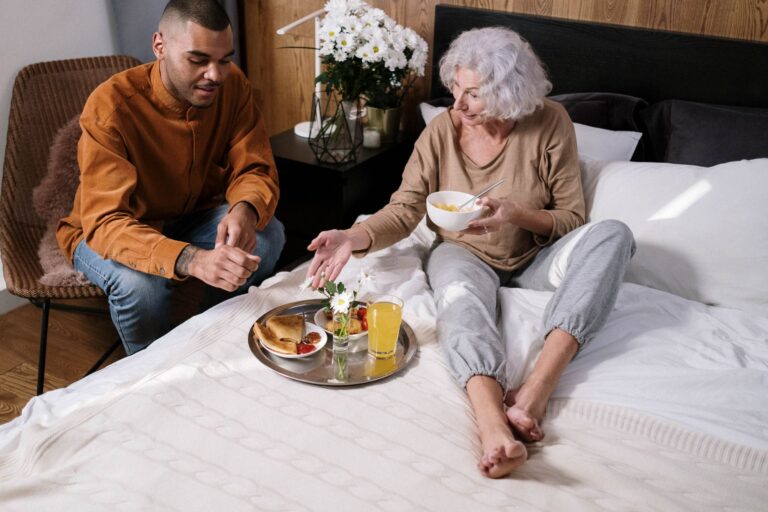
Cameras and bed alarms can help keep a husband with dementia safe at night by alerting you the moment he stirs or stands. They do not stop falls or exits by themselves, so each alert needs a fast in-person response. A bed alarm is a pressure mat or sensor that sounds when weight leaves the bed or chair.
About six in 10 people living with dementia will wander at least once, according to the Alzheimer's Association in its wandering guidance. Many do so repeatedly. That risk makes an early alert plus a clear response plan essential.
Medical information disclaimer: This article is for general educational purposes only and does not provide medical advice, diagnosis, or treatment. Always consult a physician or other qualified health professional about symptoms, medications, tests, or treatment decisions.
Table of Contents
- What will a camera or bed mat do?
- How can you cut nighttime wake-ups?
- What should his walking path look like?
- How do you slow exits without locking him in?
- Why can't an alarm work alone?
What will a camera or bed mat do?
For night wandering, the MedicAlert Foundation advises motion alarms, pressure mats, or monitoring devices paired with night lights in its Alzheimer's safety advice. The mat or sensor sounds when he sits up or steps off the pad. A camera or audio monitor adds eyes on the hall or door while you respond.
The alert is only a cue. Alzheimer's of Central Alabama advises pairing any bed mat or camera alert with a prompt in-person response plan in its wandering safety tips. Decide now who gets up, what shoes and light you need, and how you guide him back or to the bathroom.
How can you cut nighttime wake-ups?
Start with body needs. The MedicAlert Foundation advises limiting fluids two hours before bed and making sure he toilets before sleep.
Keep a night light on between bed and bathroom. Keep wake time, meals, and bedtime steady. If pain, hunger, or a full bladder wakes him, track the time for two nights and shift dinner, fluids, or toileting earlier.
What should his walking path look like?
If the alarm wakes you after he stands, the room must be forgiving. Alzheimer's of Central Alabama advises clear floors, night lights, and gates at stairwells.
Place glasses, walker, and shoes where he expects them. Keep the bed low and your path short so you reach him quickly.
- Leave night lights in bedroom, hall, and bathroom.
- Remove throw rugs, cords, and clutter from the walking path.
- Put a gate at the top and bottom of stairs.
How do you slow exits without locking him in?
Night exits need door control that does not trap him. The MedicAlert Foundation advises out-of-sight deadbolts placed high or low, while the Alzheimer's Association advises night lights and covered or camouflaged door knobs.
Never lock him in at home. The Alzheimer's Association advises never leaving a person with a wandering history unsupervised in new or changed surroundings.
Why can't an alarm work alone?
Hospital studies urge caution. A 2022 review in Age and Ageing found bed and chair alarms, wearable sensors, and risk scores were not tied to major fall drops. You can read details in the full Age and Ageing review. Fierce Healthcare reported an 18-month University of Florida and VA trial on 349 beds.
Bed alarms did not cut falls even with extra staff training and promotion. Researcher Ronald Shorr said alarms alone cannot magically eliminate falls. Federal hospital rule 42 CFR 482.13 defines restraint by reduced freedom of movement. CMS guidance notes an audible alarm can act as restraint if fear of noise keeps him in bed. Test the tone while he is awake and change tactics if he freezes.
You Might Also Like
- WHO’s Second Dementia Risk-Reduction Guideline in 2026: Questions Adults in Midlife Can Discuss With a Clinician
- Vitamin Supplements in the 2026 WHO Dementia Guideline: What People With Mild Cognitive Impairment Can Track Without Self-Diagnosing
- The WHO 45% Modifiable Dementia Risk Estimate in 2026: Questions Adults in Midlife Can Discuss With a Clinician