Balancing independence and safety when living with a chronic brain condition requires more than installing grab bars or hiring supervision—it demands a thoughtful reassessment of what independence actually means and which risks are truly worth managing. The goal is not to eliminate all danger, which is neither possible nor desirable, but to preserve meaningful autonomy while reducing preventable harm. Someone with early-stage dementia may still safely prepare meals, manage finances, or live alone with targeted supports; someone else with the same diagnosis might face greater challenges with executive function or safety judgment. The difference lies not in the diagnosis itself, but in how individual strengths, specific deficits, and available resources are aligned.
Many people and their families approach this balance by retreating into total restriction—moving someone into assisted living, removing all independent activities, or imposing constant supervision. This approach eliminates certain risks but erases much of what makes life feel worth living. Conversely, some families take too little action, overlooking genuine hazards and creating situations where someone’s cognitive decline leads to preventable injury, financial harm, or crisis. The practical answer sits between these extremes: a deliberate, evolving strategy that expands or contracts support based on current abilities rather than assumed limitations.
Table of Contents
- What Changes in the Brain When Independence Becomes Harder
- Why Total Independence and Total Restriction Both Fail
- How Safety Protocols Support Rather Than Replace Independence
- Practical Strategies for Specific High-Risk Activities
- The Limits of Technology and the Cost of Constant Monitoring
- How Family Roles Change as Independence Diminishes
- Reassessing Safety and Independence as the Condition Evolves
What Changes in the Brain When Independence Becomes Harder
Chronic brain conditions affect independence through different pathways depending on the diagnosis. In dementia, decline typically begins in memory and executive function—the ability to plan, sequence, and make decisions. Someone might remember how to cook but lose the ability to safely manage the sequence of turning on the oven, setting temperature, and monitoring time. In Parkinson’s disease, physical symptoms like rigidity and tremor interfere with tasks like buttoning clothes or writing, while cognitive changes may come later or not at all. In traumatic brain injury, the deficit profile can be highly specific—perhaps intact memory but poor impulse control, or clear thinking but severe fatigue that limits how much they can do in a day.
The relationship between diagnosis and independence loss is not linear. Two people with Alzheimer’s disease at the same stage of disease progression can have dramatically different day-to-day abilities. One might remain capable of paying bills from statements but unable to use online banking; another might handle technology easily but need reminders to eat. Neuroimaging studies show that cognitive reserve—the brain’s ability to resist or work around damage—varies widely based on education, lifelong mental activity, and genetics. This is why some people live independently for years with significant brain pathology, while others decline more rapidly. The brain doesn’t fail all at once; it fails unevenly, in pockets, which is what makes safety planning so complex.
Why Total Independence and Total Restriction Both Fail
The most dangerous assumption families make is that either full independence or full supervision is the goal. Neither is realistic for most chronic brain conditions. A person who lives truly independently—preparing all meals, managing all finances, making all decisions—may do so while having gaps in memory or judgment that expose them to serious harm. A person under complete supervision, by contrast, loses the cognitive stimulation, sense of mastery, and identity that comes from managing their own life. Depression and faster cognitive decline often follow total restriction, and the person’s quality of life deteriorates in ways that sometimes exceed the protection gained.
Research on autonomy in dementia care shows that people retain a deep need for control and participation in decisions affecting their lives, even as their cognitive abilities decline. A person who can no longer remember to take medications still understands and feels the difference between being asked, “Would you like to take your medication now?” and being told, “Take this pill.” One preserves some dignity and agency; the other reduces them to compliance. The limitation of full restriction is that it treats safety as a binary—either completely safe or completely at risk. In reality, most situations involve some level of residual risk that humans navigate all the time. We accept the risk of driving, crossing streets, or using kitchen knives because we value what those activities provide. The same principle applies to someone with a brain condition.
How Safety Protocols Support Rather Than Replace Independence
Effective safety protocols are designed to reduce the highest-consequence risks while preserving as much independent activity as possible. A person with mild cognitive impairment who can no longer safely manage a gas stove might switch to electric or induction cooking, eliminating the most dangerous failure mode (forgetting the stove is on) while keeping their ability to prepare meals. A person who gets lost during drives can use GPS with voice guidance or limit driving to familiar routes. A person who struggles with medication adherence can use a pill organizer with alarms, or transfer oversight to a pharmacist rather than a family member, reducing the emotional burden and friction of daily reminders.
The design of these protocols matters enormously. An alarm system that notifies family every time someone goes outside teaches the person that their movements are monitored and restricted. A motion-sensor light that comes on automatically if they wander at night does the same job without the surveillance feeling. A locked freezer prevents the repeated purchases and hoarding that sometimes occur in dementia, but an open freezer with a limited quantity of labeled containers allows them to make choices independently. These are not just quality-of-life tweaks—they are safety measures that work better precisely because they preserve autonomy and avoid the resentment and resistance that comes from feeling controlled.
Practical Strategies for Specific High-Risk Activities
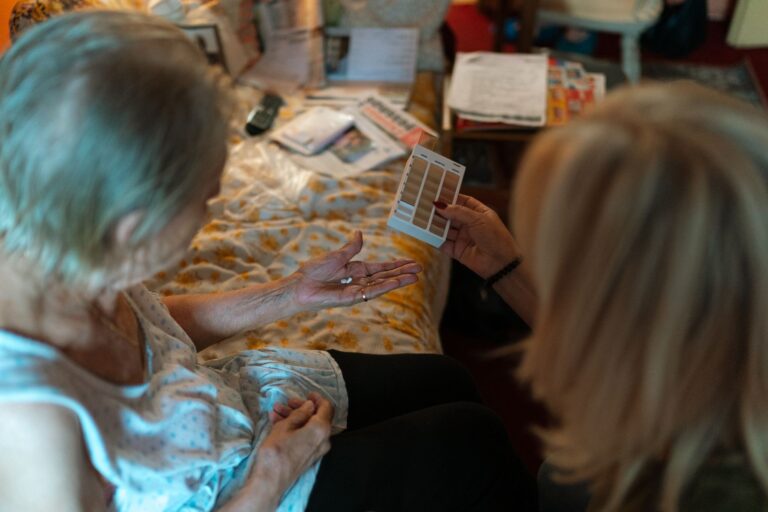
Medication management is one of the earliest independence losses in conditions like Alzheimer’s disease, yet it is also one of the most addressable. Research shows that people with mild-to-moderate dementia who use a multi-chambered pill organizer with large, clear labels and a simple check-off sheet can often continue managing their own medications. If that fails, moving to a blister pack dispensed weekly by a pharmacy removes the burden while allowing them to take the medication themselves each time. The progression from independence, to supported independence, to full assistance can happen over months or years, and each level can last as long as the person’s abilities support it. Financial management presents a different challenge. Many people with early-stage dementia remain entirely capable of understanding their finances, but they may become more vulnerable to scams, impulse purchases, or poor judgment in one specific area (like helping family members with money they cannot spare). Some families solve this by setting up automatic bill pay for fixed expenses, limiting access to credit cards, or having the person review—rather than execute—major decisions.
Others shift management entirely to a trustee. The key difference is knowing what the person actually needs help with, rather than assuming they cannot handle anything. Driving deserves special attention because it combines physical, cognitive, and judgment demands, and because the consequences of failure are severe. A neuropsychological driving evaluation, administered by specialists trained in brain conditions, can determine whether someone remains safe behind the wheel or should stop. These evaluations do not always conclude “stop immediately.” For some people with early Parkinson’s or mild cognitive decline, the answer is “safe to continue with these limitations”—perhaps no night driving, or highways only. The evaluation gives objective evidence to replace the vague family worry or the person’s own denial. When driving must end, the identity loss is real and should be acknowledged. The practical response is usually not just “you can’t drive anymore” but a plan for alternative transportation and a conversation about what driving represented to them (independence, identity, purpose) and what can replace it.
The Limits of Technology and the Cost of Constant Monitoring
Technology offers genuine safety benefits—GPS watches for someone prone to wandering, door sensors that alert caregivers, automatic stove shutoffs, medication reminders. But technology also has real limits, and relying on it too heavily creates a false sense of safety. A GPS watch helps you find someone who has wandered, but it does not prevent the fall that caused them to wander in the first place. A medication reminder app cannot force someone to take the pill if they refuse or forget it is there. A door sensor alerts you to the fact that someone has left home, but if you are an hour away, that alert may come too late. The psychological cost of constant monitoring should not be dismissed.
Research in long-term care settings shows that people who feel watched develop higher rates of depression and anxiety. A family member who installs cameras throughout a parent’s home to monitor them around the clock may think they are ensuring safety, but they are also ensuring that their parent never feels truly alone, never has genuine privacy, and is constantly aware of surveillance. This is not a small trade. For someone whose identity is already fragmenting due to a brain condition, the loss of privacy and autonomy can accelerate psychological decline. The practical middle ground is targeted monitoring—cameras or alarms in high-risk areas like the kitchen or bathroom, motion sensors that detect falls, but not omniscient surveillance. And technology should be chosen with the person’s knowledge and ideally consent. A hidden camera installed “for their own good” is not a safety measure; it is a violation.
How Family Roles Change as Independence Diminishes
As someone’s abilities decline, family members often find themselves caught between incompatible roles. They want to support independence, but they also want to prevent harm. They love the person, but they resent the burden. They grieve who the person was while trying to care for who the person is now. These tensions are not problems to be solved; they are inherent to the situation.
The most functional arrangement is usually one where roles are clear and explicit. One family member is the primary decision-maker about healthcare, another manages finances, another coordinates day-to-day support. When everyone is trying to do everything, decisions are contradictory and the person with the brain condition receives mixed messages. When one person tries to do it all, burnout is inevitable. Clear role definition does not eliminate the emotional difficulty, but it does reduce the practical friction that makes emotional difficulty worse.
Reassessing Safety and Independence as the Condition Evolves
The balance between independence and safety is not static. Someone with Parkinson’s disease might remain fully independent for a decade, then decline rapidly over two years. Someone with dementia might stay at one functional level for years, then have a sudden drop after an illness or medication change. Families often make the mistake of having one conversation about independence and safety (“Mom can no longer live alone”) and then treating that decision as permanent. The more realistic approach is regular reassessment—every 6 months, or whenever something changes. A person who cannot safely cook might still safely use a microwave.
A person who cannot manage a household budget might still handle small everyday purchases with prepaid cards. A person who needs help with showering might still dress themselves and choose their own clothes. These reassessments are usually uncomfortable because they often mean acknowledging decline. It is easier to maintain the current level of independence, even if it has become risky, than to admit the loss and adjust support. But delayed adjustment usually means a crisis—a fall, a financial mistake, a missed medication dose—that forces a sudden, dramatic change rather than a gradual one. Incremental adjustments allow the person with the condition time to adapt, and allow their identity and self-image to shift with their abilities.
- —