Exercises doctors sits at the center of this dementia and brain health question.
Deep core strengthening exercises focus on your innermost abdominal muscles—primarily the transverse abdominis, multifidus, and pelvic floor—rather than the surface muscles you can see. Doctors commonly recommend six key exercises for this population: dead bugs, bird dogs, glute bridges, quadruped leg lifts, side-lying leg raises, and abdominal bracing in various positions. For someone with cognitive decline or dementia, a strong deep core provides the foundational stability needed to prevent falls, maintain balance during daily activities like dressing or transferring from a chair, and preserve functional independence as long as possible. This article explores each of these six recommended exercises, explains why deep core strength matters specifically for brain health and aging, and provides guidance on how to perform them safely and effectively.
Table of Contents
- Why Do Doctors Emphasize Deep Core Strength for Cognitive Health and Fall Prevention?
- How Deep Core Muscles Differ from Superficial “Six-Pack” Muscles and Why That Matters
- How to Assess Your Starting Point and Choose the Right Difficulty Level
- The Six Exercises Doctors Recommend and How to Perform Each One
- Common Mistakes That Reduce Effectiveness and When to Pause or Modify
- Progression and Variation as Your Strength Improves
- Long-Term Benefits Beyond Physical Strength and Sustaining a Routine
- Conclusion
Why Do Doctors Emphasize Deep Core Strength for Cognitive Health and Fall Prevention?
The deep core muscles act like an internal corset, stabilizing your spine and pelvis during movement. When these muscles weaken—which commonly happens with aging and reduced activity—the risk of falls increases dramatically, and even minor stumbles can result in serious injuries. For individuals with dementia or mild cognitive impairment, the added challenge of balance coordination makes a strong deep core even more critical.
Research in gerontology shows that core stability directly correlates with the ability to catch yourself during a stumble, reducing fracture risk by up to 40 percent in older adults. Additionally, the physical activity involved in core training stimulates blood flow to the brain and supports the release of neurochemicals that aid cognitive function. A 70-year-old with early memory loss who falls and fractures a hip often experiences a rapid decline in both physical and cognitive status, whereas one who maintains core strength can avoid that cascade.

How Deep Core Muscles Differ from Superficial “Six-Pack” Muscles and Why That Matters
Your rectus abdominis—the muscle that creates a six-pack appearance—is a surface muscle. While traditional crunches engage it, they do little for the deep stabilizers that truly prevent injury. The transverse abdominis and multifidus, by contrast, remain active during everyday movements like standing, walking, and reaching.
However, if you’ve spent decades doing crunches or situps, you may have inadvertently overworked the superficial muscles while neglecting the deep ones. This creates a muscle imbalance that can actually increase your injury risk. Someone with a strong-looking abdomen might still have weak deep stabilizers, making them vulnerable to strain when lifting groceries or twisting to look over their shoulder. The exercises recommended by doctors specifically activate these deep layers while often keeping the superficial muscles relatively quiet, retraining your core in the way it was designed to function.
How to Assess Your Starting Point and Choose the Right Difficulty Level
Before beginning any core program, it’s worth understanding your baseline. A physical therapist can test your ability to engage your deep core by watching your movement patterns or using real-time ultrasound imaging, but a simpler self-assessment involves lying on your back with knees bent and placing your fingers just inside your hip bones. Take a gentle breath in, and as you exhale, try to draw your lower abdomen inward without lifting your rib cage or holding your breath.
If you feel tension under your fingers, you’re engaging the right muscles. If your ribs flare or you feel mostly in your upper abs, your recruitment pattern needs retraining. This assessment determines whether you start with basic isometric holds or progress more quickly. Someone with moderate cognitive decline may benefit from the simplicity of one or two basic exercises repeated daily rather than a varied program, reducing confusion while still building strength.

The Six Exercises Doctors Recommend and How to Perform Each One
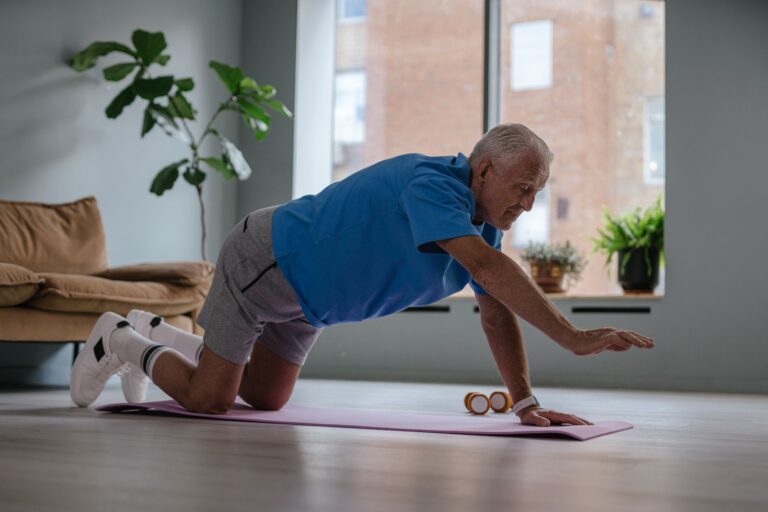
The first exercise, dead bugs, begins lying on your back with arms extended toward the ceiling and knees bent at 90 degrees, shins parallel to the floor. Slowly lower your right arm behind your head while straightening your left leg, hovering it just above the ground, then return to center. Alternate sides in a controlled manner, moving only as far as you can while keeping your lower back pressed to the floor—this is the key to isolating the deep core. The second, bird dogs, starts on hands and knees with a neutral spine. Extend your right arm forward and left leg back simultaneously, pause for two seconds, and return, then switch sides. Move slowly and deliberately; speed defeats the purpose.
Third, glute bridges involve lying on your back with knees bent and feet flat on the floor. Press through your heels to lift your hips until your body forms a straight line from knees to shoulders, squeezing your glutes at the top. This exercise emphasizes the posterior chain and deep spinal stabilizers. Fourth, quadruped leg lifts are performed on hands and knees, lifting one leg straight back at hip height while maintaining a level pelvis—avoid letting your hips rotate or sag. Hold for 2-3 seconds and lower. Fifth, side-lying leg raises involve lying on your side and lifting your top leg to hip height while keeping your torso stable and not rolling backward. Sixth, abdominal bracing in standing involves placing one hand on your abdomen and drawing in your deep muscles while maintaining normal breathing, holding the contraction for 10-20 seconds, which can be done while standing at the kitchen counter during daily activities.
Common Mistakes That Reduce Effectiveness and When to Pause or Modify
The most frequent error is moving too quickly. When you rush through these exercises, momentum takes over and your deep muscles disengage—you’re essentially performing an exercise without activating the target tissue. Another mistake is breath-holding; holding your breath increases abdominal pressure and actually disengages the deep core. Instead, exhale during the exertion phase of each movement.
A third pitfall is overestimating your ability and progressing too fast, which causes compensatory patterns where large surface muscles take over and stability suffers. If you experience sharp pain (not just muscle fatigue or a gentle stretch sensation) during any exercise, stop immediately. Someone with advanced dementia who cannot remember instructions from one day to the next may benefit from simple, repeated activities like glute bridges performed daily at the same time, with a caregiver present for safety. Additionally, individuals taking medications that affect balance or have recent spinal surgery should consult their physician before starting any new program.

Progression and Variation as Your Strength Improves
Once basic dead bugs and bird dogs feel easy and you can maintain proper form for 3 sets of 12-15 repetitions, you can progress by increasing hold time, adding slight movement variations, or performing exercises on unstable surfaces. For example, bird dogs can be performed with brief pulses at the extended position, making the movement more challenging without requiring you to push through a full range of motion. Glute bridges can be progressed to single-leg bridges if balance permits, significantly increasing the demand on your deep stabilizers.
Another variation involves combining exercises—for instance, after a set of bird dogs, immediately moving into a plank hold. However, more variation is not always better for someone with cognitive impairment. A consistent routine with three core exercises performed three times weekly often yields better results than constantly switching exercises, as the nervous system needs repetition to encode proper movement patterns.
Long-Term Benefits Beyond Physical Strength and Sustaining a Routine
The benefits of consistent deep core strengthening extend across months and years. People who maintain this practice often report improved posture, reduced back pain, better balance during walking, and a greater sense of physical confidence. For individuals with cognitive decline, these physical improvements can also reduce caregiver burden—a parent or spouse requires less physical assistance with transfers and daily activities, allowing them to maintain dignity and independence longer.
The neurological benefits of regular exercise also support overall brain health, potentially slowing the rate of cognitive decline. However, sustaining a core-strengthening routine requires structure. Setting up a consistent time each day (such as after breakfast or during a specific television show) creates an automatic habit, making adherence easier for both the individual and their caregiver. Many find that simple visual reminders—a colored resistance band left on the bed, a printed instruction card posted in the exercise area—help maintain consistency over months.
Conclusion
The six exercises recommended by doctors—dead bugs, bird dogs, glute bridges, quadruped leg lifts, side-lying leg raises, and abdominal bracing—target the deep core muscles that stabilize your spine and prevent falls. For people managing cognitive decline or dementia, a strong deep core can be the difference between maintaining independence and requiring increased assistance with daily activities.
Starting with a simple assessment, choosing exercises you can perform with proper form, and progressing gradually will build strength safely. The next step is to pick one or two exercises and practice them consistently for two to three weeks before adding others, giving your nervous system time to relearn proper movement patterns. Even small improvements in core stability can meaningfully reduce injury risk and support long-term brain health through the physical activity itself.
You Might Also Like
- 9 Exercises Doctors Recommend to Strengthen the Core and Support the Lumbar Spine
- 6 Exercises Doctors Recommend to Strengthen the Muscles Supporting the Pelvis
- 6 Exercises Doctors Recommend for Improving Core Strength and Spine Support
For more, see Alzheimer’s Association.