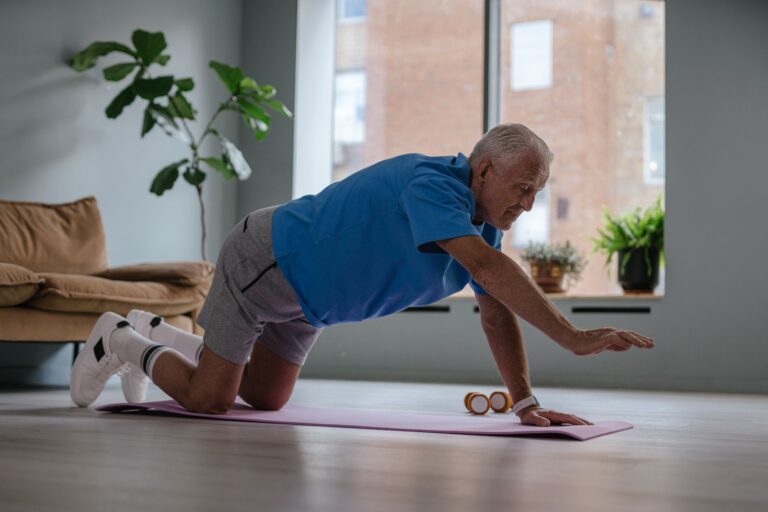
Specialists recommend nine core exercises for spine stabilization, with the most effective being movements that activate the deep abdominal muscles—particularly the transversus abdominis and lumbar multifidus—which create a stiffening effect in the lumbar spine by attaching to the thoracolumbar fascia. These exercises, which include bird-dog movements, glute bridges, dead bug exercises, and controlled pelvic tilts, have been shown in clinical research to reduce pain by an average of 3.08 points on the pain scale, compared to just 1.71 points for general physical therapy. For older adults and those concerned with brain health, maintaining spinal stability is crucial—a strong, stable spine supports better balance, reduces fall risk, and ensures proper blood flow to the brain through the vertebral arteries that run through the spine.
This article explores the nine most effective spine stabilization exercises recommended by physical therapists and orthopedic specialists. We’ll explain how each exercise works, why these movements are superior to standard strengthening routines, what progression looks like from beginner to advanced, and how to integrate these exercises safely into your daily routine. Whether you’re recovering from an injury, managing chronic back pain, or simply want to maintain better posture and mobility as you age, understanding these evidence-based movements can help you take control of your spinal health.
Table of Contents
- What Makes Deep Core Activation the Foundation of Spine Stabilization?
- The Bird-Dog Exercise—The Essential Movement for Spinal Stabilizers
- The Dead Bug Exercise—Building Core Awareness from a Safe Starting Position
- The Glute Bridge—Connecting Spinal Stability to Hip Strength
- Pelvic Tilts and Controlled Lumbar Stabilization—The Foundation of Neutral Spine
- Progression from Static to Dynamic Movement—The Critical Principle for Lasting Results
- Breathing, Mindfulness, and Nervous System Support for Spine Health
- Conclusion
What Makes Deep Core Activation the Foundation of Spine Stabilization?
Deep core activation differs fundamentally from traditional abdominal crunches or sit-ups. Rather than focusing on the visible rectus abdominis muscle, spine stabilization exercises target the stabilizer muscles that lie beneath the surface—the transversus abdominis and lumbar multifidus. These deep muscles don’t move your spine; instead, they brace and support it, creating an internal corset that protects the vertebrae and discs from harmful movement and stress. When these muscles are weak or not properly activated, the spine becomes unstable, placing extra load on the joints and discs, which can lead to pain and injury over time. The clinical evidence strongly supports deep core activation over general strengthening. Research comparing core stabilization exercises to conventional physical therapy found that specialized core work is superior for improving proprioception (body awareness), balance, muscle thickness, and reducing functional disability.
The difference isn’t subtle—patients using core stabilization protocols showed pain reduction more than twice as effective as those doing standard exercises. For someone with dementia or cognitive concerns, this matters because better balance and stability reduce fall risk, which is one of the most serious health threats for older adults living independently. A key limitation of deep core work is that it requires patience and precision. Many people expect visible results quickly or assume that harder exercise means better results. In reality, deep core activation is often subtle—you may feel mild muscle tension rather than intense burning. If you push too hard or use excessive repetitions before mastering proper form, you may activate superficial muscles instead and miss the point entirely.

The Bird-Dog Exercise—The Essential Movement for Spinal Stabilizers
The bird-dog exercise is considered an essential movement for activating the deep spinal stabilizer muscles, and it’s particularly valuable after injury when you need to rebuild confidence and control in the spine. To perform a bird-dog, start on your hands and knees in a neutral spine position, then slowly extend one leg straight behind you while simultaneously extending the opposite arm straight ahead, creating a straight line from your fingertips to your toes. Hold this position for 2-3 seconds while maintaining a stable core—your torso should not rotate or shift—then return to the starting position and repeat on the opposite side. What makes bird-dog so effective is that it demands simultaneous activation of stabilizer muscles across your entire core while you’re moving limbs in opposite directions.
This mimics real-world activities like walking, climbing stairs, or reaching for objects while standing. For older adults concerned about balance and fall prevention, bird-dog exercises teach your nervous system how to maintain postural stability even when limbs are moving—exactly the skill you need when you step off a curb or reach for something on a high shelf. However, bird-dog becomes ineffective or even harmful if performed with a compensatory movement pattern. The most common mistake is allowing the lower back to arch, which means the deep core muscles aren’t engaged and instead the spine is being stressed in the opposite direction. If you can’t maintain a completely neutral spine without arching, you’re not yet ready for the full movement—instead, practice modified versions where you extend only one limb at a time, or try the dead bug exercise first.
The Dead Bug Exercise—Building Core Awareness from a Safe Starting Position
The dead bug exercise is recommended as an essential foundational movement for core activation, especially for those beginning a spine stabilization program. The name comes from the position: you lie on your back with your knees bent, feet flat on the floor, arms extended toward the ceiling, and then slowly lower opposite arms and legs toward the floor in a controlled manner, like an upside-down insect moving its limbs. The key is that your lower back should maintain contact with the floor throughout the movement—if your back arches away from the floor, you’ve gone too far and are losing core engagement. Dead bug exercises offer a significant advantage for people new to core work because the supine (lying) position removes balance challenges and makes it easier to feel exactly when and where your deep core muscles are engaging.
You can place your hand under your lower back to monitor whether you’re maintaining neutral spine, and the movement is slow enough that you can pause and adjust if you notice a problem. This makes dead bug ideal for older adults, people in recovery, or anyone who needs to build confidence before progressing to more challenging movements. A limitation worth noting is that dead bug work stays static and horizontal—it doesn’t fully prepare you for the standing balance demands of everyday life. Once you’ve mastered dead bug and bird-dog exercises, progression to standing and dynamic movements becomes essential for translating core strength into better stability during actual daily activities.

The Glute Bridge—Connecting Spinal Stability to Hip Strength
The glute bridge is performed by lying on your back with your knees bent and feet flat on the floor, then pressing through your heels to lift your hips toward the ceiling until your body forms a straight line from your knees to your shoulders. Holding this position for 2-3 seconds activates the gluteal muscles—particularly the gluteus maximus, which is the largest and most powerful muscle in your body—and also engages the deep core stabilizers that keep your lumbar spine in neutral position. The glute bridge is valuable because it addresses a widespread problem: many people with sedentary lifestyles have weak gluteal muscles, and these weak glutes force the lower back and hip flexors to work harder, leading to pain and poor posture. This exercise demonstrates why spine stabilization is never just about the core—it’s about the entire kinetic chain.
Strong glutes directly support proper pelvic alignment, which in turn reduces mechanical stress on the spine and lumbar discs. For someone concerned with brain health, this matters because core stability and proper posture are linked to better balance and proprioception, which are crucial for maintaining independence and preventing falls that could cause serious head injury. The tradeoff with glute bridge work is that it can sometimes be performed with excessive hip extension (hiking the hips too high), which can actually increase lower back strain rather than protect it. The goal is to achieve hip extension using glute power while maintaining a neutral lumbar spine—your body should move as one unit, not flex at the lower back. If you feel lower back strain during glute bridges, it usually means you’re hipping too high or not engaging your core sufficiently.
Pelvic Tilts and Controlled Lumbar Stabilization—The Foundation of Neutral Spine
Pelvic tilts and controlled lumbar stabilization exercises form a simple but essential regimen that reduces mechanical stress on the spine by teaching you to recognize and control the position of your pelvis and lower back. These movements involve lying on your back with knees bent, gently tilting your pelvis so your lower back flattens against the floor (posterior tilt) and then tilting back to create a slight natural curve (neutral spine). The exercise trains your nervous system to understand what neutral spine feels like and builds the muscular control to maintain it during other movements. What makes this approach valuable is that many people don’t actually know what neutral spine feels like—they may have spent decades moving with excessive arch (hyperlordosis) or excessive flatness (flexion), and their nervous system has become accustomed to these dysfunctional positions. Pelvic tilt work essentially recalibrates your body’s internal gyroscope.
For older adults, this recalibration is particularly important because maintaining proper spinal alignment reduces injury risk and improves the biomechanics of movement, directly supporting better balance and stability. A common misconception is that you should always flatten your lower back completely. In reality, the human spine has natural curves—cervical, thoracic, and lumbar—and these curves are essential for shock absorption and proper mechanics. The goal isn’t to eliminate the lumbar curve but to find the neutral position where the curve is neither exaggerated nor absent. If you push into excessive posterior pelvic tilt, you’ll fatigue the core muscles quickly and may actually reduce stability.

Progression from Static to Dynamic Movement—The Critical Principle for Lasting Results
A key principle that separates effective spine stabilization programs from ineffective ones is progression based on control. Movement should progress from static (lying motionless) to dynamic (standing, walking, jumping) based on proper neutral spine control at each stage. Many people rush through exercises or try to add weight and speed before they’ve mastered the foundational movements, which defeats the purpose and risks re-injury. The progression might look like: dead bug (lying) → bird-dog (all fours) → modified glute bridge → full glute bridge with pause → glute bridge with limb movement → standing core bracing while walking. The emphasis should always be on control and precision rather than repetition count or duration.
It’s better to perform 5 dead bug repetitions with perfect form, maintaining neutral spine throughout, than to perform 20 repetitions with compensatory movements. This principle is especially important for people managing dementia or cognitive decline, because poor form doesn’t just risk injury—it also teaches your nervous system the wrong movement pattern, which actually makes you less stable in daily life. One limitation of progression-based training is that it requires patience and sometimes feels slower than expected. If you’re accustomed to intense, high-repetition exercise, spine stabilization work may initially feel too easy or subtle. However, this perception is misleading—the subtle, controlled movements are doing deep work that high-intensity exercise cannot accomplish.
Breathing, Mindfulness, and Nervous System Support for Spine Health
Recent 2026 guidelines emphasize that spine stabilization isn’t purely mechanical—the nervous system plays an equally important role in maintaining stability and managing pain. Mindfulness-based stress reduction combined with diaphragmatic breathing (5 or more minutes daily) has been shown to help lower cortisol levels and signal to your nervous system that it’s safe, which paradoxically makes your core muscles work more efficiently. When your nervous system is in a heightened state of stress or fear, your muscles tend to contract unnecessarily, creating tension and reducing flexibility—the opposite of what’s needed for healthy spinal function.
For people concerned with brain health and dementia prevention, this connection is significant. Chronic stress and high cortisol levels are associated with cognitive decline, while the parasympathetic activation (relaxation response) triggered by diaphragmatic breathing supports better sleep, clearer thinking, and reduced systemic inflammation. Combining spine stabilization exercises with intentional breathing and mindfulness creates a comprehensive approach to neurological and physical health.
Conclusion
The nine exercises specialists recommend for spine stabilization—deep core activation, bird-dog, dead bug, glute bridge, pelvic tilts, and their variations—all share a common principle: they build strength in the deep muscles that truly protect your spine, rather than chasing visible muscle definition. The clinical evidence is clear: core stabilization reduces pain more than twice as effectively as general physical therapy and improves balance, proprioception, and functional ability. These benefits extend beyond pain relief—for older adults and anyone concerned with brain health, a stable spine means better balance, reduced fall risk, and improved overall mobility.
Your next step is to start with the foundational movements—dead bug and pelvic tilts—and spend 1-2 weeks mastering these before progressing to bird-dog and glute bridge work. Practice with attention to form and control, focus on diaphragmatic breathing, and be patient with the process. You’re not training for intense strength; you’re retraining your nervous system to maintain stability in everything you do. That foundation, built carefully over time, is what creates lasting spine health and supports the physical stability necessary for independent living and cognitive wellness.