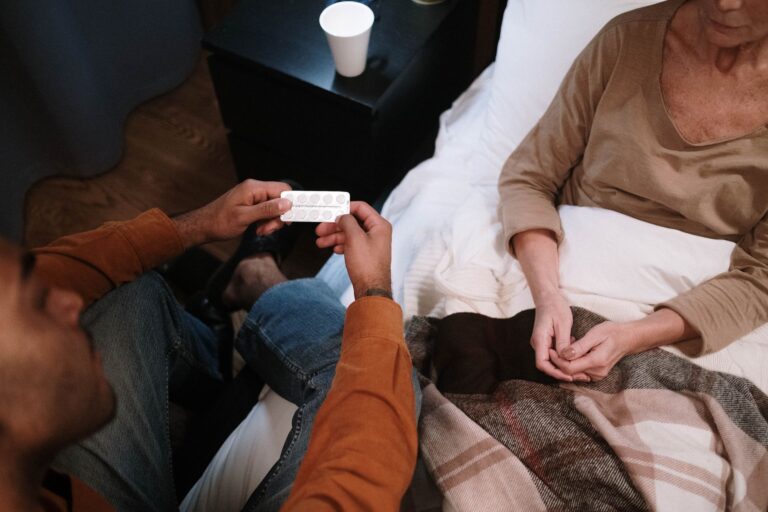
Night terrors in elderly adults with dementia are primarily caused by the progressive deterioration of brain regions that regulate sleep architecture, particularly the suprachiasmatic nucleus and the brainstem structures responsible for managing transitions between sleep stages. As dementia damages these areas, the brain loses its ability to move smoothly between deep sleep and lighter sleep phases, triggering episodes of intense fear, screaming, thrashing, and confusion that can last anywhere from thirty seconds to several minutes. A person with moderate Alzheimer’s disease, for example, might bolt upright at two in the morning shouting about intruders, eyes wide open but completely unresponsive to a spouse’s reassurance, then have no memory of the event the next day.
Beyond the neurological degradation itself, a range of compounding factors makes night terrors more frequent and more severe in this population. Medications commonly prescribed to dementia patients, underlying pain conditions they cannot articulate, sundowning behavior, disrupted circadian rhythms, and even the sleeping environment all play contributing roles. This article breaks down the specific mechanisms behind these episodes, how they differ from ordinary nightmares, which medications and medical conditions worsen them, and what caregivers can realistically do to reduce their frequency without resorting to heavy sedation.
Table of Contents
- Why Does Dementia Specifically Trigger Night Terrors in Older Adults?
- How Medications and Medical Conditions Worsen Nighttime Episodes
- The Role of Sundowning and Circadian Disruption
- What Caregivers Can Do to Reduce Night Terror Frequency
- When Night Terrors Signal Something More Serious
- Pharmacological Options and Their Risks
- Emerging Research and Future Directions
- Conclusion
- Frequently Asked Questions
Why Does Dementia Specifically Trigger Night Terrors in Older Adults?
The relationship between dementia and night terrors is rooted in how neurodegenerative diseases dismantle the brain’s sleep infrastructure. In healthy sleep, the brain cycles through four stages in roughly ninety-minute intervals, with the deepest stage, known as N3 or slow-wave sleep, occurring primarily in the first half of the night. Night terrors happen during partial arousals from this deep sleep. In a healthy brain, the transition out of N3 is managed by inhibitory circuits that prevent the body from activating while consciousness gradually surfaces. Dementia erodes these circuits. Lewy body dementia is particularly notorious for this because it attacks the brainstem regions directly involved in sleep-stage regulation, which is why patients with Lewy body dementia experience parasomnias at rates far higher than those with other dementia subtypes. The degeneration of the suprachiasmatic nucleus, the brain’s master clock located in the hypothalamus, adds another layer.
This structure relies on signals from the retina and from melatonin production to calibrate the body’s circadian rhythm. As Alzheimer’s disease progresses, the suprachiasmatic nucleus loses neurons, and the body’s internal clock drifts. Sleep becomes fragmented, daytime napping increases, and the consolidated nighttime sleep period breaks apart. When deep sleep does occur, it is shallower and more unstable, creating more opportunities for the partial arousals that produce night terrors. It is worth noting that not all dementia patients who experience nighttime agitation are actually having night terrors. True night terrors involve a specific electrophysiological pattern, a sudden partial arousal from slow-wave sleep with autonomic activation including rapid heart rate, dilated pupils, and sweating. Many episodes caregivers describe as night terrors are actually confusional arousals, REM sleep behavior disorder, or even nocturnal delirium, each of which has different causes and responds to different interventions. The distinction matters because sedating someone who is experiencing REM sleep behavior disorder with a benzodiazepine might help, while the same drug given to someone in nocturnal delirium could make things dramatically worse.

How Medications and Medical Conditions Worsen Nighttime Episodes
Several classes of drugs commonly prescribed to elderly dementia patients are known to destabilize sleep architecture and increase the frequency of parasomnias. Cholinesterase inhibitors such as donepezil, one of the most widely prescribed Alzheimer’s medications, increase acetylcholine levels throughout the brain, including in the sleep-regulating circuits. When taken in the evening, donepezil has been associated with vivid dreams, nightmares, and disrupted sleep. Some clinicians switch the dosing to morning, which can help, though this does not eliminate the problem for all patients. Antidepressants in the SSRI and SNRI families can suppress REM sleep and alter the balance between sleep stages, sometimes pushing more sleep pressure into slow-wave periods and paradoxically increasing the conditions that produce night terrors. Undertreated pain is one of the most overlooked contributors.
An elderly person with dementia who has arthritis, neuropathy, a urinary tract infection, or constipation may not be able to communicate their discomfort during waking hours, let alone during sleep. Pain acts as an arousal stimulus. During deep sleep, when the brain is less capable of processing and contextualizing sensory input, a surge of pain signals can trigger the kind of abrupt, panicked partial awakening that characterizes a night terror. One study from a Norwegian nursing home found that systematically treating pain in dementia residents with a stepwise analgesic protocol reduced nighttime agitation episodes by roughly a third, even though the protocol was not specifically targeting sleep disturbances. However, if a caregiver or clinician attributes all nighttime episodes to pain and responds only with analgesics, they risk missing other treatable causes such as obstructive sleep apnea, which is significantly underdiagnosed in elderly populations. Sleep apnea causes repeated oxygen desaturation events that fragment sleep and provoke arousals from deep sleep, creating conditions nearly identical to those that trigger night terrors. A person with moderate dementia may not tolerate a CPAP machine, but positional therapy, oral appliances, or even weight management where applicable can make a meaningful difference.
The Role of Sundowning and Circadian Disruption
Sundowning, the well-documented pattern of increased confusion and agitation in dementia patients during late afternoon and evening, shares neurological roots with nighttime parasomnias but is not the same phenomenon. Sundowning typically peaks between four and eight in the evening, while night terrors occur during the first few hours of consolidated sleep. What connects them is the degradation of circadian signaling. A person whose internal clock is no longer properly synchronized with the external light-dark cycle may enter the evening in a state of heightened cortisol production and sympathetic nervous system activation, the physiological opposite of what the body needs to transition into restful sleep. When sleep does eventually come, it is entered from a state of neurochemical agitation, which sets the stage for unstable sleep and partial arousals. Light exposure patterns are a major modifiable factor.
Many dementia patients, particularly those in residential care facilities, spend the majority of their day in artificially lit indoor environments with light levels far below what the suprachiasmatic nucleus needs to maintain circadian entrainment. A resident in a typical nursing home might receive fewer than five minutes of outdoor daylight per day. Compare this to someone receiving structured bright light therapy of ten thousand lux for thirty minutes each morning, and the difference in sleep quality, melatonin production timing, and nighttime agitation frequency is measurable. One randomized trial across twelve Dutch nursing homes found that ceiling-mounted bright light panels in communal living areas reduced nighttime restlessness and improved sleep efficiency by a modest but clinically meaningful margin. The challenge is that circadian interventions take time to show results, often two to four weeks of consistent implementation, and they require buy-in from care staff who may be skeptical or stretched too thin to maintain the routine. Caregivers looking for a quick fix may find this frustrating, but the cumulative benefit of restoring even partial circadian function tends to be more durable and safer than pharmacological alternatives.

What Caregivers Can Do to Reduce Night Terror Frequency
The most effective non-pharmacological approach is environmental and behavioral modification, though it requires consistency and some trial and error. The bedroom environment should be kept cool, between sixty-five and sixty-eight degrees Fahrenheit, dark except for a single low-wattage nightlight with a warm color temperature to prevent disorientation without suppressing melatonin, and free of stimulating noise. White noise machines can help mask environmental sounds that might trigger partial arousals, though some patients find them agitating rather than soothing, so a trial period is necessary. Establishing a consistent pre-sleep routine is critical, though the tradeoff is that rigid routines can become a source of distress if they are disrupted by hospital stays, travel, or changes in caregiving staff. A routine might include a warm bath, a small snack containing tryptophan such as warm milk or a few crackers with cheese, dimming lights an hour before bed, and avoiding screens or stimulating television programs in the evening.
The goal is to lower sympathetic nervous system activity gradually rather than expecting the person to transition from full wakefulness to sleep abruptly. When night terrors do occur, the caregiver’s response matters. Attempting to wake someone mid-episode usually prolongs and intensifies it. The safer approach is to ensure the person cannot injure themselves, speak in a low, calm voice without demanding they respond, and wait for the episode to resolve. Bed rails, which might seem like a safety measure, can actually increase injury risk during thrashing episodes, so floor-level beds or mattresses placed directly on the floor are often a better option. Documenting the timing, duration, and apparent triggers of each episode creates data that a physician can use to adjust the treatment plan.
When Night Terrors Signal Something More Serious
Frequent night terrors in a dementia patient should not be dismissed as simply part of the disease. A sudden increase in episode frequency or intensity can signal an acute medical problem. Urinary tract infections, one of the most common acute illnesses in elderly populations, often present atypically in dementia patients. Rather than the burning and urgency a younger person would report, a UTI in someone with advanced dementia may manifest exclusively as increased confusion and nighttime agitation. Similarly, medication changes made in the preceding two weeks, including adjustments to dosing rather than new prescriptions, are a common precipitant that caregivers may not think to mention to the physician. There is also the difficult reality that in some cases, night terrors in dementia patients are a marker of disease progression rather than a correctable problem.
As the disease advances into later stages and more brain tissue is lost, the sleep-wake system can deteriorate to the point where consolidated sleep becomes impossible. At this stage, the goal of intervention shifts from eliminating night terrors to managing safety and supporting caregiver endurance. Caregivers of dementia patients with severe sleep disruption have significantly elevated rates of depression, cardiovascular disease, and immune dysfunction. Any treatment plan that focuses only on the patient without addressing caregiver respite is incomplete. A limitation of current research is that most studies on parasomnias in dementia have been conducted in institutional settings, where environmental variables are more controllable. Home caregivers face a substantially different situation, often managing nighttime episodes alone, without backup, and while sleep-deprived themselves. The interventions that show modest benefit in a nursing home with rotating staff may be impractical for a seventy-eight-year-old spouse providing twenty-four-hour care.
Pharmacological Options and Their Risks
When non-pharmacological interventions are insufficient, clinicians sometimes turn to low-dose melatonin, trazodone, or in more severe cases, clonazepam. Melatonin at doses between 0.5 and 3 milligrams, taken one to two hours before bedtime, can help consolidate sleep onset and reduce the fragmentation that leads to parasomnias, though its efficacy in advanced dementia is limited because the receptors it acts on may themselves be degraded. Trazodone at twenty-five to fifty milligrams is one of the more commonly used sleep aids in dementia care because it promotes sleep without the anticholinergic burden that makes drugs like diphenhydramine dangerous in this population.
A patient with mild to moderate Alzheimer’s who was experiencing three to four night terror episodes per week might see that reduced to one or fewer with trazodone, though daytime sedation and orthostatic hypotension, which increases fall risk, are real concerns. Antipsychotics such as quetiapine are sometimes used off-label for severe nighttime agitation, but they carry an FDA black box warning for increased mortality risk in elderly dementia patients. This does not mean they are never appropriate, but it does mean that the decision to use them should reflect a careful weighing of the severity of the episodes against the documented risks, and it should be revisited regularly rather than left on autopilot as a standing prescription.
Emerging Research and Future Directions
Sleep disturbance research in dementia is moving toward earlier intervention and better phenotyping. There is growing recognition that disrupted sleep is not merely a symptom of dementia but may actively accelerate neurodegeneration through impaired glymphatic clearance, the brain’s waste-removal system that operates primarily during deep sleep. This creates a vicious cycle in which dementia disrupts sleep, and disrupted sleep worsens dementia.
Interventions that preserve sleep quality earlier in the disease course, potentially including targeted light therapy, acoustic stimulation during slow-wave sleep, and novel melatonin receptor agonists, may prove to have disease-modifying benefits beyond simply reducing nighttime episodes. Wearable sleep-tracking technology is also making it more feasible to monitor sleep architecture at home without the burden of formal polysomnography. As these devices improve in accuracy, they may allow clinicians to identify the specific sleep-stage abnormalities driving an individual patient’s night terrors and tailor interventions accordingly, rather than relying on caregiver reports that inevitably lack the granularity needed for precise diagnosis.
Conclusion
Night terrors in elderly dementia patients arise from a convergence of neurodegeneration, circadian collapse, medication effects, undertreated pain, and environmental factors. No single intervention resolves them for every patient, and the most effective approaches tend to combine consistent sleep hygiene, appropriate light exposure, pain management, medication review, and environmental modifications. Pharmacological options exist but carry meaningful risks in this population and should be used as targeted additions to a broader strategy rather than first-line solutions.
Caregivers managing these episodes need both practical tools and realistic expectations. Night terrors may diminish with intervention but are unlikely to disappear entirely as dementia progresses. Building a care plan that includes respite support, documentation of episodes for the medical team, and a safe sleeping environment is more sustainable than pursuing a cure that does not exist. The priority is reducing harm, preserving sleep for both patient and caregiver, and maintaining quality of life within the constraints of a progressive disease.
Frequently Asked Questions
Are night terrors in dementia patients the same as nightmares?
No. Nightmares occur during REM sleep, and the person typically wakes up and can describe a frightening dream. Night terrors occur during deep non-REM sleep, involve intense physical agitation such as screaming or thrashing, and the person usually has no memory of the episode afterward. The distinction affects treatment, since medications that help with nightmares may not address night terrors.
Should I try to wake my parent during a night terror?
Generally, no. Attempting to wake someone during a night terror often prolongs the episode and can increase their confusion and agitation. Instead, stay nearby, speak calmly without raising your voice, and make sure they cannot fall out of bed or strike a hard surface. The episode will typically resolve on its own within a few minutes.
Can melatonin help with night terrors in someone who has dementia?
Low-dose melatonin, usually between 0.5 and 3 milligrams, can help improve overall sleep consolidation and may reduce the frequency of partial arousals that trigger night terrors. However, its effectiveness diminishes in more advanced stages of dementia because the brain’s melatonin receptors may be compromised. It is generally considered safe but should still be discussed with a physician.
How do I know if the nighttime episodes are night terrors or something else?
True night terrors typically occur in the first third of the night, involve intense physical arousal with little or no responsiveness, and are followed by amnesia for the event. If episodes occur later in the night, involve complex movements like punching or kicking during apparent dream enactment, or if the person can recall vivid dream content, the cause may be REM sleep behavior disorder, which is especially common in Lewy body dementia and requires different management.
Does sleep apnea contribute to night terrors in dementia patients?
Yes. Obstructive sleep apnea causes repeated drops in blood oxygen that fragment sleep and provoke arousals from deep sleep, creating conditions that are prime triggers for night terrors. Sleep apnea is significantly underdiagnosed in elderly populations, and a sleep evaluation is worth pursuing if nighttime episodes are frequent, particularly if the person snores heavily or has observed breathing pauses during sleep.