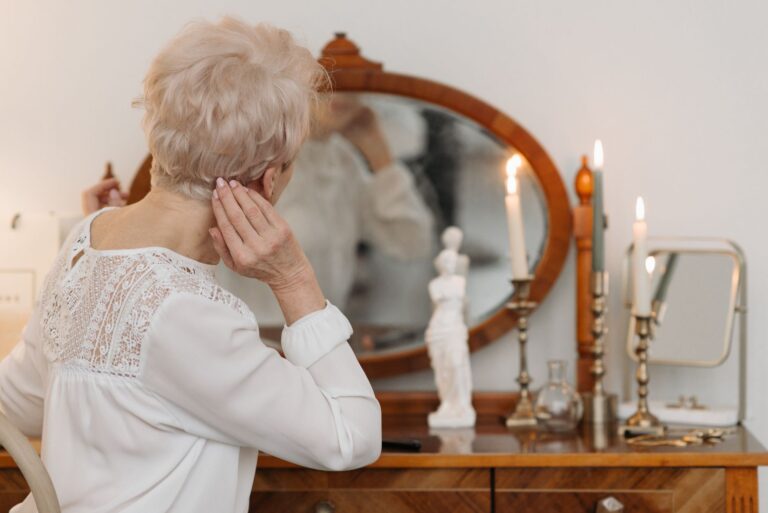
The best sensory activities for late-stage dementia are those that bypass language and cognition entirely, reaching a person through channels that remain functional even as the disease progresses. Music, touch, scent, and controlled visual stimulation consistently rank among the most effective approaches because they engage parts of the brain that tend to be more resilient to dementia’s damage. A person who can no longer recognize family members may still calm visibly when hearing a song from their youth, or respond to the feel of a soft blanket pressed into their hands.
These responses are not coincidental — they reflect the brain’s preserved capacity for sensorimotor and emotional experience long after verbal and cognitive function have diminished. For families and care staff working with someone in the late stages of dementia, this article covers the evidence behind each major sensory modality — music therapy, tactile stimulation, multisensory environments, aromatherapy, and emerging technologies like gamma-frequency stimulation. It also addresses honest limitations: some interventions show clear short-term benefit but no lasting effect, and what works well in a clinical setting may need adaptation for a home or residential care context.
Table of Contents
- Why Do Sensory Activities Work for Late-Stage Dementia?
- Music Therapy — The Most Consistently Supported Sensory Intervention
- Touch and Tactile Stimulation — What Remains When Language Fails
- Snoezelen and Multisensory Environments — Promise and Honest Limitations
- Emerging Research — 40Hz Gamma Stimulation and What It Means Now
- Aromatherapy and Visual Stimulation — Lower Evidence, Widespread Use
- How to Combine Sensory Activities Into a Daily Care Routine
- Conclusion
- Frequently Asked Questions
Why Do Sensory Activities Work for Late-Stage Dementia?
Late-stage dementia strips away much of what we associate with a person’s independent life: the ability to hold a conversation, recognize faces, manage daily tasks. What often remains longer are the sensorimotor pathways — the parts of the nervous system that process sensation, movement, and basic emotional response. A 2025 systematic review published through PubMed Central put it plainly: the rationale for sensory-based care “lies in the proposition that the provision of a sensory environment places fewer demands on intellectual abilities but capitalizes on residual sensorimotor abilities.” In other words, you are working with what is still there rather than demanding what has been lost. This distinction matters practically. Asking a person with severe dementia to play a trivia game or follow a multi-step craft project may produce distress, confusion, or withdrawal.
Placing a warm, textured cloth in their hands or playing a familiar piece of music asks nothing intellectual of them — it simply creates a sensory event the brain can respond to. The result, across multiple types of stimulation, tends to be reduced agitation, moments of positive affect, and sometimes brief social engagement that wouldn’t otherwise occur. There is also a dignity argument. Sensory engagement does not require the person to perform or succeed. It meets them where they are. For families watching a loved one recede from verbal communication, these moments of response — a hand that squeezes back, a face that relaxes, a body that sways to music — carry enormous emotional weight, both for the person receiving care and for those providing it.

Music Therapy — The Most Consistently Supported Sensory Intervention
Of all sensory modalities studied in dementia care, music has the most robust body of supporting evidence. A 2025 study examining individualized music interventions in people with severe dementia found immediate improvements across a striking range of outcomes: positive affect, spontaneous speech, social interaction, attentiveness, enjoyment, and relaxation. These are not trivial findings. In a population where verbal communication has largely ceased, seeing any increase in spontaneous speech or social interaction represents a meaningful quality-of-life improvement. The key word in that research is individualized. Generic background music — a radio on in a common room, a playlist chosen by staff — does not produce the same results as music tied to a specific person’s life history.
A woman who danced to Patsy Cline in her thirties may respond differently to “Crazy” than to a generic instrumental. Getting this right requires some biographical work upfront: asking family members about favorite artists, significant songs, decades of musical preference. The investment is small compared to the return. One important note for caregivers: volume and context matter. Music played too loudly, or at an agitating tempo during a difficult behavioral moment, can worsen distress rather than ease it. Calm, familiar, personally meaningful music played at low-to-moderate volume in a quiet setting produces the best outcomes. Music is also one of the few sensory interventions that can be done with almost no cost or specialist equipment — a phone, a speaker, and a family member’s knowledge of the person’s history is enough to begin.
Touch and Tactile Stimulation — What Remains When Language Fails
Tactile sensation is among the last senses to deteriorate as dementia progresses. This makes touch-based activities particularly valuable in late stages, when other forms of engagement have become difficult to sustain. Gentle hand massage, the feel of soft textures like fleece blankets or stuffed animals, and skin-to-skin contact through hand-holding are all widely recommended in dementia care settings — and for good reason. The tactile system’s resilience means the person is more likely to register and respond to what they are feeling than to what they are seeing or hearing. Fidget tools and textured objects — sometimes called fidget blankets or sensory muffs — have become a standard item in dementia care.
These are objects designed with varied textures, buttons, loops, and small attached items that keep hands busy without requiring directed thought. For people who exhibit repetitive hand movements, restlessness, or pulling at clothing, a fidget tool can redirect that energy in a way that reduces anxiety. The mechanism is straightforward: the hands are occupied with something pleasant and nonthreatening, and the brain registers that input rather than generating the agitation signal. A simple comparison: a person in late-stage dementia who receives a five-minute hand massage with light lotion may show more visible relaxation than one who receives fifteen minutes of verbal reassurance during an agitated episode. This is not to minimize the importance of voice and presence — both matter — but it illustrates why tactile input often cuts through when words cannot. Caregivers sometimes underestimate how powerful a warm, calm hand can be.

Snoezelen and Multisensory Environments — Promise and Honest Limitations
Multisensory stimulation environments, commonly known as Snoezelen rooms, were developed in the Netherlands in the 1970s and have since spread to dementia care facilities worldwide. A typical Snoezelen room combines fiber-optic lights, soft music, aromatherapy diffusers, textured balls, and color-changing water columns to engage multiple senses simultaneously in a calm, non-demanding setting. The idea is immersive: the person enters a space designed entirely around sensory experience, with nothing expected of them cognitively. A 2025 meta-analysis of randomized controlled trials confirmed that multisensory stimulation is an effective non-pharmacological intervention for reducing neuropsychiatric symptoms and improving cognitive function in people with dementia. That is a meaningful endorsement — particularly “non-pharmacological,” since behavioral medications carry significant side-effect burdens in elderly populations. However, an important caveat from a Cochrane systematic review must not be glossed over: there is no evidence of long-term efficacy for Snoezelen.
The short-term behavioral benefits observed during sessions do not appear to persist once the person leaves the environment. The benefit is real, but it is acute, not cumulative. This tradeoff shapes how Snoezelen should be used in care planning. It is not a treatment that will slow dementia or produce lasting improvement. It is a tool for in-the-moment quality of life — reducing distress during a difficult part of the day, providing a calm sensory experience during personal care routines, or offering meaningful engagement during a visit. For facilities with the resources to build or access such a room, it is worth using. For families at home, a less formal version — dimmed lights, a favorite scent in the air, soft music, a weighted blanket — can approximate the same principle without the specialized equipment.
Emerging Research — 40Hz Gamma Stimulation and What It Means Now
One of the more striking recent developments in dementia research involves not a traditional sensory activity but a controlled sensory stimulus: flickering light and sound at 40 hertz, the frequency of gamma brainwaves. MIT researchers and affiliated scientists published findings in November 2025 from an open-label extension study showing that daily 40Hz audiovisual stimulation over two years was safe, feasible, and potentially slowed cognitive decline in some Alzheimer’s patients. Some participants also showed reductions in amyloid and tau proteins — the pathological hallmarks of Alzheimer’s. The results are genuinely intriguing, but they require careful interpretation. The study involved a small number of participants, and outcomes varied significantly: three late-onset Alzheimer’s patients showed improvement or slower decline, while two early-onset patients did not show significant benefit.
This is not a ready-made clinical intervention. The researchers themselves note that large multicenter randomized controlled trials are needed before any clinical adoption is appropriate. Families should be cautious about commercial devices claiming to harness this effect — the research is still in early stages, and the specific parameters (frequency, duration, delivery method) matter considerably. What the 40Hz research does suggest is that even passive sensory stimulation — simply being exposed to a specific light and sound pattern — may have neurological effects beyond the behavioral benefits seen with music or touch. If subsequent trials confirm these findings, it could open a new category of sensory intervention for dementia care. For now, it is worth watching, not prescribing.

Aromatherapy and Visual Stimulation — Lower Evidence, Widespread Use
Aromatherapy occupies an interesting position in dementia sensory care: the clinical evidence base is limited, but practical use in care settings is widespread, and there is a plausible neurological rationale for why it might work. The olfactory system connects more directly to the brain’s memory and emotion centers — the hippocampus and amygdala — than other senses do. In dementia, these regions are damaged, but the olfactory pathway may remain partially functional longer than verbal memory.
Lavender is commonly used for its calming associations; rosemary has been studied for alertness; personal scents tied to a person’s history — a particular soap, a food smell from childhood — may prompt brief emotional recognition even in late stages. Visual stimulation through familiar photographs, nature videos, or high-contrast simple images can also prompt brief moments of recognition and positive response. A family photo placed where it is visible, a loop of garden footage on a tablet, or a window with a bird feeder outside — these are low-cost, easy-to-implement approaches. They do not require the person to engage actively; they simply provide something pleasant and familiar for the eyes to rest on.
How to Combine Sensory Activities Into a Daily Care Routine
No single sensory activity covers everything, and no person with late-stage dementia will respond identically to any given intervention. The practical approach most consistent with current evidence is to build a varied, biography-informed sensory routine: familiar music during morning care, a brief hand massage in the afternoon, a walk near a garden window in good weather, a familiar scent associated with comfort.
The goal is not stimulation for its own sake but moments of positive experience distributed through the day. As dementia research continues to evolve — particularly around gamma-frequency stimulation and individualized music protocols — care approaches are likely to become more precise. For now, families and caregivers who prioritize sensory engagement over purely task-based care are already in step with the best evidence available.
Conclusion
Sensory activities for late-stage dementia work because they ask nothing of the person intellectually while offering something their nervous system can still receive and respond to. Music remains the best-supported intervention, particularly when personalized to the individual’s history. Touch — through massage, textured objects, and simple human contact — engages a system that stays intact longer than most.
Multisensory environments like Snoezelen produce real short-term benefits, though evidence for lasting effects is absent. Aromatherapy and visual stimulation round out a daily routine with relatively low effort and some biological plausibility, even if rigorous trial data is thinner. The emerging work on 40Hz gamma stimulation is worth following as a genuine scientific development, but it is not ready to replace established approaches. What is ready, right now, is a sensory-first care philosophy that takes seriously what the person in late-stage dementia can still experience — and builds each day around offering those experiences with consistency and care.
Frequently Asked Questions
Can music therapy be done at home, or does it require a professional?
It can be done at home by family members or caregivers with no professional training. The most important factor is personalization — choosing music meaningful to that specific person — not formal clinical delivery. A music therapist can help design a program, but a family member playing a person’s favorite songs is a meaningful and evidence-supported intervention.
How long should sensory activity sessions last for someone with late-stage dementia?
Shorter sessions tend to work better. Most evidence-based protocols use sessions of 10 to 30 minutes. Overstimulation or fatigue can increase agitation rather than reduce it, so watching the person’s response closely and ending while engagement is still positive is more important than hitting a target duration.
Are Snoezelen rooms worth the cost for a care facility?
They can be, but primarily as a tool for in-the-moment behavioral management and quality of life — not as a treatment that produces lasting improvement. The Cochrane review found no evidence of long-term efficacy. Facilities should weigh the cost against other investments and use Snoezelen as one part of a broader sensory care strategy.
Should aromatherapy be used with all dementia patients?
No. Some individuals have sensory sensitivities, allergies, or negative associations with certain scents. Introducing any new aromatherapy should be done gradually, observing the person’s response. What is calming for one person may be agitating for another.
What is a fidget blanket and where can one be found?
A fidget blanket is a lap-sized textile with varied textures, buttons, ribbons, zippers, and other small attached objects designed to keep hands engaged without requiring purposeful thought. They are widely available through dementia care supply retailers and can also be handmade by families.