For someone living with Parkinson’s disease, a staircase transforms from a mundane architectural feature into a genuine hazard. The combination of motor control difficulties, muscle weakness, and a phenomenon called freezing of gait makes stair navigation one of the most challenging daily activities older adults with Parkinson’s face. Research shows that annual fall risk in people with Parkinson’s ranges from 45 to 68 percent””three times higher than in healthy individuals””and more than half of all stair-related falls occur during descent, when the body must control forward momentum while stepping down. The solution involves a combination of environmental modifications, targeted physical therapy, and sometimes counterintuitive strategies.
Consider this paradox: some people with Parkinson’s who struggle to walk across a flat living room floor find stairs surprisingly manageable because the visual cues from each step help their brain overcome freezing episodes. This doesn’t mean stairs are safe””far from it””but it illustrates how complex the relationship between Parkinson’s and movement truly is. This article examines why stairs present such significant challenges for people with Parkinson’s, the science behind freezing of gait, compensatory mechanisms the body employs, and practical strategies for reducing fall risk. We’ll also address when stair use becomes inadvisable and what alternatives exist.
Table of Contents
- Why Do Stairs Become So Difficult for People with Parkinson’s Disease?
- Understanding Freezing of Gait and Its Role in Stair Falls
- How the Body Compensates During Stair Navigation
- Practical Strategies for Safer Stair Navigation
- When Stairs Become Too Dangerous
- The Importance of Medication Timing
- Looking Ahead: Research and Emerging Approaches
- Conclusion
Why Do Stairs Become So Difficult for People with Parkinson’s Disease?
Stair climbing demands far more from the body than level walking. Each step requires larger lower extremity joint moments, distinctive muscle coordination patterns, and places additional challenges on balance that flat surfaces simply don’t impose. For someone with Parkinson’s disease, where motor control is already compromised, these heightened demands expose vulnerabilities that might not be obvious during regular walking. The basal ganglia, the brain region most affected by Parkinson’s, plays a crucial role in automating complex movement sequences. When this system deteriorates, activities that healthy individuals perform without conscious thought””like alternating feet on stairs while maintaining balance””require intense concentration.
Research has found that despite having poorer knee extensor strength, people with Parkinson’s actually rely more heavily on these muscles during stair walking as a compensatory mechanism. Their bodies are working harder to accomplish what once came naturally. Approximately 60 percent of all people living with Parkinson’s have experienced at least one fall. What makes this statistic particularly concerning is that many of these falls don’t happen during obviously risky activities. They happen during routine movements in familiar environments””like the stairs someone has climbed thousands of times before their diagnosis.
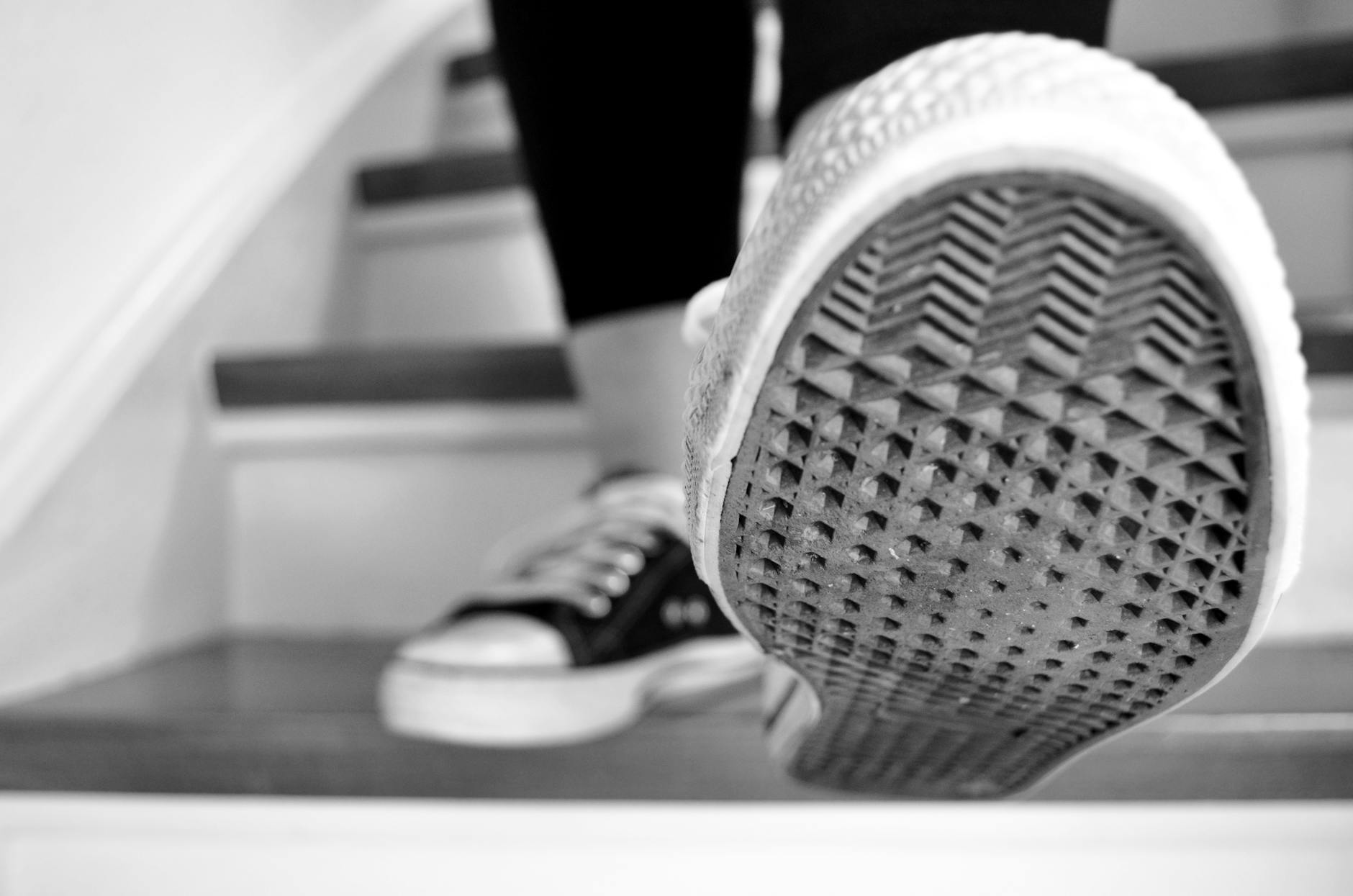
Understanding Freezing of Gait and Its Role in Stair Falls
Freezing of gait represents one of the most disorienting and dangerous symptoms of Parkinson’s disease. During these episodes, a person suddenly feels as though their feet are glued to the ground. They know they want to move. They can see where they need to go. But their legs simply won’t cooperate. According to an analysis of over 2,000 falls in people with Parkinson’s, 61 percent were freezing-related. Freezing episodes are commonly triggered by obstacles, tight spaces, doorways, and transitions””exactly the kind of environmental features that characterize staircases.
The top of a staircase represents a transition from flat walking to descent. A landing represents a transition from one flight to another. Each of these moments creates an opportunity for freezing to occur in exactly the wrong place. However, the relationship between freezing and stairs isn’t straightforward. For some individuals, the rhythmic, predictable nature of stairs actually helps. The visible edges of each step provide external cues that can bypass the faulty internal movement signals from the basal ganglia. This is why occupational therapists sometimes use visual cues like tape lines on floors to help people with Parkinson’s initiate walking. The limitation here is significant: while visual cues may help with movement initiation, they don’t address balance impairments or muscle weakness, and relying on this paradox as a safety strategy would be misguided.
How the Body Compensates During Stair Navigation
Research into stair ambulation in Parkinson’s disease reveals fascinating compensatory mechanisms. Studies examining joint kinetics during stair ascent and descent show that people with Parkinson’s redistribute the work their muscles perform. They may have weaker quadriceps than healthy individuals, yet they depend on these same muscles more heavily when climbing stairs. This compensation comes at a cost. Using weakened muscles beyond their optimal capacity accelerates fatigue. A person might manage the first flight of stairs reasonably well, only to find the second or third flight exponentially more difficult.
The compensatory strategy that helped them climb safely in the morning may fail them later in the day when fatigue accumulates. Consider someone who climbs stairs to their second-floor bedroom each night. Early in the disease, their compensatory mechanisms work adequately. As the condition progresses, the margin for error narrows. One night, the combination of medication wearing off, accumulated daily fatigue, and a momentary distraction proves sufficient for a fall. This progression explains why stair safety must be reassessed regularly, not treated as a one-time determination.

Practical Strategies for Safer Stair Navigation
Several evidence-based approaches can reduce stair-related fall risk, though each involves tradeoffs. Exercise programs represent one of the most effective interventions, with research showing they can reduce fall rates by approximately 35 percent in people in early to mid-stages of Parkinson’s. However, exercise benefits diminish in advanced stages, and the type of exercise matters significantly””general fitness programs differ from balance-specific and gait-focused interventions. Environmental modifications offer another layer of protection. Handrails on both sides of stairs allow for bilateral support.
High-contrast tape on stair edges enhances visibility, leveraging that visual cue phenomenon. Adequate lighting eliminates shadows that might be misinterpreted as obstacles or uneven surfaces. The tradeoff with environmental modifications is cost and feasibility””not everyone owns their home or can afford extensive renovations. Stairlifts eliminate stair navigation entirely, converting a hazardous activity into a passive one. They’re expensive, require installation, and some people resist them as symbols of declining independence. Yet for someone with frequent freezing episodes or significant balance impairment, a stairlift may represent the difference between remaining in a familiar home and needing to relocate to single-floor living.
When Stairs Become Too Dangerous
There comes a point for many people with Parkinson’s when stair use is no longer advisable, regardless of modifications or strategies. Identifying this threshold requires honest assessment rather than optimism. Warning signs include freezing episodes that occur specifically on or near stairs, multiple near-falls even with handrail use, inability to recover balance when slightly pushed or jostled, and significant medication-related fluctuations that create unpredictable “off” periods. A critical limitation of all compensatory strategies is their dependence on cognitive engagement. The person must remember to use the handrail, must concentrate on each step, must recognize when they’re fatigued.
Parkinson’s disease often involves cognitive changes that reduce this capacity for vigilance. When someone begins having difficulty with medication schedules or demonstrates confusion about familiar routines, their ability to employ safety strategies consistently becomes unreliable. Falls on stairs carry particularly high injury potential because of the height and hard surfaces involved. A fall while walking across a carpeted room might result in bruising. A fall down a flight of stairs can mean hip fractures, head injuries, or worse. The calculation of acceptable risk necessarily shifts when the consequences of failure are severe.

The Importance of Medication Timing
Parkinson’s medications don’t provide constant symptom control. They work in cycles, with peak effectiveness followed by gradual wearing off. Many people with Parkinson’s learn to time their most demanding activities for periods when their medication is working optimally.
Stair navigation should be considered a demanding activity. For example, someone whose medication provides good control for about four hours after each dose might schedule all necessary trips upstairs during the first three hours of each cycle. They would avoid stairs during the wearing-off period when freezing and motor difficulties are more likely. This requires planning and sometimes inconvenience, but it represents a rational risk-reduction approach.
Looking Ahead: Research and Emerging Approaches
Current research into Parkinson’s disease and falls increasingly focuses on prediction and prevention rather than just injury reduction. The 2024 identification of gait freezing as a strongly associated prognostic factor for falls suggests that clinicians may eventually be able to risk-stratify patients more accurately, targeting intensive interventions toward those most likely to fall.
Wearable technology that detects freezing episodes in real time is under development, with the goal of providing immediate cues to help people restart movement before a fall occurs. Whether such technologies will prove practical and affordable remains to be seen, but they represent a shift from treating falls as inevitable to attempting to interrupt them at the moment they begin.
Conclusion
Stairs become serious obstacles in Parkinson’s disease because of the combined effects of motor control difficulties, muscle weakness, balance impairment, and freezing of gait. The statistics are sobering: fall risk three times higher than in healthy individuals, over half of stair falls occurring during descent, and more than 60 percent of falls related to freezing episodes. These aren’t problems that willpower or determination can overcome””they’re neurological realities that demand practical responses.
The path forward involves honest assessment of individual capabilities, appropriate environmental modifications, targeted exercise programs, careful medication timing, and willingness to adopt alternatives like stairlifts when necessary. Regular reassessment matters because Parkinson’s is progressive, and strategies that worked six months ago may be inadequate today. Working with physical therapists, occupational therapists, and movement disorder specialists provides the expertise needed to make these ongoing decisions safely.