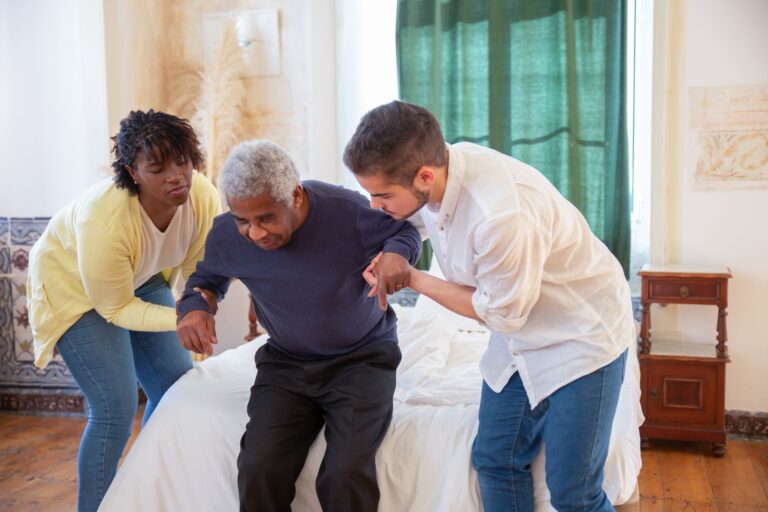
Falls in Parkinson’s disease are more severe than typical age-related falls because of a convergence of motor dysfunction, impaired protective reflexes, and compromised bone health. About 80% of falls in Parkinson’s occur due to postural instability and freezing of gait””the temporary, involuntary inability to move””which means the person often cannot catch themselves or break their fall effectively. When someone with Parkinson’s falls, approximately 50% of those falls result in severe secondary injuries, and the risk of hip fracture is 3.2 times higher than in people without the disease. Consider a 68-year-old man with Parkinson’s who experiences a freezing episode while stepping off a curb: his muscles lack the strength and reaction time to prevent the fall, and years of reduced physical activity have weakened his bones, making fracture far more likely than it would be for his neighbor of the same age.
The statistics are sobering. Between 45% and 68% of people with Parkinson’s fall annually””three times the rate seen in healthy individuals””and by 10 years after diagnosis, an estimated 27% will have experienced a hip fracture. What sets these falls apart is not just their frequency but their consequences: longer hospitalizations, higher rates of institutionalization, worse mobility outcomes, and increased one-year mortality compared to non-Parkinson’s patients with similar injuries. This article examines the specific mechanisms that make Parkinson’s-related falls so dangerous, from the motor symptoms that impair balance and gait to the non-motor factors like orthostatic hypotension and cognitive decline. We will also explore why injuries tend to be more severe, which risk factors compound the danger, and what emerging research suggests about predicting and preventing these falls.
Table of Contents
- Why Are Falls in Parkinson’s Disease More Frequent and Dangerous?
- The Role of Motor Symptoms in Fall Severity
- Non-Motor Factors That Compound Fall Risk
- Why Injuries From Falls Are More Severe in Parkinson’s
- Disease Progression and Risk Factor Accumulation
- The Healthcare and Economic Burden
- Emerging Research in Fall Prediction
- Conclusion
Why Are Falls in Parkinson’s Disease More Frequent and Dangerous?
The answer lies in the disease‘s direct assault on the body’s balance and movement systems. Patients with the postural instability and gait difficulty (PIGD) subtype of Parkinson’s are significantly more likely to suffer falls, including both balance-related and freezing-related falls. Unlike the tremor-dominant form of Parkinson’s, PIGD disrupts the fundamental mechanisms people rely on to stay upright and respond to perturbations. When a healthy person stumbles, their body automatically engages corrective movements. In Parkinson’s, this response is delayed, weakened, or absent entirely. Muscle weakness plays a critical but often underappreciated role.
The extensors and flexors in people with Parkinson’s are substantially weaker than in the general population, with extensor weakness””affecting the ankles, knees, glutes, and hips””typically exceeding flexor weakness. This matters because extensor muscles are essential for maintaining upright posture and generating the force needed to recover from a loss of balance. A person whose ankle extensors cannot quickly push back against the ground has no way to prevent a backward fall. The timing of fall risk also reveals important patterns. Fifteen percent of Parkinson’s patients have already experienced a fall at the time of diagnosis, before they even know they have the disease. By seven years post-diagnosis, one-third of clinical visits report a fall, and about one-tenth involve frequent falls. This progression is not merely a function of aging””it reflects the relentless advance of the disease itself, with falls increasing alongside advancing disability.

The Role of Motor Symptoms in Fall Severity
Freezing of gait represents one of the most frightening and dangerous motor symptoms. During a freezing episode, a person’s feet seem glued to the floor despite their intention to walk. These episodes commonly occur when initiating movement, turning, approaching doorways, or navigating crowded spaces. The danger is twofold: the sudden stop can cause forward momentum to continue while the feet remain planted, and the person cannot execute the stepping movements needed to prevent a fall. Unlike a typical trip where someone might take several quick steps to regain balance, freezing eliminates that option entirely. Postural instability compounds the problem. Healthy individuals maintain balance through constant, unconscious adjustments.
In Parkinson’s, the basal ganglia’s ability to coordinate these adjustments deteriorates. When pushed or pulled off balance, a person with Parkinson’s may exhibit a “retropulsion”””a tendency to step backward repeatedly without being able to stop””or simply fall like a felled tree. However, it’s important to note that not all Parkinson’s patients experience the same degree of postural instability. Those with tremor-dominant disease may retain relatively intact balance for many years, while PIGD patients face these challenges much earlier in their disease course. Rigidity and bradykinesia (slowness of movement) further impair protective responses. Even when a person recognizes they are falling, the stiffness and slowness characteristic of Parkinson’s prevent them from extending their arms quickly enough to break the fall or rotating their body to land on a less vulnerable area. What might be a minor stumble for a healthy person becomes a direct impact to the hip or head.
Non-Motor Factors That Compound Fall Risk
While motor symptoms receive the most attention, three critical non-motor factors significantly increase fall risk and severity: orthostatic hypotension, fear of falling, and cognitive impairment. Orthostatic hypotension””a sudden drop in blood pressure upon standing””affects a substantial proportion of Parkinson’s patients and can cause dizziness, lightheadedness, or fainting when rising from a chair or bed. A fall caused by syncope or near-syncope often occurs without any protective response, as the person may lose consciousness or near-consciousness before hitting the ground. Research has identified significant associations between falls and cardiovascular dysfunction, psychosis, sleep disturbances, and cognitive decline. Cognitive impairment is particularly insidious: it affects a person’s ability to recognize hazardous situations, make safe decisions about movement, and maintain the divided attention needed to walk safely while doing other things.
A person with intact cognition might notice a wet floor and slow down; someone with cognitive decline may not process the danger until they are already falling. Psychotropic medications, often prescribed for the depression, anxiety, and psychosis that can accompany Parkinson’s, contribute independently to fall risk. These medications can cause sedation, dizziness, and impaired coordination. However, discontinuing them is not always possible or advisable””untreated psychiatric symptoms can themselves increase fall risk through agitation, poor judgment, or medication non-adherence. This creates a difficult clinical tradeoff where treatment decisions must weigh competing risks.

Why Injuries From Falls Are More Severe in Parkinson’s
When someone with Parkinson’s falls, the injury is often worse than what a similar fall would cause in a healthy person. The numbers tell the story: 32.2% of fallers sustain fractures, with an additional 25.8% suffering bruises, skin lacerations, and other injuries. The 3.2-fold increased risk of hip fracture is not simply because people with Parkinson’s fall more often””their bones are more vulnerable to breaking when they do fall. Several factors contribute to compromised bone health in Parkinson’s. Reduced physical activity leads to bone density loss. Vitamin D deficiency is common, both from reduced sun exposure and from disease-related factors.
Malnutrition affects many patients, particularly in later stages when swallowing difficulties emerge. Low body mass index, osteoporosis, and the disease process itself all weaken the skeleton. By the time a person with advanced Parkinson’s falls, their bones may be substantially more fragile than those of their peers. For example, consider the difference in outcomes after a hip fracture. Parkinson’s patients exhibit longer hospitalizations, higher rates of institutionalization, worse mobility, and higher one-year mortality compared to non-Parkinson’s patients with the same injury. The fracture is not just a single event but the beginning of a cascade: immobility during recovery leads to deconditioning, which worsens Parkinson’s symptoms, which increases fall risk, which threatens additional injury. Breaking this cycle is extraordinarily difficult once it begins.
Disease Progression and Risk Factor Accumulation
Disease severity and duration are central drivers of fall risk, creating a troubling reality: the longer someone lives with Parkinson’s, the more likely they are to fall and the more severe those falls are likely to be. This is not inevitable for every patient, but it represents the general trajectory. As disability advances, the protective factors that once helped””strength, balance, reflexes, cognition””erode simultaneously. Polypharmacy and increased levodopa dosage emerge as risk factors, though the relationship is complex. Higher levodopa doses often reflect more advanced disease rather than causing falls directly.
However, motor fluctuations””the wearing off of medication effects between doses, or dyskinesias caused by peak medication levels””can create windows of particular vulnerability. A patient might be stable mid-morning when medication is working optimally but at high fall risk during the off periods before the next dose. Age, dementia, vitamin B12 deficiency, and posture deformities all increase severity. Female patients present an interesting paradox: despite generally milder motor symptoms, women with Parkinson’s are significantly more likely to report falls, injuries, and healthcare use. The reasons likely involve lower baseline bone density, different body composition, and possibly differences in activity patterns or willingness to report falls. This finding cautions against assuming that milder-appearing disease means lower fall risk.
The Healthcare and Economic Burden
The consequences of Parkinson’s-related falls extend far beyond the individual. Direct medical costs for Parkinson’s patients who fall are double those of non-fallers. The costs of fall-related fractures in Parkinson’s are close to double those in healthy older people, reflecting longer hospital stays, more intensive rehabilitation needs, and higher rates of complications. Consider a typical scenario: A 72-year-old woman with Parkinson’s falls at home and fractures her hip.
She requires emergency surgery, a week-long hospital stay, transfer to a rehabilitation facility for several weeks, and then home physical therapy for months. She may never return to her previous level of function. Her husband, who was managing as her caregiver, can no longer cope with her increased needs, leading to nursing home placement. Her Parkinson’s medications need adjustment because she is now deconditioned and prone to orthostatic hypotension. The cascade of costs””financial, functional, and personal””dwarfs what the same fracture would cause in someone without Parkinson’s.
Emerging Research in Fall Prediction
A 2024 study offers a glimpse of how technology might help identify high-risk patients before they fall. Using wearable sensors during a simple two-minute walk and 30-second postural sway task, researchers achieved 78% accuracy (with an area under the curve of 0.85) at predicting falls 60 months in the future, and 84-92% accuracy at predicting falls within 24 months. This suggests that subtle changes in gait and balance””imperceptible to clinical observation””may signal impending fall risk long before the first serious fall occurs.
Such tools could transform how clinicians approach fall prevention. Rather than waiting for a patient to fall before intensifying interventions, predictive models could identify those most likely to benefit from early physical therapy, medication adjustments, home modifications, or assistive devices. However, these technologies remain research tools for now. Translating them into routine clinical practice will require validation in diverse populations, integration with clinical workflows, and demonstration that early intervention actually prevents the falls these tools predict.
Conclusion
Falls in Parkinson’s disease are more severe because the disease systematically undermines every defense against falling and every factor that protects against serious injury. Motor symptoms like postural instability and freezing of gait cause falls that cannot be prevented or controlled. Muscle weakness prevents protective responses. Non-motor symptoms””orthostatic hypotension, cognitive impairment, medication effects””add layers of risk.
Compromised bone health means that when falls occur, fractures follow in roughly one-third of cases. The path forward requires recognizing fall prevention as a core component of Parkinson’s care rather than an afterthought. This means aggressive management of modifiable risk factors, including bone health optimization, medication review, physical therapy for strength and balance, and home safety modifications. It means honest conversations with patients and families about risk, particularly as the disease progresses. And it means continuing to develop and validate predictive tools that can identify high-risk patients before the first devastating fall.