Disease fall sits at the center of this dementia and brain health question.
Understanding do people with parkinson’s disease fall more often is essential for anyone interested in dementia care and brain health. This comprehensive guide covers everything you need to know, from basic concepts to advanced strategies. By the end of this article, you’ll have the knowledge to make informed decisions and take effective action.
Table of Contents
- How Much More Often Do Parkinson’s Patients Fall Compared to Others?
- Why Postural Instability and Freezing Cause Most Parkinson’s Falls
- Risk Factors That Predict Falls in Parkinson’s Disease
- How Disease Subtype Affects Fall Patterns
- Treatment Approaches That May Reduce Fall Risk
- When Falls Signal Disease Progression
- Looking Ahead: Research Directions and Emerging Approaches
- Conclusion
How Much More Often Do Parkinson’s Patients Fall Compared to Others?
The difference in fall rates between people with Parkinson’s disease and the general population is substantial and well-documented. Annual fall risk in Parkinson’s disease ranges from 45% to 68% according to research data, while one study found that 38.8% of patients reported at least one fall since disease onset, with 68% of those becoming recurrent fallers. The contrast with healthy older adults is stark: while falls are already a concern in aging populations, Parkinson’s disease amplifies this risk dramatically. Perhaps the most sobering comparison involves injury outcomes. People with Parkinson’s disease face a hip fracture risk four times higher than the general population.
This isn’t simply because they fall more often””though they do””but also because the nature of their falls tends to be different. Balance impairments mean they may be less able to catch themselves or break their fall effectively, and the medications used to treat Parkinson’s can affect bone density over time. A 2025 study examining 6,977 visits from 3,100 participants provides recent confirmation of these patterns. Researchers found that participants with diagnosed Parkinson’s disease had significantly higher odds of falling than those with prodromal alpha-synucleinopathy””an early stage before full symptoms develop””with an odds ratio of 1.66. This suggests that fall risk increases as the disease progresses from its earliest stages.

Why Postural Instability and Freezing Cause Most Parkinson’s Falls
The Parkinson’s Foundation reports that 80% of falls in Parkinson’s disease are due to two specific symptoms: postural instability and freezing of gait. Understanding these mechanisms helps explain why standard fall prevention advice often falls short for this population. Postural instability refers to the impaired ability to maintain balance during standing and walking. In healthy individuals, the brain constantly makes small adjustments to keep the body upright, responding to shifts in weight, uneven surfaces, or unexpected bumps. In Parkinson’s disease, these automatic corrections become slower and less effective. When someone without Parkinson’s stumbles, they typically catch themselves without thinking.
When someone with Parkinson’s stumbles, their corrective response may come a fraction of a second too late””and that fraction makes the difference between regaining balance and hitting the ground. Freezing of gait presents a different but equally dangerous challenge. A person walking across a room may suddenly feel as though their feet are glued to the floor, unable to take the next step despite wanting to move forward. The upper body, however, continues its momentum, creating a dangerous mismatch that frequently results in falls. Freezing episodes often occur during transitions””starting to walk, turning corners, approaching doorways, or navigating crowded spaces. However, if a person experiences freezing primarily when medications are wearing off, adjusting the timing of doses may help reduce episodes. This illustrates why working closely with a movement disorder specialist matters.
Risk Factors That Predict Falls in Parkinson’s Disease
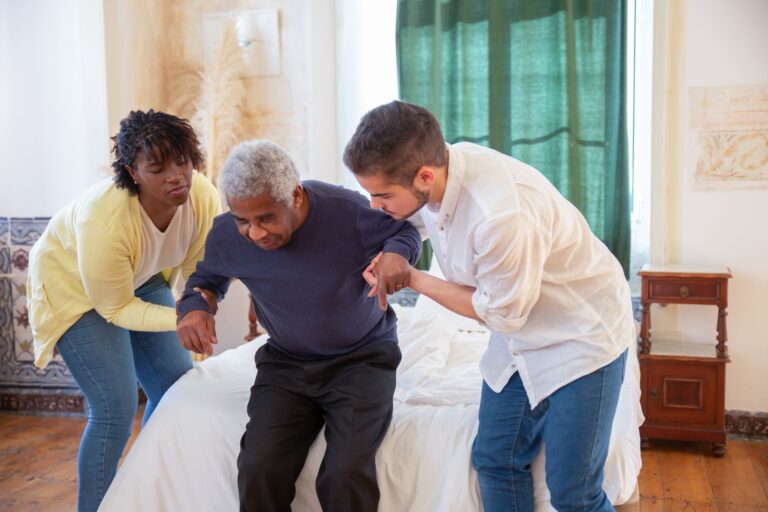
Research published in Frontiers in Aging Neuroscience in 2024 identified several key risk factors that predict falls in Parkinson’s patients. Walking with assistance carried the highest risk, with an odds ratio of 3.248″”meaning those who needed help walking were more than three times as likely to fall as those who walked independently. Vitamin B12 deficiency (OR: 2.667), polypharmacy (OR: 2.493), posture deformities (OR: 2.199), and dementia (OR: 1.862) also significantly increased risk. These findings highlight an important nuance: not everyone with Parkinson’s faces the same fall risk. A recently diagnosed person with mild symptoms, good nutrition, and minimal other medications has a very different risk profile than someone with advanced disease, multiple health conditions, and cognitive changes.
Age itself is a factor, though its effect (OR: 1.039) is relatively modest compared to disease-specific factors. The same research identified protective factors worth noting. Treatment with levodopa””the primary medication for Parkinson’s motor symptoms””showed protective effects against falling. Higher education levels also appeared protective, possibly because education correlates with better access to healthcare, more proactive management of symptoms, or greater ability to implement fall prevention strategies. These findings suggest that optimizing medical treatment isn’t just about symptom control””it may directly reduce fall risk.

How Disease Subtype Affects Fall Patterns
Not all Parkinson’s disease presents the same way, and research has revealed meaningful differences in fall risk between subtypes. Patients with the PIGD subtype””characterized by postural instability and gait difficulty””are significantly more likely to suffer falls compared to those whose symptoms are predominantly tremor-based. PIGD patients experience more falls overall, more balance-related falls specifically, and more falls occurring at home. This distinction matters for practical planning. Someone with tremor-dominant Parkinson’s might reasonably focus fall prevention efforts on situations involving fine motor control or when tremor is most pronounced.
Someone with PIGD subtype, however, faces a more pervasive risk that affects daily activities throughout the home. Their fall prevention strategy needs to be more comprehensive, addressing everything from bathroom safety to furniture arrangement to nighttime routines. The home fall risk for PIGD patients deserves particular attention. While we might assume that familiar environments are safer, the research suggests otherwise for this group. The comfort of home can breed complacency””walking to the bathroom at night without turning on lights, rushing to answer the phone, or navigating around furniture that’s been in the same place for years. For PIGD patients, these ordinary moments carry elevated risk.
Treatment Approaches That May Reduce Fall Risk
The finding that levodopa treatment offers protective effects against falls underscores the importance of appropriate medication management. When motor symptoms are well-controlled, mobility improves, and the risk of falls decreases. However, this relationship isn’t straightforward. Levodopa can cause dyskinesias””involuntary movements””that might themselves contribute to balance problems. The goal is finding the optimal dose that maximizes mobility while minimizing side effects. Physical therapy and exercise programs designed for Parkinson’s patients have shown promise in reducing falls, though their effectiveness varies.
Programs emphasizing balance training, strength building, and gait practice appear most beneficial. Some patients benefit from specific techniques like big-step walking or exaggerated movements that help overcome the tendency toward small, shuffling steps. The tradeoff is that such programs require consistent effort and access to knowledgeable therapists””resources that aren’t universally available. Addressing modifiable risk factors offers another avenue for intervention. Correcting vitamin B12 deficiency, reducing unnecessary medications (addressing polypharmacy), and managing posture problems can all potentially lower fall risk. These interventions require coordination among healthcare providers and active patient engagement, but they address factors that research has directly linked to falls.
When Falls Signal Disease Progression
A sudden increase in fall frequency sometimes indicates that Parkinson’s disease is progressing or that current treatments need adjustment. Families often report that falls were the first sign that something had changed, even before formal assessments showed disease advancement. This pattern makes falls not just a safety concern but also a potential diagnostic indicator.
However, increased falls don’t always mean the disease itself has worsened. Infections””particularly urinary tract infections””can temporarily worsen Parkinson’s symptoms, including balance. Medication interactions, dehydration, sleep problems, or unrelated health issues can all increase fall risk without representing true disease progression. The challenge lies in distinguishing temporary, treatable causes from genuine advancement of Parkinson’s disease.
Looking Ahead: Research Directions and Emerging Approaches
Fall prevention in Parkinson’s disease remains an active area of research, with investigators exploring wearable sensors that can detect gait changes before falls occur, cueing devices that help overcome freezing episodes, and personalized exercise programs based on individual risk profiles. The large-scale studies emerging in recent years, including the 2025 research examining thousands of patient visits, provide the foundation for more targeted interventions.
What the research consistently confirms is that falls in Parkinson’s disease aren’t inevitable accidents but rather predictable events with identifiable risk factors. This understanding shifts the conversation from resignation to prevention””not eliminating falls entirely, which may be unrealistic, but reducing their frequency and severity through informed, proactive management.
Conclusion
People with Parkinson’s disease do fall more often””substantially more often””than their peers without the condition. With annual fall rates ranging from 45% to 68%, a three-fold increase compared to age-matched controls, and hip fracture risk four times higher than the general population, falls represent one of the most significant safety challenges in Parkinson’s care. The causes are largely understood: postural instability and freezing of gait account for 80% of falls, while factors like vitamin B12 deficiency, multiple medications, and walking with assistance further elevate risk.
The path forward involves recognizing individual risk profiles, optimizing treatment with medications like levodopa that offer protective effects, addressing modifiable factors, and adapting living environments to reduce hazards. For those with the PIGD subtype, particular attention to home safety is warranted. While falls cannot be entirely prevented, understanding why they happen and who is most at risk creates opportunities to reduce their frequency and protect quality of life.
You Might Also Like
- Why Some People Progress From MCI to Alzheimer’s Disease
- Michael J. Fox Opens Up About Life After Multiple Broken Bones With Parkinson’s Disease
- Why Protein Clearance Fails in Alzheimer’s Disease
For more, see Alzheimer’s Association — caregiving.