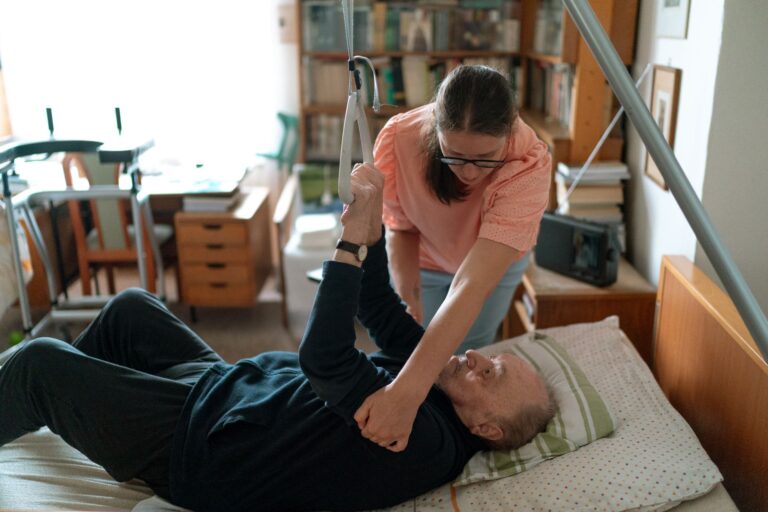
Movement change sits at the center of this dementia and brain health question.
When cognitive decline begins, the way a person moves and holds their body often changes in subtle but important ways. These changes in posture and movement are not just random—they reflect how the brain’s control over muscles, balance, and coordination is affected as cognition worsens. Understanding these shifts can help us recognize early signs of cognitive problems and improve care for those experiencing them.
At first, posture may become more stooped or hunched. This happens because the brain areas responsible for maintaining upright stance and balance start to weaken. The muscles that keep the spine straight lose some of their tone or strength, leading to a forward-leaning position. People might also stand with less confidence, appearing more rigid or cautious in their movements.
Movement itself slows down noticeably during cognitive decline. Walking speed decreases; steps become shorter and less steady. This is partly due to impaired motor planning—the brain struggles to coordinate complex sequences needed for smooth walking—and partly because balance control deteriorates. The gait may look shuffling or hesitant rather than fluid.
Another common change involves increased variability in movement patterns. Instead of consistent steps or gestures, motions become uneven—sometimes too fast, sometimes too slow—or irregularly timed. This inconsistency reflects disruptions in neural circuits that regulate timing and rhythm of muscle activation.
Fine motor skills also suffer as cognition declines. Tasks requiring precise hand movements—like buttoning a shirt or writing—become more difficult due to reduced dexterity and coordination problems linked with brain deterioration.
Postural reflexes that protect against falls tend to weaken as well. Normally when we lose balance slightly, automatic adjustments happen quickly through reflex pathways controlled by the brainstem and cerebellum combined with higher centers like the cortex; these responses slow down or fail altogether during cognitive impairment increasing fall risk.
In some types of dementia such as Parkinson’s disease dementia or Lewy body dementia, specific motor symptoms appear alongside cognitive issues: rigidity (stiff muscles), tremors (shaking), bradykinesia (slowness), and postural instability are common features that directly affect how someone moves[3][4]. These symptoms highlight how intertwined movement control is with cognition since both rely on overlapping brain regions vulnerable in these diseases.
Emotionally driven changes can indirectly influence posture too: anxiety about falling may cause people to adopt overly cautious stances; frustration from difficulty moving can lead to stiffness; depression might reduce motivation resulting in slumped shoulders[5].
As cognitive decline progresses further into moderate or severe stages:
– Posture becomes increasingly stooped.
– Gait turns very slow with frequent pauses.
– Movements grow smaller (a phenomenon called hypokinesia).
– Balance worsens dramatically causing frequent falls.
– Ability to initiate voluntary movements diminishes leading sometimes even to freezing episodes where one cannot move temporarily.
These physical manifestations mirror underlying neural degeneration affecting multiple systems controlling motion including sensory feedback loops from joints/muscles back up into the central nervous system which help maintain stability during standing/walking.
Interestingly though exercise—even high-intensity training—can help preserve better posture and mobility longer by stimulating neuroplasticity (the brain’s ability to adapt) along with improving muscle strength[1]. Regular physical activity supports healthier brain structures involved in movement regulation such as hippocampus & prefrontal cortex which also play roles beyond memory including executive functions necessary for coordinated action planning[1][4].
In everyday life this means encouraging people at risk for cognitive decline not only mentally but physically active helps maintain better postural alignment & smoother gait patterns delaying disability onset related both directly & indirectly through improved mood/confidence levels[5].
Overall then,
changes seen include:
– Stooped posture from weakened spinal support
– Slower walking speed
– Shorter stride length
– Irregular step timing
– Reduced arm swing while walking
– Diminished fine motor skills like grasping/manipulating objects
– Weakened protective reflexes causing instability
All these alterations arise because parts of the nervous system coordinating sensory input integration plus motor outpu
For more, see CDC — Alzheimer’s and Dementia.