Familiar faces can become harder to recognize because dementia damages brain systems that connect what a person sees with stored memories. The eyes may work normally, but the brain may no longer identify the face; this type of recognition problem is called visual agnosia. The change can affect relatives, friends, and even the person's own reflection. It may leave someone feeling surrounded by strangers, but it does not necessarily mean that affection or emotional attachment has disappeared.
Medical information disclaimer: This article is for general educational purposes only and does not provide medical advice, diagnosis, or treatment. Always consult a physician or other qualified health professional about symptoms, medications, tests, or treatment decisions.
Table of Contents
- Recognition requires more than seeing a face
- Is it a visual problem or a memory problem?
- Who develops this difficulty?
- What the behavior does—and does not—mean
- How caregivers can respond
Recognition requires more than seeing a face
Recognizing someone involves several linked tasks. The brain must perceive a face, distinguish it from other faces, connect it with stored knowledge, and retrieve details such as the person's relationship or name.
dementia can interrupt this process in different places. The Alzheimer's Society explains that damage involving temporal-lobe functions may prevent the brain from matching visual information with memory, even when the eyes remain healthy in its guidance on dementia-related perception changes. A person might therefore see facial features clearly without experiencing the familiar sense of "I know you." Another person may recognize the face as familiar but be unable to retrieve the name or relationship.
Is it a visual problem or a memory problem?
Failed recognition does not always reflect a face-specific visual impairment. In a study of 181 people with probable Alzheimer's disease, difficulty recognizing famous faces was linked more strongly to problems accessing names and identity-related knowledge than to difficulty visually distinguishing faces according to University of Pittsburgh researchers. This distinction helps explain apparently inconsistent responses.
someone may match two photographs of the same person yet be unable to say who that person is. Voice, scent, or another cue may still activate information that the face alone no longer reaches. Semantic dementia can produce a similar pattern by progressively eroding word meanings and knowledge about people. A 2024 UCSF study found that participants with semantic dementia had impaired face recognition and naming despite preserved perceptual face matching early in the disease in findings published in Neuropsychologia.
Who develops this difficulty?
Not everyone with dementia loses the ability to recognize familiar people, and the symptom does not appear at the same stage for everyone. One Alzheimer's study found that recognition of oneself and personally familiar faces remained intact in mild disease but became impaired in moderate disease according to researchers from the University of Liège and CHU Liège. The underlying dementia syndrome also matters.
Semantic dementia can weaken stored knowledge about a person, while posterior cortical atrophy can disrupt visual processing needed to recognize faces and objects. Recognition can also vary by person and context. Someone might recognize a relative's voice but not their photograph, know that a face is familiar without recalling the relationship, or react warmly without being able to name the visitor.
What the behavior does—and does not—mean
A failure to recognize a spouse, child, or longtime friend can feel like personal rejection. It is more accurately understood as a symptom: the brain cannot reliably connect the available cue with the person's identity. Emotional attachment may persist even when explicit identification fails.
A familiar voice, scent, manner, or feeling of safety can still matter when the person cannot retrieve a name or relationship. A mirror can create particular confusion if the person no longer recognizes their own reflection. They may interpret the image as another individual rather than understanding that they are looking at themselves.
How caregivers can respond
The immediate goal is reassurance, not proof that the person should remember. The Alzheimer's Society recommends supportive cues and family-photo memory books because other routes to recognition may remain available in its memory-loss guidance. Useful approaches include: Even when a person cannot identify who is present, a familiar voice or other sensory cue may still evoke comfort and emotional connection.
- Offer a familiar voice or scent as an additional cue.
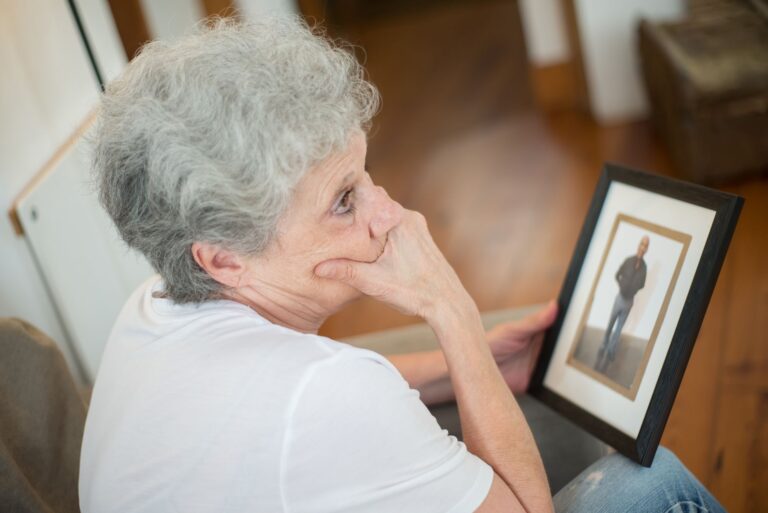
- Use a photo book that connects familiar faces with family memories.
- Reassure the person if an unrecognized face or reflection causes distress.
- Treat the missed recognition as a dementia symptom rather than a statement about the relationship.