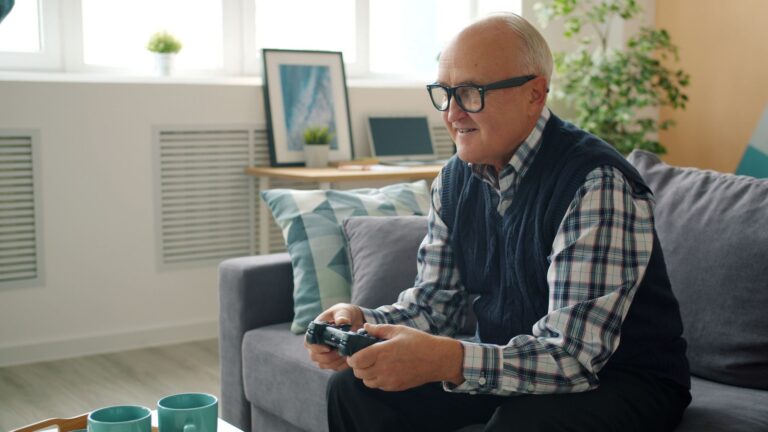
As of September 2026, games can support engagement, conversation and modest short-term cognitive gains in dementia care. They have not been shown to prevent dementia, and commercial brain-training claims deserve caution. Cognitive stimulation means varied activities that engage thinking and social interaction. It may include word games, puzzles, music, discussion and creative activities—not only products marketed as brain games.
Medical information disclaimer: This article is for general educational purposes only and does not provide medical advice, diagnosis, or treatment. Always consult a physician or other qualified health professional about symptoms, medications, tests, or treatment decisions.
Table of Contents
- Can brain-training games prevent dementia?
- Do games help people who already have dementia?
- Which activities count as cognitive stimulation?
- Is cognitive stimulation the same as cognitive training?
- How should caregivers choose and adapt a game?
Can brain-training games prevent dementia?
Strong evidence does not show that brain-training games reduce a person's risk of developing dementia, according to the Alzheimer's Society's review of brain training. A good score or improvement within one game should not be treated as proof of broader protection. Results also cannot be generalized from one app to another.
Most commercial products have not been tested, and different games target different abilities. Be wary of claims that a game prevents, delays or protects against dementia. In 2016, the Federal Trade Commission's Lumosity case ended with a $2 million settlement over allegations involving unsupported claims about cognitive impairment, dementia and Alzheimer's disease.
Do games help people who already have dementia?
Structured cognitive stimulation probably provides a small, short-term cognitive benefit for people with mild-to-moderate dementia. A 2023 Cochrane review examined 37 randomized trials involving 2,766 participants. Across 25 trials reporting MMSE cognitive scores, participants receiving cognitive stimulation scored 1.99 points higher than control groups immediately after treatment.
Results varied substantially between studies, so that average does not predict how much any individual will benefit. The evidence for communication and social interaction may be more useful when choosing care goals. Five studies involving 702 participants provided high-quality evidence of improvement in those areas. Shared enjoyment and conversation are therefore more defensible aims than promises of "brain fitness.".
Which activities count as cognitive stimulation?
Cognitive stimulation combines varied mental activity with interaction. Examples include word games, puzzles, music, discussion and creative projects, often delivered in a social group.
The best choice is usually an activity the person recognizes and can still enjoy. Practical options might include: The activity does not need an app, subscription or competitive format. Its value may come from participation, communication and connection rather than finishing correctly.
- Completing a familiar saying or simple word clue.
- Matching picture cards without keeping score.
- Sorting cards by color or suit.
- Working together on a puzzle with fewer pieces.
- Naming songs, discussing music or singing along.
Is cognitive stimulation the same as cognitive training?
No. Cognitive stimulation uses varied, socially engaging activities, while cognitive training focuses on practicing particular mental tasks repeatedly. This distinction matters in care decisions.
NICE recommends group cognitive stimulation therapy for mild-to-moderate dementia but advises against cognitive training as a treatment for mild-to-moderate Alzheimer's disease. A commercial memory exercise is therefore not interchangeable with a structured group program. When considering a service, ask whether it combines different activities, encourages interaction and adapts tasks to participants' abilities.
How should caregivers choose and adapt a game?
Start with familiarity and current ability, not the game's advertised difficulty or health claims. Give one simple step at a time, offer supervision and remove unnecessary rules.
Watch the person's response during play: Do not assume benefits will last after sessions end. The Cochrane review's median treatment length was 10 weeks, and only eight studies assessed whether benefits persisted afterward.
- Continue when the activity holds attention and supports comfortable interaction.
- Simplify the task if rules, scoring or too many pieces create confusion.
- Offer prompts without turning mistakes into a test.
- Switch activities when interest fades.
- Stop when frustration increases.
You Might Also Like
- Books for Dementia Care FAQ for September 2026: Source-Checked Answers to Common Questions
- What Is New With Games for Dementia Care in September 2026? Latest FDA, NIH, WHO, and CMS sources and Key Takeaways
- Games for Dementia Care 2026 Guide: safety, access, and evidence limits; Key Facts and Questions to Ask