Low lighting increases dementia-related fear because the condition damages the brain regions responsible for visual processing and spatial awareness, making it nearly impossible for a person to accurately interpret what they’re seeing in dim environments. When someone with dementia enters a poorly lit room, shadows aren’t simply recognized as benign features—they’re often misinterpreted as threatening objects or people, triggering genuine fear and anxiety. This isn’t a misreading born from confusion alone; it’s a neurological consequence of how dementia alters the brain’s ability to process visual information. Consider a person with moderate dementia who wakes at night to use the bathroom. The hallway is dimly lit. A shadow cast by a door frame becomes, in their mind, a person standing in their way. Their heart rate rises.
They feel trapped or threatened. They call out in distress. The family member rushing to help doesn’t see an intruder—they see only darkness and a frightened loved one. This scenario plays out in countless homes and care facilities every night, and it’s rooted in how dementia changes the brain’s visual centers. The occipital lobe, which interprets visual stimuli, and the parietal lobe, which handles spatial awareness, are both vulnerable to dementia’s progression. As these regions deteriorate, the ability to distinguish objects from their background—especially in low light—becomes severely compromised. This isn’t a behavioral problem to manage with medication alone; it’s a sensory problem that responds to environmental intervention.
Table of Contents
- How Does Dementia Damage the Brain’s Vision System?
- Why Shadows Become Threats in a Dementia-Affected Brain
- Behavioral and Psychological Symptoms Are Nearly Universal in Dementia
- What Clinical Research Shows About Lighting as an Intervention
- Why One Person’s Perfect Lighting Is Another’s Overstimulation
- Designing Dementia-Friendly Spaces with Strategic Lighting
- Lighting’s Role in Supporting the Body’s Circadian Rhythm
How Does Dementia Damage the Brain’s Vision System?
dementia doesn’t just affect memory and thinking; it fundamentally alters how the brain processes what the eyes see. People with dementia show significantly worse contrast sensitivity than those without cognitive decline, meaning they struggle to distinguish an object from its surroundings. In bright, clearly lit environments, this deficit may be minor. In a dimly lit room, it becomes profound. A person might not see the edge of a step, the outline of furniture, or the boundary between the wall and a doorway—not because their eyes have failed, but because their brain can no longer extract meaningful visual information from low-contrast environments. This visual impairment is so significant that it can actually predict dementia long before diagnosis. Research shows that reduced visual contrast sensitivity may indicate dementia up to 12 years before cognitive symptoms emerge.
The connection runs deeper still: poorer visual contrast sensitivity is associated with greater cerebral amyloid and tau accumulation in individuals with Alzheimer’s disease—the hallmark pathological features of the condition. In other words, the vision problems aren’t a side effect of dementia; they’re intertwined with the disease’s core pathology. The practical consequence is immediate and measurable. People with dementia who also have vision problems face a 32% higher risk of one or two falls and a 71% higher risk of frequent falls. A person who cannot see clearly in low light cannot move safely through their environment. They may freeze, shuffle cautiously, or grip railings. Fear often accompanies this uncertainty, and that fear is rational—their brain is telling them that their surroundings are genuinely unclear.
Why Shadows Become Threats in a Dementia-Affected Brain
The misinterpretation of shadows represents one of the most distressing aspects of living with dementia. A shadow cast by a window blind, a curtain fold, or even a piece of furniture in dim light can be perceived as a person, an animal, or an intruder. This isn’t a delusion in the psychiatric sense; it’s a perceptual error driven by the brain’s inability to process visual information accurately. The dementia-affected brain doesn’t have enough visual detail to distinguish a shadow’s true nature, so it fills in the gap with a threat. Caregivers often misinterpret these moments as behavioral outbursts or confusion that needs to be reasoned away. A family member might say, “There’s no one there, Mom, it’s just a shadow.” But to the person experiencing the fear, the threat feels absolutely real.
Their visual system is reporting danger, and no amount of verbal reassurance can override what their senses appear to be telling them. The fear response is not irrational—it’s a logical consequence of impaired visual processing. One important limitation to understand: the evidence on lighting and anxiety specifically is limited. While studies show that proper lighting reduces agitation, depression, and other behavioral symptoms, researchers note that “evidence on anxiety specifically is too limited to draw firm conclusions.” This doesn’t mean lighting doesn’t help with fear and anxiety; it means the research remains incomplete. Individual responses vary widely. Some people may actually become more agitated with very bright light, suggesting that lighting adjustments need to be personalized rather than applied as a one-size-fits-all solution.
Behavioral and Psychological Symptoms Are Nearly Universal in Dementia
Nearly all people living with dementia experience behavioral and psychological symptoms (BPSD), with prevalence rates reaching up to 97%. These symptoms include anxiety, fear, agitation, depression, hallucinations, and delusions. Low lighting is not the only trigger—dementia’s effects on the brain create vulnerability to many forms of distress. However, low lighting is a modifiable trigger, which makes it especially important to address. The relationship between lighting and anxiety in dementia is part of a larger picture.
Studies examining the effects of ambient bright light on behavioral symptoms found that higher daytime light exposure is associated with lower apathy, appetite changes, delusions, and hallucinations. Lower nighttime light exposure, conversely, is associated with lower agitation and nighttime behaviors. These findings suggest that the brain’s response to light is deeply connected to the psychiatric and behavioral expressions of dementia. When lighting is wrong, the nervous system doesn’t settle; when lighting is right, there’s measurable improvement. An example from clinical practice: a person with moderate dementia in a nursing home begins having severe anxiety episodes in the late afternoon and evening—a phenomenon known as “sundowning.” When the facility adjusts the lighting in common areas during these hours, increasing illumination and shifting the color temperature to a brighter, bluer tone, the person’s anxiety often decreases noticeably. The change isn’t psychological placebo; it’s a direct response to the brain receiving clearer visual information and receiving appropriate circadian rhythm signals.
What Clinical Research Shows About Lighting as an Intervention
Systematic reviews of clinical trials have identified specific lighting parameters that improve behavioral symptoms in dementia. The research consistently points to these optimal conditions: an illuminance level of 350–750 lux, a color temperature of 4,500–9,325 K (described as “blue-white” lighting), exposure for 10–12 hours daily, with improvements typically appearing after at least 4 weeks of consistent use. The results are meaningful but not uniformly dramatic. Three of four studies examining the effect of bright ambient light showed positive effects on depressive symptoms. A 2014 study found that “blue-white” lights resulted in measurable reductions in agitation and depression, plus improved sleep duration and quality.
Not every study showed the same magnitude of effect, and individual responses varied, but the direction of the evidence was clear: proper lighting reduces behavioral and emotional symptoms. It’s important to compare this to other interventions. Behavioral symptoms in dementia are often addressed with medication—antipsychotics, antidepressants, or anti-anxiety drugs—which carry risks including sedation, falls, and side effects. A lighting intervention has no medication side effects, though it requires deliberate environmental design. The tradeoff is that lighting changes take time to show benefit (4 weeks minimum) and require consistent implementation. A person cannot receive “proper lighting” on a schedule; their environment must be intentionally designed and maintained.
Why One Person’s Perfect Lighting Is Another’s Overstimulation
Not every dementia care environment can simply increase brightness and expect universal improvement. Mixed results across studies suggest that overstimulating or understimulating lighting exacerbates behavioral symptoms. In other words, lighting that is too bright can increase agitation just as much as lighting that is too dim can increase fear. The challenge is finding the individual’s optimal balance. Aging eyes themselves require about 30% more illumination than younger eyes to see clearly. This creates a fundamental challenge in shared care environments: the staff members, nurses, and family members present in the space don’t need nearly as much light as the person with dementia does to see clearly.
What feels adequately lit to a caregiver may feel harshly bright to themselves or to other residents. What feels adequate to the staff may feel darkly threatening to the person with dementia. Personalized lighting—the ability to adjust brightness and color temperature in a specific person’s room or area—is often more practical than sitewide changes. Another warning: individual responses to light can be unpredictable and may even change over time as dementia progresses. A person who initially benefits from bright daytime light might later become oversensitive to it. Regular reassessment is necessary. What worked well last month may need adjustment this month.
Designing Dementia-Friendly Spaces with Strategic Lighting
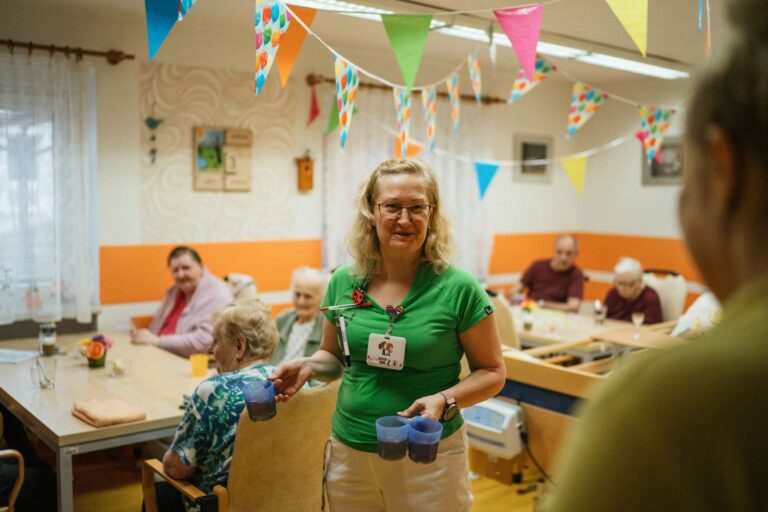
Healthcare design guidelines have begun to address dementia-specific lighting needs. Bathrooms, where falls are common and fear is high, should have brighter and more uniform lighting than in other areas of the home. Bedrooms should be designed to allow darkness at night for sleep while maintaining calibrated low-level lighting that prevents disorientation if the person wakes and needs to move about.
Hallways and common areas benefit from consistent, adequate illumination without harsh shadows or glare. The design principle isn’t simply “bright is better.” Overlit environments can feel institutional and unpleasant; they may also increase glare and visual fatigue. Proper dementia-friendly lighting involves reducing shadows, avoiding dark corners, ensuring even illumination across surfaces, and choosing color temperatures that support the body’s natural rhythms. A well-designed space feels welcoming while providing the visual clarity that someone with dementia needs to navigate safely and without fear.
Lighting’s Role in Supporting the Body’s Circadian Rhythm
Beyond the immediate effects on fear and anxiety, lighting affects the circadian rhythm—the body’s internal 24-hour cycle that regulates sleep, hormone production, alertness, and mood. Proper lighting directly influences these cycles. Inadequate lighting throughout the day results in drowsiness, impaired mobility, and sensory issues.
At night, light exposure that’s too bright disrupts sleep and can increase nighttime agitation. The evidence shows that coordinated lighting throughout the day and night—bright, blue-white light during daytime hours and dim, warm light in the evening—supports better sleep, lower nighttime agitation, improved daytime alertness, and more stable mood. A person with dementia in an environment with strategic 24-hour lighting design shows measurable behavioral improvements. The lighting doesn’t cure dementia or restore lost cognitive function; it removes a modifiable source of fear and disorientation while supporting the body’s natural regulatory systems.
- —