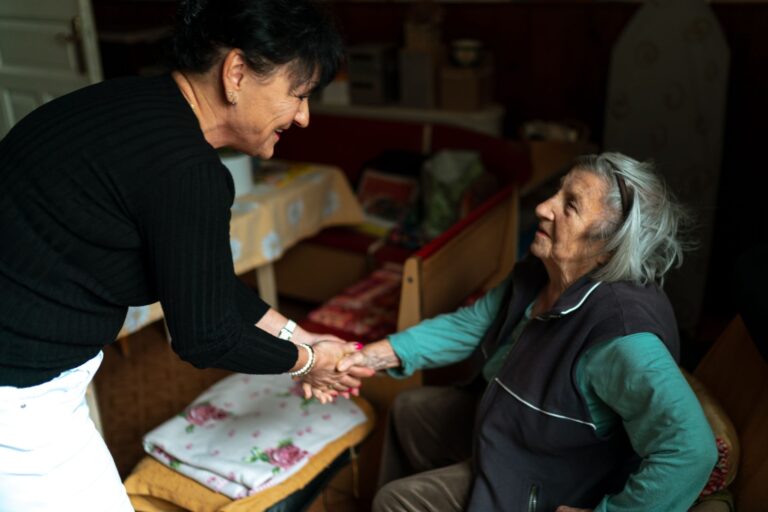
Talking to someone with dementia requires adapting your communication style to match how their brain is processing information. The goal isn’t to pretend they haven’t changed or to speak to them as you would anyone else—it’s to create a way of connecting that works with their current abilities rather than against them. This means slowing down, simplifying language, and using visual cues alongside words. The specific changes you make depend on the stage of dementia.
Early-stage dementia might mean they forget what you said mid-conversation but can still engage in meaningful dialogue if you give them time to process. By mid-stage, they may lose the thread entirely within minutes, and you’ll need to repeat information or redirect gently. A person in late-stage dementia may not recognize you verbally but can respond to tone of voice and physical touch. Treating each stage differently—rather than using the same approach across all stages—makes conversations feel less frustrating for both of you.
Table of Contents
- How Does Dementia Affect Communication Abilities?
- Managing Your Own Emotions When Speaking with Someone with Dementia
- Creating the Right Environment for Conversation
- Using Specific Conversation Strategies and Techniques
- What to Avoid When Talking to Someone with Dementia
- Responding When Conversations Become Difficult
- Adjusting Your Approach as Dementia Progresses
- Frequently Asked Questions
How Does Dementia Affect Communication Abilities?
dementia changes the brain’s ability to process, store, and retrieve information in predictable ways. The person may struggle to find words, repeat questions they’ve already asked, lose the thread of a conversation, or confuse details and timelines. Some days will be better than others—what neurologists call “good days” and “bad days”—so the same person might hold a coherent ten-minute conversation one afternoon and forget you visited that same evening. A common misconception is that someone with dementia is simply slow to understand. That’s only partially true. The issue is often that their brain needs more time to process sensory input, retrieve the right words, and formulate a response. If you rush through sentences or expect an immediate reply, they may feel pressured and shut down.
Compare this to how someone might respond during a moment of extreme fatigue—they hear you, but answering feels like climbing a mountain. Someone with dementia experiences that weight for much of the day. The language areas of the brain deteriorate at different rates depending on which type of dementia is present. In Alzheimer’s disease, short-term memory typically goes first, then language production. In frontotemporal dementia, language can be devastated early while memory stays relatively intact. In Lewy body dementia, attention and processing speed are affected first, so the person may have days where cognition fluctuates dramatically. Knowing which type of dementia your loved one has helps explain why they struggle with specific things and why a strategy that worked last week might not work today.
Managing Your Own Emotions When Speaking with Someone with Dementia
Conversations with someone who has dementia can trigger frustration, grief, and exhaustion in the person who loves them. Your loved one asks the same question five times in an hour, and you’ve answered carefully each time, and on the sixth time you feel the irritation rising in your chest. They don’t remember your visit from yesterday. They seem like they’re deliberately being difficult when they refuse to accept something true. These feelings are valid, and they’re also incredibly common—but they can sabotage your communication if you let them drive your tone of voice. The warning here is blunt: your emotional state will transfer to the person with dementia through your tone, facial expression, and body language, often faster and more powerfully than your actual words. If you’re annoyed, they may become defensive or withdrawn even if they don’t consciously remember why. If you’re anxious, they may pick up on that anxiety and mirror it back.
This doesn’t mean you need to perform happiness all the time—it means noticing when frustration is building and taking a break. Step outside for two minutes. Take three slow breaths. Get water. Then come back. One effective strategy is to reframe repetitive questions as new questions each time. Instead of thinking “they’re asking this again,” try thinking “they’ve forgotten, and right now this is a real, current worry for them.” The forgetting is part of the disease, not a choice. When you stop interpreting their behavior as deliberate or frustrating, the conversation often becomes easier—not because they’ve changed, but because you’ve changed how you’re showing up.
Creating the Right Environment for Conversation
The setting where you talk matters as much as what you say. A crowded, noisy room with multiple conversations happening—a family dinner, a busy café—places enormous cognitive load on someone with dementia. They’re trying to filter out background noise, track one conversation, and formulate responses all at once. A quiet room with one person, or a smaller group with minimal distractions, makes communication dramatically easier. Environmental factors that help: facing the person directly so they can see your lips and expressions; good lighting (dim rooms make facial expressions hard to read); minimal background noise (TV, music, other conversations); familiar surroundings (their own home is easier than a hospital or unfamiliar place); time of day (many people with dementia have “sundowning,” where cognition and mood worsen in late afternoon or evening).
If someone is harder to reach at 6 p.m., try visiting at 10 a.m. A limitation of environmental adjustment is that you can’t always control every factor. Hospital rooms are often noisy and bright with fluorescent lights. Family gatherings are inherently social and busy. If you’re stuck in a less-than-ideal setting, you can still modify what you control: move closer to reduce background noise, choose a quieter corner, sit beside them rather than across the room (it feels less interrogating), and keep your visit shorter if they’re becoming overwhelmed.
Using Specific Conversation Strategies and Techniques
Effective communication with someone with dementia relies on concrete techniques that work with, not against, how their brain is operating. Use simple sentences with one idea per sentence. Instead of “Do you remember when your sister came to visit last month and we all went to that restaurant downtown you used to like?” try “Your sister is coming today. She’ll be here in an hour.” Use their name at the start of sentences to grab attention. Make statements rather than asking complex questions—”It’s lunchtime” rather than “Are you hungry?” Use visual cues whenever possible. If you’re talking about an upcoming visit, show them a calendar with the date circled. If you’re asking about their day, look at what they’re doing: “I see you’re looking at the garden.
What do you like about the flowers?” Incorporate photos, objects, or anything that gives their brain a concrete reference point instead of expecting them to pull information from memory. If they’re struggling to remember who someone is, show them a photo and say the person’s name, rather than testing whether they remember. A comparison that helps: think of it like speaking to someone whose language you don’t know fluently. You don’t use complex grammar or long sentences. You use short phrases, hand gestures, and point at things. You say the same thing multiple ways if they don’t understand the first time. You don’t get frustrated when they don’t catch every word. This is what conversation with someone with dementia often requires—the adjustment of someone learning a new communication system, not the tolerance of someone who’s slow.
What to Avoid When Talking to Someone with Dementia
There are specific communication patterns that reliably make interactions harder and should be avoided. Don’t argue or try to convince someone that their memory is wrong. If they believe they need to go pick up their child from school (who is now an adult), arguing “No, your daughter is 42 now” creates distress and accomplishes nothing. Instead, validate the feeling—”You care about your daughter, that’s clear”—and redirect: “Let’s have some tea first. Then we can figure out what to do.” Don’t ask questions about memory loss to test their cognition. Questions like “Do you remember who I am?” or “What did you have for breakfast?” often feel like accusations, and failing creates shame.
Don’t use baby talk, over-explain, or talk about them as if they’re not in the room. Don’t correct every mistake—if they call a great-grandchild by a sibling’s name and the conversation is flowing, let it go. If it matters that you’re correct, gently provide the right information without making it an issue. A major warning: don’t use sarcasm or complex humor. The parts of the brain that process sarcasm are often affected early in dementia. A sarcastic comment meant to be playful (“Sure, you didn’t eat breakfast, you just arrived in that kitchen by magic!”) can sound mean or confusing to someone whose brain is struggling. What lands as humor in a traditional conversation reads as mockery or criticism to someone with dementia.
Responding When Conversations Become Difficult
Some conversations will end badly no matter what you do. The person becomes angry, inconsolable, or stuck in an upsetting memory loop. The first response is always to stop trying to resolve it. Don’t push harder. Don’t try to reason through the emotion. Trying harder makes things worse.
Instead, change the subject or the environment. Move to a different room. Offer something that engages their senses—food, music, a walk. If they’re angry about something that happened “years ago,” you’re not going to fix that anger by explaining. You’re going to reduce it by distraction and calm presence. If they’re refusing to do something necessary—take medication, eat, go to the doctor—and they’re upset about it, pull back and try again later. A battle you lose in the moment can often be won by waiting an hour and approaching differently, or enlisting help from someone they respond to better.
Adjusting Your Approach as Dementia Progresses
The communication strategies that work well in early-stage dementia may become obsolete in later stages. In early-stage, you can have conversations about events, decisions, and feelings. By mid-stage, those conversations become shorter and may not stick past the next hour. By late-stage, verbal communication may matter far less than tone of voice, touch, and presence.
As dementia progresses, shift focus from trying to communicate information to communicating safety and affection. Instead of telling them what’s happening (“We’re going to the doctor today”), show them: help them into clothes, get in the car, arrive at a familiar location. Many people in late-stage dementia respond better to a calm hand on the shoulder and a familiar voice saying their name than to lengthy explanations. Studies on end-stage dementia show that the emotional tone of caregivers—calm or anxious, patient or rushed—registers with the person even when words don’t. A speech-language pathologist can help you adapt as the disease progresses, identifying which communication methods still reach your loved one.
Frequently Asked Questions
Should I remind someone with dementia of facts they’ve forgotten?
Only if the information matters and they seem stressed by not knowing. If someone asks where their deceased spouse is, reminding them they died often causes them to grieve the loss all over again. If they ask where the bathroom is and can’t find it, redirect them to the bathroom rather than testing their memory.
Is it okay to use white lies to avoid upsetting someone with dementia?
Yes, if the alternative causes distress and the lie is harmless. If they believe their mother is coming to visit and she’s been dead for decades, telling the truth causes fresh grief each time. Saying “Your mother isn’t available right now, but I’m here” respects their emotional reality while being technically honest.
What should I do if someone with dementia becomes angry during a conversation?
Stop the conversation immediately. Don’t defend yourself or continue explaining. Change the environment, offer a soothing activity, and try again later if necessary. Continuing to talk when someone is angry typically escalates the situation.
How do I talk to someone with dementia about their diagnosis?
In early-stage dementia, have the conversation when they’re calm and alert, in a quiet space, and involve their doctor. Keep it factual and simple, and be prepared to repeat it—they may not retain the information. In mid-to-late stage, they may not understand or retain the diagnosis, so focus on what they can understand: “You’re safe. I’m here with you.”
Is it helpful to show photos or videos to someone with dementia to help them remember?
Sometimes. Photos can trigger memories, but they can also cause frustration if the person can’t place them. If you use photos, don’t turn it into a memory test. Simply share them as a way to talk together: “Look at this garden you used to have” rather than “Do you remember this?”