Not recognizing family members typically emerges in the moderate to advanced stages of dementia, though the exact timing varies significantly from person to person. While someone in early-stage dementia usually retains the ability to recognize loved ones, middle-stage dementia often brings confusion about who family members are—a person might know they’re looking at someone familiar but cannot place who they are or how they’re related. By late-stage dementia, many people no longer recognize anyone, though they may still respond to tone of voice, touch, or familiar routines even when the identity remains a blank.
The progression is not linear or predictable. One person might fail to recognize their spouse at 3 years post-diagnosis while another does so at 7 years. The specific brain changes underlying the disease, the individual’s baseline cognitive reserve, and even the stress level of the moment can shift whether recognition happens or not. A family member might walk in on a good day and be greeted by name, then return the next day to complete non-recognition—leaving families in an emotionally disorienting limbo where they’re never quite sure which version of their loved one they’ll encounter.
Table of Contents
- Why Does Family Recognition Fade in the Middle Stages of Dementia?
- The Emotional Reality—Not the Same as Not Caring
- Different Types of Dementia Show Different Patterns
- Adapting Communication When Recognition Is Lost
- When Non-Recognition Leads to Safety Concerns
- The Role of Triggers Beyond Faces
- What Non-Recognition Means for Long-Term Planning
- Frequently Asked Questions
Why Does Family Recognition Fade in the Middle Stages of Dementia?
Family recognition involves multiple cognitive systems working together—memory, visual processing, emotional association, and the ability to connect a face to a name and relationship. In moderate dementia, the hippocampus and other memory centers have accumulated enough damage that this chain breaks down. The brain can still process that a face is present, but it cannot retrieve the stored associations that make that face meaningful. This is different from other memory losses. Someone might forget what their son had for breakfast yesterday, but that’s a recent event.
Failing to recognize a son at all suggests deeper damage—the erosion of long-term semantic and episodic memory networks. Neuroimaging studies show that by moderate dementia, there’s measurable shrinkage in the medial temporal lobe and hippocampus, the very structures that bind faces to identities. For example, a person with Alzheimer’s disease might be able to see you standing in front of them but genuinely cannot access the network that labels you as “my daughter” or “my brother.” The speed and pattern of decline vary with the type of dementia. Vascular dementia, caused by multiple small strokes, can produce sudden recognition failures as new infarcts occur. Lewy body dementia often preserves social recognition longer than Alzheimer’s does, though alertness and attention fluctuations mean recognition can appear and disappear within a single day.
The Emotional Reality—Not the Same as Not Caring
Families frequently interpret non-recognition as a sign that their loved one no longer cares about them or has “left” them. This is one of the hardest misunderstandings to navigate. A person with advanced dementia who does not recognize you by name still has emotional memory intact far longer than conscious recognition. They may not know you’re their child, but they often know you’re someone who brings safety, comfort, or distress—and that feeling is real.
The limitation here is that emotional memory cannot fully replace the conscious experience of “my family knows me.” The loss is real and it is painful. Caregivers describe an ache that comes from explaining who they are, over and over, to someone they’ve known for decades. Some days feel like abandonment because the person acts as if meeting you for the first time. At the same time, many people report that despite the lack of recognition, their loved one seems calmer, more comfortable, or more emotionally attuned when they’re present—suggesting that some layer of connection persists even when identity does not. Research on reminiscence therapy and emotion-focused care suggests that rather than fighting the loss of cognitive recognition, the most effective approach is to lean into what remains: the ability to respond to a warm voice, a familiar song, a hand to hold, or the ritual of a shared meal.
Different Types of Dementia Show Different Patterns
Alzheimer’s disease, which accounts for 60–80% of dementia cases, typically produces progressive loss of remote memories. Family recognition usually erodes somewhere in the middle stages, often around years 2–5 post-diagnosis, though some people remain further along than others. The neural tangles and plaques spread gradually from the memory centers outward, so the oldest, most deeply encoded memories—like the face of a child you raised—are often lost before more recent information.
Frontotemporal dementia affects the frontal and temporal lobes differently and can produce personality changes and language loss before memory becomes severely impaired. Someone with FTD might know perfectly well who their family is but become hostile, unfiltered, or emotionally flat with them—a different kind of non-recognition where the person is identified but the relationship itself becomes unrecognizable. Lewy body dementia, caused by abnormal protein deposits called Lewy bodies, often preserves facial recognition longer than Alzheimer’s but introduces severe fluctuations in consciousness and vivid visual hallucinations. A person might recognize you clearly in the morning, hallucinate that you’re a stranger by afternoon, then recognize you again by evening.
Adapting Communication When Recognition Is Lost
Families who accept that cognitive recognition may not return can shift their approach to communication in ways that reduce frustration on both sides. Instead of leading with identity (“Hi Mom, it’s me, your daughter Sarah”), some caregivers introduce themselves with function or feeling (“Hi, I’m here to help you have lunch” or “I’m someone who cares about you”). This removes the cognitive demand to retrieve a memory and instead invites the person to interact with what’s in front of them.
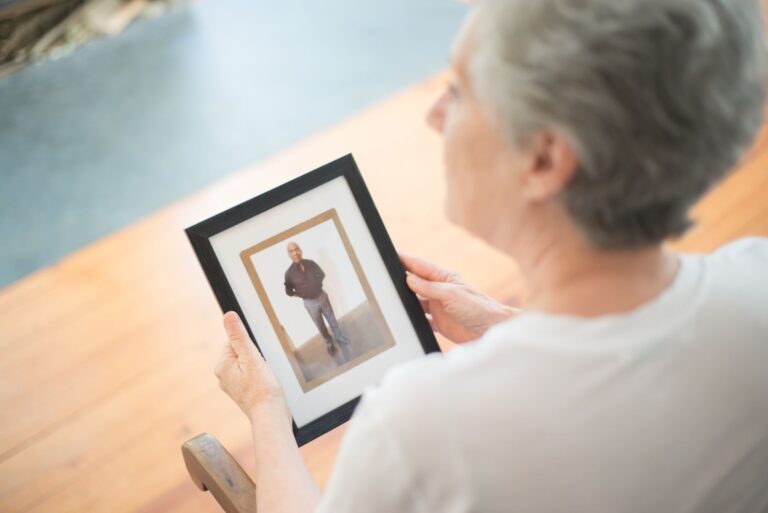
A practical tradeoff exists here: investing emotional energy into restoring recognition rarely works and often backfires—it can lead to frustration when the person cannot or will not remember. Reframing the visit as an opportunity to share a moment, listen to music together, or sit quietly together often produces better outcomes than drilling “Do you know who I am?” The trade is that you give up on one goal (being recognized as your specific role in their life) and pursue another (being a calm, consistent presence). Some families use photos, names written on objects, or consistent clothing or jewelry to serve as external memory cues. Others find that introducing themselves by a nickname or a specific family story works better than “I’m your son”—it can occasionally spark a different pathway to recognition or at least to engagement.
When Non-Recognition Leads to Safety Concerns
As family recognition fades, so may the person’s awareness of who “belongs” in their home and who doesn’t. Someone with advanced dementia might not recognize a caregiver who has worked with them for months, or might trust a stranger more readily than a family member because the stranger’s face triggers no competing or confusing emotions. This creates a documented safety risk: cases of people with dementia being exploited, wandering away with strangers, or becoming distressed when unfamiliar people approach them.
A significant limitation of late-stage dementia care is that you cannot rely on the person’s own judgment to identify threats or safe people. Full-time supervision, locked doors, ID bracelets, and GPS monitoring become necessary in ways that feel restrictive and sad but are often essential. Families also report the painful experience of being mistaken for a threat—a person with advanced dementia might become afraid of or aggressive toward a family member who, to them, is a stranger in their space. This is not personal rejection; it’s a neurological reality that demands patience and sometimes professional support.
The Role of Triggers Beyond Faces
While facial recognition is what most families worry about, recognition is actually multisensory. A person who does not recognize their spouse by sight might suddenly become present when they hear their spouse’s laugh, smell their cologne, or feel their touch. These sensory memories are encoded differently than visual identification and often persist longer.
One family reported that their mother, who had not spoken to or recognized anyone in weeks, suddenly looked directly at her daughter when a particular Aretha Franklin song played—the one that had played at their family reunions for decades. The moment was temporary; she did not maintain the recognition once the song ended. But it demonstrates that identity and connection don’t entirely disappear; they sometimes just live in different parts of the brain, accessible through different doors.
What Non-Recognition Means for Long-Term Planning
Families who receive a dementia diagnosis should understand non-recognition as a likely endpoint, though the timing is unpredictable. This knowledge can inform decisions about living arrangements, the hiring of professional caregivers, the frequency of visits, and even the timing of advance care planning conversations.
Having a healthcare proxy or power of attorney in place before someone reaches a stage where they cannot participate in major decisions is critical—and by the time non-recognition is established, most people are no longer able to engage meaningfully in those conversations. Some families find that accepting non-recognition as inevitable actually reduces anxiety about the decline and allows them to focus on quality-of-life issues: pain management, comfort, the presence of familiar objects and people, and the maintenance of dignity. Others describe the time after recognition is lost as paradoxically easier in some ways—the pressure to “get through” to someone who remembers is gone, and what remains is simply the work of being present, which is perhaps what was most important all along.
Frequently Asked Questions
If my parent doesn’t recognize me, does that mean the dementia is in the late stage?
Not necessarily. Non-recognition can begin in moderate dementia and vary day to day. Some people experience it years into the disease; others reach late stage while still maintaining some recognition. Consult with their doctor about where they fall on the cognitive decline scale.
Can anything bring back family recognition once it’s lost?
Cognitive recognition rarely returns once significantly lost, but multisensory triggers—music, scent, touch—can sometimes activate emotional memory or temporary moments of connection. These are not the same as restored recognition, but they matter.
Should I keep visiting if my loved one doesn’t recognize me?
Yes. Research shows that people with dementia benefit from the emotional presence and tone of voice of familiar people, even without cognitive recognition. Your calm presence may reduce anxiety or agitation, and you are honoring your relationship.
How do I tell my loved one who I am if they always ask?
Avoid repeating explanations that frustrate both of you. Instead, introduce yourself by role or feeling (“I’m someone who’s here to keep you company”) or use external cues like photos or names. This reduces cognitive demand and often works better.
Is non-recognition a sign of pain or distress in dementia?
Not necessarily. Someone may fail to recognize you while being quite content. However, if they become agitated, fearful, or hostile when you approach, consult their doctor—they may be experiencing pain, infection, or medication side effects that masquerade as behavioral changes.
Can a person with advanced dementia still have good quality of life without recognizing family?
Yes. Quality of life in late dementia depends more on comfort, freedom from pain, and consistent, gentle care than on cognitive recognition. Many families report their loved one remains peaceful and responsive to kindness, even without memory.