Blue light—the short-wavelength light emitted by screens, overhead LEDs, and natural daylight—disrupts sleep in dementia patients far more severely than it does in cognitively healthy people. This happens because dementia damages the brain regions that regulate circadian rhythms, the internal 24-hour clock that coordinates sleep-wake cycles. A person with mild cognitive impairment or Alzheimer’s disease may experience fragmented sleep, early morning waking, or extreme nighttime agitation even in a dimly lit room, while a healthy adult might sleep through similar lighting conditions without trouble. The relationship between blue light and sleep disruption in dementia is direct and measurable.
Blue light signals the brain to suppress melatonin—the hormone that makes us sleepy—by activating photosensitive cells in the retina called intrinsically photosensitive retinal ganglion cells (ipRGCs). In older adults without dementia, this system remains relatively intact: exposure to evening blue light delays sleep slightly, but the body compensates. In dementia, this compensation fails. Evening screen use, bright overhead lighting, or even unshaded windows can trigger hours of wakefulness and behavioral disturbance, and the person cannot easily return to sleep once the light exposure ends.
Table of Contents
- How Does Blue Light Trigger Sleep Problems Differently in Dementia?
- Why Standard Sleep Advice Fails for Dementia Patients
- Circadian Rhythm Disruption and Behavioral Changes
- Practical Lighting Changes That Actually Reduce Sleep Disruption
- Screens, Tablets, and the Myth of Protective Eyewear
- Medical Monitoring and Sleep Assessment
- Caregiver Sleep Loss and the Cascading Impact on Care Quality
How Does Blue Light Trigger Sleep Problems Differently in Dementia?
In dementia, the suprachiasmatic nucleus—the brain‘s master clock—degenerates, especially in advanced Alzheimer’s disease and Lewy body dementia. This cluster of nerve cells normally receives light information and maintains a steady rhythm; without it, the brain loses its ability to consolidate sleep into a continuous nighttime block. Blue light, which normally just shifts the timing of sleep, becomes a direct stimulant.
A study of nursing home residents with moderate-to-advanced dementia found that those exposed to bright light during evening hours showed a threefold increase in nighttime waking episodes compared to those in dimmed environments, and they stayed awake an average of 2 hours longer per night. The damage is not uniform across dementia types. Frontotemporal dementia and Lewy body dementia often produce more severe circadian disruption than Alzheimer’s disease, because they damage the brain’s internal timekeeping circuits earlier and more aggressively. A caregiver might notice that a family member with Lewy body dementia becomes actively confused and agitated when exposed to evening light, whereas someone with Alzheimer’s might simply fall asleep later and wake earlier. The key difference is that blue light acts as a persistent arousal trigger in dementia, not merely a sleep-timing shift.
Why Standard Sleep Advice Fails for Dementia Patients
Conventional sleep hygiene—”avoid screens two hours before bed”—rarely works for dementia patients, and attempting to enforce it can create conflict. The problem is that people with dementia often have no awareness of time; they do not understand that it is “bedtime” or recognize that screens are the source of their wakefulness. A caregiver might remove a tablet at 8 PM to protect sleep, but the patient becomes distressed and confused, demanding the device back or becoming combative. Meanwhile, overhead ceiling lights or even ambient light from a hallway can trigger equal disruption.
A major limitation of blue-light reduction strategies is that they only address one component of a much larger problem. Dementia patients often experience disrupted sleep regardless of lighting conditions, due to pain, medication side effects, urinary frequency, or architectural brain changes. Turning off screens helps in some cases but fails completely in others. A caregiver who reads that “blue light causes sleep problems in dementia” and then turns off all evening lights might see no improvement, leading to frustration and abandonment of the strategy. The more effective approach requires a medical evaluation to rule out other causes: sleep apnea, restless leg syndrome, medication timing, and UTI or delirium from other sources.
Circadian Rhythm Disruption and Behavioral Changes
As dementia progresses, the sleep-wake cycle often inverts: the patient sleeps during the day and wakes at night in a pattern called sundowning. Blue light exposure intensifies this reversal. Morning light exposure—which should reinforce wakefulness during the day—loses its effect, while evening light, which should signal sleep, becomes stimulating. An older adult with middle-stage Alzheimer’s may sleep from 2 PM to 6 PM (during late afternoon light) and then be wide awake from 10 PM to 3 AM, agitated and confused. Families often interpret this as “the disease” without recognizing that lighting choices worsen it.
The behavioral fallout extends beyond the bedroom. Nighttime wakefulness in dementia correlates strongly with daytime aggression, wandering, and accusations. A person who has been awake from midnight to dawn, in darkness and confusion, often becomes hostile when a caregiver appears in the morning. Sleep deprivation from circadian disruption also accelerates cognitive decline; studies show that dementia patients with the most fragmented sleep-wake cycles lose cognitive function 1.5 times faster than those with even slightly better sleep consolidation. This makes blue-light management not optional but part of the disease management plan.
Practical Lighting Changes That Actually Reduce Sleep Disruption
Controlling blue light in a dementia patient’s environment requires specificity, not just general dimming. The most effective approach is to eliminate blue light in the 2-3 hours before bedtime (or before the desired sleep time) and increase exposure to bright, blue-enriched light in the morning. This means replacing standard overhead LEDs—which emit strong blue peaks—with warm-white bulbs (2700K or lower) in evening areas, and using bright cool-white light (5000K or higher) in morning spaces or during breakfast. A family that switches from cool-white LEDs in the bedroom to warm Edison bulbs often sees improvement in sleep onset within 1-2 weeks.
A practical tradeoff: warmer lights are dimmer and less energizing, which can slow daytime activity and engagement if used all day. The solution is selective timing: warm lights in the bedroom and bathrooms during evening and night, but normal or bright cool light in living areas during daytime. Many families install separate circuits or smart bulbs so they can shift lighting without manual bulb changes. However, this requires reliable electricity and technical setup; in care facilities with limited budgets or in-home settings without electrical flexibility, the intervention is harder to implement. Caregiver education is also critical—if a family member leaves on overhead lights or the caregiver fails to dim lights before bedtime, the lighting strategy collapses.
Screens, Tablets, and the Myth of Protective Eyewear
Blue-light filtering glasses (or “gaming glasses”) are heavily marketed for dementia care but do not address the core problem. These lenses block roughly 50–90% of blue light, depending on the brand, but in dementia, the issue is not just the wavelength of light—it is the intensity, timing, and patient’s inability to self-regulate screen time. A person with dementia holding a bright tablet at 9 PM will still be aroused by the light even through blue-blocking lenses, because the total illumination level remains high. Furthermore, asking a person with cognitive decline to keep glasses on consistently is impractical; they are easily removed, lost, or forgotten.
A major warning: do not rely on blue-light glasses as a substitute for environmental control. If a dementia patient is using a screen in a dark room while wearing blue blockers, they are still getting intense visible light and the arousal effect. The research that supports blue-light glasses shows small effects in healthy adults with high screen exposure; it does not show clinically meaningful improvements in dementia patients with fragmented sleep. The most useful intervention is removing or covering screens during evening hours—not filtering them—and redirecting the person to low-light activities like listening to music, reading large-print books under warm light, or quiet conversation.
Medical Monitoring and Sleep Assessment
Before assuming blue light is the culprit, a doctor should evaluate the dementia patient’s sleep pattern with objective data. Wearable devices like actigraphy watches (which detect movement and infer sleep-wake status) can reveal whether sleep is truly fragmented or whether the patient is simply quiet but awake in bed. A caregiver may report “he was up all night,” but an actigraph might show he slept 6 hours with frequent brief arousals—a pattern suggesting sleep apnea or medication-induced restlessness rather than pure light-triggered insomnia.
This distinction matters because the treatment differs: sleep apnea requires a CPAP or dental device, while medication timing adjustment might solve medication-related wakefulness. Sleep studies (polysomnography) in dementia patients are underused, partly because they are hard to arrange for someone who is confused and may not tolerate the monitor leads. However, for patients with severe or worsening sleep disruption despite environmental changes, a study is worth pursuing, because it can identify treatable conditions like REM sleep behavior disorder (common in Lewy body dementia, sometimes dangerous) or periodic breathing that exacerbate blue-light sensitivity.
Caregiver Sleep Loss and the Cascading Impact on Care Quality
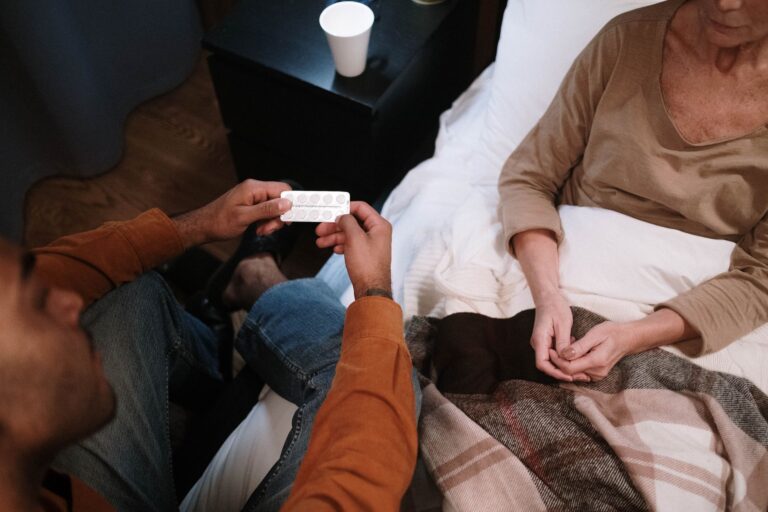
A dementia patient’s disrupted sleep directly damages the caregiver’s sleep, often more than it damages the patient’s. A family member providing nighttime care for someone who wakes repeatedly may get only 3-4 fragmented hours per night over weeks or months. This caregiver sleep loss increases depression, reduces patience, and impairs decision-making—ironically, making it harder to implement consistent lighting strategies or other care interventions.
A caregiver who is exhausted is more likely to leave lights on out of convenience, skip morning bright-light exposure, or resort to sedating medications rather than environmental adjustments. Studies of family caregivers of dementia patients show that 50–70% experience clinically significant sleep disturbance, and many report that the disruption lasted years, even after admission to a care facility. This has a direct economic impact: exhausted, unwell caregivers miss work or reduce hours, incurring lost income that often exceeds the cost of professional care alternatives. Recognizing blue-light management not just as a dementia treatment but as a caregiver support strategy changes the priority: controlling lighting is as much about protecting the person providing care as it is about the patient’s sleep itself.
- —