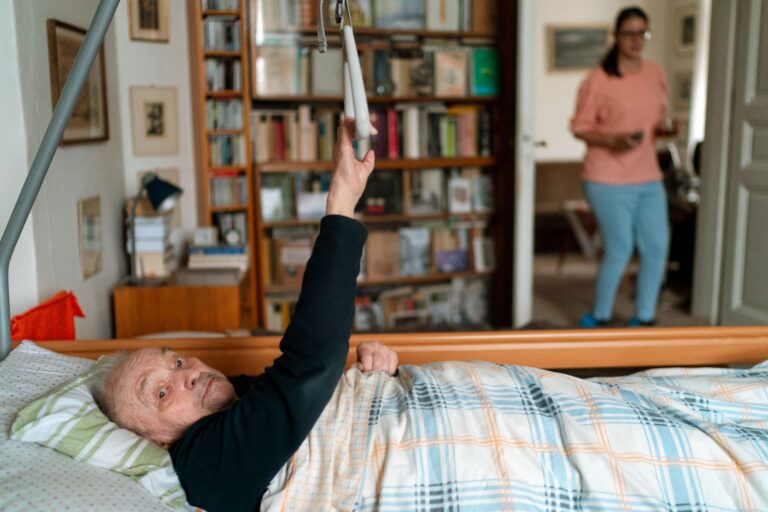
Vision changes in people with Alzheimer’s disease create a dangerous intersection of two separate deficits—failing eyesight combined with declining judgment and memory. When someone in the early or middle stage of Alzheimer’s develops cataracts, macular degeneration, or depth perception problems, their ability to navigate safely, recognize hazards, or perform basic tasks like taking medication becomes compromised in ways that are often not obvious to family members. A person might walk through a darkened hallway and misjudge the height of a step because the combination of reduced vision and cognitive decline impairs their ability to adapt to the spatial change, increasing their immediate risk of falling.
The relationship between vision loss and Alzheimer’s safety is not simply additive—it multiplies the danger. A healthy older adult with cataracts might squint or move to better lighting. A person with Alzheimer’s and cataracts may not recognize what’s wrong, may forget they just walked through that hallway, or may attempt the same task multiple times without learning from a near-miss. The safety implications extend beyond falls to include medication mix-ups, disorientation in familiar places, and inability to use assistive devices that depend on clear vision.
Table of Contents
- WHAT VISION CHANGES OCCUR ALONGSIDE ALZHEIMER’S?
- HOW VISION LOSS COMPOUNDS FALL RISK IN ALZHEIMER’S
- MEDICATION ERRORS AND VISION IN ALZHEIMER’S
- ENVIRONMENTAL ADAPTATIONS FOR VISION AND COGNITION CHALLENGES
- DRIVING SAFETY WITH DECLINING VISION AND COGNITION
- COORDINATION BETWEEN EYE CARE AND NEUROLOGY
- VISION SCREENING AND REALISTIC EXPECTATIONS IN ALZHEIMER’S
- Frequently Asked Questions
WHAT VISION CHANGES OCCUR ALONGSIDE ALZHEIMER’S?
Alzheimer’s disease itself can affect vision through changes in the brain regions that process visual information, separate from age-related eye diseases. Many people with Alzheimer’s also develop common eye conditions like cataracts, age-related macular degeneration (AMD), and presbyopia, making it difficult to isolate which vision loss stems from brain changes versus eye problems. The result is vision that becomes unreliable—sometimes worse in low light, sometimes missing peripheral motion, sometimes unable to distinguish objects against similar backgrounds.
Depth perception is frequently compromised, making stairs and curbs feel ambiguous, and color perception can fade, so important visual cues—like the red handle on a cabinet, or a white cup on a white tablecloth—blend together. A person might see an object but not comprehend its distance or size, reaching for something they perceive as within arm’s reach but is actually across the room. This mismatch between what the eyes see and what the brain interprets as distance and dimension is a leading cause of falls in Alzheimer’s care settings.
HOW VISION LOSS COMPOUNDS FALL RISK IN ALZHEIMER’S
Falls are one of the leading causes of injury and death in people with Alzheimer’s disease, and poor vision is a major contributing factor. The bathroom is the single most dangerous room in a home for someone with Alzheimer’s and vision loss—wet surfaces reduce contrast, lighting is often inadequate, and the combination of impaired depth perception and memory loss creates a trap. A person may not remember that the bathroom floor is slippery, may misperceive the location of the toilet or bathtub, and may have no way to mentally prepare for the hazard. Stairs present a similar hazard.
Even with good lighting and contrast, someone with reduced depth perception and Alzheimer’s cannot reliably judge step height or the location of the edge. They may miss a step not because they cannot see it, but because their brain is not processing the visual information correctly. A significant limitation of many fall-prevention interventions is that they assume a person can see, remember, and use safety equipment like grab bars or adapted clothing—assumptions that often fail in moderate to advanced Alzheimer’s. No amount of good lighting will help if the person also cannot remember that they are at risk on the stairs.
MEDICATION ERRORS AND VISION IN ALZHEIMER’S
Reading medication labels becomes impossible when vision deteriorates, and this is often the point where families first notice they have a serious problem on their hands. A person may not be able to see the difference between a white blood-pressure pill and a white pain reliever, may take two doses because they cannot read whether they already took one, or may skip a dose entirely because they cannot see which medication goes with which meal. The memory loss of Alzheimer’s is compounded by the inability to read—the person cannot rely on visual cues to guide them through a known routine.
One real scenario involves a woman in the middle stage of Alzheimer’s who developed cataracts and began taking her husband’s larger doses of medication by mistake. She could not see the difference in tablet size and did not remember the instructions she had learned years ago. Medication errors are uniquely dangerous because they often go undetected until symptoms of overdose or missed doses appear, and by then several dangerous doses may have been taken. Many families resort to a pill organizer with large, clearly labeled compartments, but this works only if someone is present to verify that the person takes the correct compartment at the correct time.
ENVIRONMENTAL ADAPTATIONS FOR VISION AND COGNITION CHALLENGES
The home environment must be adapted not only for vision clarity but also for cognitive support. This means high contrast between walls and trim, between stairs and handrails, and between kitchen items and their storage. A white toilet seat on white porcelain helps with visibility, but a person also needs clear signage with both words and images to remember which room is which or what belongs where. Removing clutter, ensuring consistent lighting throughout the home, and using motion-activated lights in hallways are standard adaptations, but they assume the person can see the light and remember how to navigate the space.
Practical tradeoffs arise when balancing independence with safety. A person may want to walk through the living room in the dark to get to the kitchen, but vision loss and Alzheimer’s make this genuinely unsafe. Some families install rails along major pathways or convert a bedroom to the main floor to avoid stairs, but these measures require recognizing the problem early and being willing to make significant home modifications. The contrast between “the person still looks fine and remembers where the kitchen is” and “we found them trying to leave through the sliding glass door” is the gap where vision loss and Alzheimer’s meet, and families often do not realize they are in this gap until a fall or wandering incident occurs.
DRIVING SAFETY WITH DECLINING VISION AND COGNITION
Driving is one of the most emotionally charged decisions in Alzheimer’s care because it represents independence, but it is also where vision and cognitive decline combine into an immediate public safety hazard. A person with Alzheimer’s and cataracts is not safe on the road, but the person themselves may not recognize the vision problem or may forget the diagnosis entirely, asking repeatedly why they cannot drive anymore. Standard vision tests like the eye chart measure only one aspect of driving safety and will not catch a person who can see the letter “E” but cannot judge the distance to an oncoming car or remember the route home.
The warning here is clear: vision tests conducted by an eye doctor are necessary but not sufficient for determining driving safety in Alzheimer’s. A comprehensive driving evaluation by an occupational therapist trained in dementia care is the appropriate step once Alzheimer’s is diagnosed, regardless of vision test results. Waiting for a vision problem to become obvious, or relying on family members to notice changes, has already cost lives. Many states have mandated physician reporting of Alzheimer’s diagnosis for driving safety reasons, and this requirement exists because the combination of vision loss and cognitive decline is too dangerous to manage informally.
COORDINATION BETWEEN EYE CARE AND NEUROLOGY
An ophthalmologist or optometrist who does not know that a patient has Alzheimer’s may miss the cognitive contribution to vision-related safety problems and may recommend interventions like cataract surgery without considering whether the person is safe for surgery or can manage post-operative recovery. Similarly, a neurologist managing Alzheimer’s may not specifically ask about vision changes and may not realize that what looks like increased confusion or falling is actually due to worsening cataracts. Families often must explicitly tell both specialists about both diagnoses and sometimes must advocate for the vision care to be optimized because it directly affects safety and function.
A specific example: a man had cataract surgery done at his request, but the surgery was followed by days of confusion because he could suddenly see his environment clearly again, and his Alzheimer’s brain could not make sense of the change. The hospital staff attributed the confusion to normal post-operative delirium, but it actually reflected the disconnect between his eyes and his brain’s ability to interpret what he was seeing. Better coordination between the eye surgeon and the neurologist would have prepared the family for this possibility and allowed for proper post-operative support.
VISION SCREENING AND REALISTIC EXPECTATIONS IN ALZHEIMER’S
Vision screening becomes important as soon as Alzheimer’s is diagnosed, even if the person reports no eye problems, because changes may be subtle and because some people lose the ability to report symptoms accurately. An eye exam at that time creates a baseline and identifies any treatable conditions like cataracts or refractive errors that could be corrected before cognitive decline makes them harder to manage. However, a realistic expectation is that correcting vision will not solve all safety problems—it will help, but it will not restore the judgment or memory that Alzheimer’s has taken away.
Some vision interventions are not possible in Alzheimer’s. Contact lenses require careful hygiene and daily management that most people with Alzheimer’s cannot sustain. Complex eyeglass prescriptions may need simplification even if it means slightly blurred vision at a distance, because the person will no longer be able to manage bifocals or progressive lenses. The practical reality is that vision care in Alzheimer’s becomes less about achieving perfect sight and more about maximizing safety and maintaining basic function with the tools and support that a person can realistically use given their cognitive state.
- —
Frequently Asked Questions
Can cataract surgery help someone with Alzheimer’s?
Cataract surgery can improve vision and may help with safety, but it is only one part of managing vision-related risks in Alzheimer’s. The person must be medically stable enough for surgery, able to follow post-operative care instructions (often impossible in moderate or advanced Alzheimer’s), and the improvement in vision will not restore judgment or memory loss. Surgery may be worth doing in early Alzheimer’s, but the risks increase significantly as cognition declines.
How do I know if my family member with Alzheimer’s is having vision problems?
Look for difficulty reading, moving cautiously in dim light, bumping into objects, reaching for things at the wrong distance, or avoiding familiar rooms. They may not report vision problems because they have forgotten they have a vision issue, or they may not realize something is wrong. An eye exam by an optometrist or ophthalmologist is the only way to identify specific vision problems, but a family observation of changed behavior often comes first.
Is it safe for someone with Alzheimer’s and vision loss to live alone?
Generally no, not in any stage beyond very early Alzheimer’s. The combination of cognitive decline and vision loss creates too much risk for falls, medication errors, wandering, and failure to recognize emergencies. Living alone would require either continuous monitoring (which is not realistic) or absence of both significant vision loss and significant cognitive decline—a narrow window that closes relatively quickly.
What can I do to prevent falls if my family member has Alzheimer’s and poor vision?
Adapt the home for high contrast, good lighting, and clear pathways. Use grab bars, remove clutter, ensure outdoor areas are well-lit, and keep a night light in bedrooms and bathrooms. However, adaptations only reduce risk; they do not eliminate it. The most important safety measure is supervision—someone who can watch for hazards and prevent dangerous activities is essential when both vision loss and Alzheimer’s are present.
Should I avoid cataract surgery because of Alzheimer’s?
Not automatically. Early-stage Alzheimer’s is often compatible with cataract surgery if the person’s medical health is good and if family members can manage post-operative recovery. Later stages of Alzheimer’s present greater risk because the person cannot follow instructions or report problems. Each situation requires discussion between the family, the eye surgeon, and the neurologist managing Alzheimer’s care.
Can prescription glasses or contacts fix the vision problems of Alzheimer’s?
Glasses can correct refractive errors (like nearsightedness) and may help with early cataracts, but they cannot fix macular degeneration or problems with how the Alzheimer’s brain processes visual information. As Alzheimer’s progresses, the person may forget to wear glasses, may not adjust to new prescriptions, or may lose the ability to benefit from them. Simplified, single-purpose glasses are often more practical than complex prescriptions. —