Reviewed by the Help Dementia Editorial Team — our editors review every article for accuracy against guidance from the National Institute on Aging, the Alzheimer’s Association, and peer-reviewed sources.
Federated learning sits at the center of this dementia and brain health question.
Federated learning is fundamentally reshaping how researchers approach Alzheimer’s disease detection and prediction while keeping patient data secure. Rather than centralizing sensitive health information from hospitals and clinics into a single database—where privacy risks multiply—federated learning allows multiple healthcare sites to collaborate on training artificial intelligence models while keeping patient data locked behind each institution’s firewalls. The data never leaves the hospital; instead, only the mathematical improvements to the predictive model are shared between sites. A landmark 2025 study demonstrated the power of this approach: researchers used federated learning across six healthcare sites in the OneFlorida+ consortium to predict progression from mild cognitive impairment to Alzheimer’s disease, achieving a 6% improvement in predictive accuracy (measured by area under the receiver operating characteristic curve) compared to models trained at individual sites alone.
This shift matters profoundly for dementia research because Alzheimer’s progression is unpredictable and highly individual. The ability to train more sophisticated models across larger, more diverse patient populations directly improves the chances of catching early signs of cognitive decline—the window when intervention may still alter disease trajectory. Yet traditional research has been hampered by privacy laws, institutional barriers, and understandable patient concerns about data security. Federated learning solves this tension. It enables the kind of large-scale collaboration that fuels medical breakthroughs while honoring the fundamental right to privacy.
Table of Contents
- How Does Federated Learning Improve Alzheimer’s Prediction?
- Privacy Mechanisms That Protect Patient Data at Every Step
- Real-World Applications Emerging Across Clinical Settings
- Why Traditional Centralized Data Sharing Cannot Meet Modern Needs
- Data Heterogeneity and the Challenge of Learning Across Diverse Populations
- Advanced Encryption and Secure Multi-Party Computation
- The Future of Federated Learning in Brain Health Research
- Conclusion
How Does Federated Learning Improve Alzheimer’s Prediction?
Federated learning uses a simple but elegant principle: bring the algorithm to the data, not the data to the algorithm. In the OneFlorida+ study, researchers deployed the same Long Short-Term Memory (LSTM) neural network model to each participating healthcare site. Each site trained the model on its own electronic health records—patient demographics, lab results, cognitive assessments, medication history—without ever uploading those records to a central server. After local training, each site sent back only the updated model parameters (the mathematical weights that encode what the model learned). A central server then averaged these updates using federated averaging algorithms, creating a globally improved model that was sent back to each site for the next round of training.
The results were striking: the federated model predicted which patients would progress from mild cognitive impairment to Alzheimer’s disease significantly better than models trained in isolation. The 6% absolute improvement in AUC may sound modest in academic terms, but in clinical practice it translates to meaningful differences in sensitivity and specificity—fewer missed early-stage cases and fewer false alarms that lead to unnecessary interventions. The researchers also employed personalized federated learning, a technique that allows each site’s model to retain some local specialization while still benefiting from global knowledge. This is crucial because patient populations vary by geography: demographic composition, healthcare practices, and disease prevalence differ between Miami and Milwaukee, yet the underlying biology of Alzheimer’s progression is universal. The LSTM architecture was chosen for good reason: these neural networks excel at learning patterns in sequential data, which is what electronic health records are—a timeline of encounters, tests, and clinical notes stretching back months or years. This temporal dimension is essential for predicting disease progression, since Alzheimer’s unfolds gradually and the rate of decline varies enormously between individuals.

Privacy Mechanisms That Protect Patient Data at Every Step
Federated learning provides a first layer of privacy protection simply by design: patient records stay local. But researchers have layered additional safeguards on top to prevent even the model parameters from leaking sensitive information. One powerful approach is differential privacy, a mathematical framework that adds precisely calibrated noise to data or model updates, making it mathematically impossible to reverse-engineer individual patients’ information from the shared model. Recent 2025 research integrates differential privacy with federated learning for Alzheimer’s detection, creating a dual-layer protection system. Another approach is homomorphic encryption, which allows computation to occur on encrypted data without ever decrypting it.
Imagine a locked safe that can perform mathematical operations while still locked: neural network parameters are encrypted before transmission, and the global model is computed entirely under fully homomorphic encryption in secure federated learning architectures. The downside is computational cost—encrypted computation is substantially slower than working with unencrypted data, which can make real-time model updates challenging. An empirical analysis of privacy mechanisms found that homomorphic encryption and secure multi-party computation significantly outperform differential privacy in achieving equitable outcomes when training data is skewed across sites (a common problem in federated healthcare systems where some sites have more complete records than others). A cutting-edge 2025 framework takes this further by integrating federated learning with quantum-inspired encryption and quantum key distribution for secure dementia classification. While quantum computing remains largely theoretical for most applications, quantum-resistant encryption is increasingly relevant as threats evolve. The limitation here is maturity: these approaches are research-grade, not yet deployed widely in clinical settings, and their computational overhead is not yet clear at scale.
Real-World Applications Emerging Across Clinical Settings
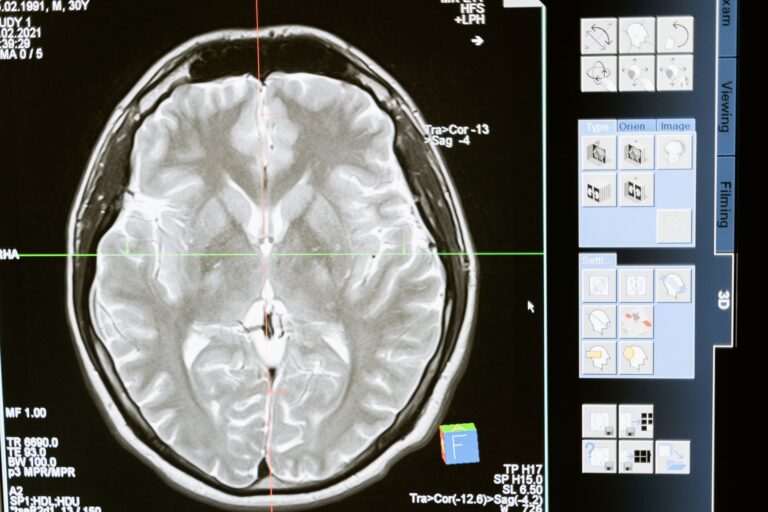
Beyond electronic health record data, researchers are deploying federated learning across multiple clinical modalities simultaneously. A 2025 study integrated medical imaging (structural MRI scans) and demographic data using federated learning frameworks across hospital settings, creating multi-modal detection systems that maintain data privacy and security while combining complementary sources of diagnostic information. MRI-based detection systems developed through federated learning can identify structural brain changes characteristic of Alzheimer’s disease—hippocampal atrophy, ventricular enlargement, cortical thinning—without requiring any institution to centralize its imaging archives. Speech offers a surprising alternative diagnostic signal.
A 2025 federated learning application detected cognitive impairment from voice recordings, exploiting subtle changes in speech patterns that emerge early in dementia: slower speech rate, reduced vocabulary diversity, increased pausing and repetition. The advantage of speech-based detection is that it requires minimal equipment—patients can provide samples via telephone or video—yet captures neurologically meaningful markers of cognitive change. When deployed in a federated framework, speech analysis systems can learn from thousands of patients across multiple sites without any site ever transmitting actual voice recordings. These multi-modal, federated approaches matter because no single diagnostic signal is sufficient for early Alzheimer’s detection. Combining structural imaging, cognitive testing, speech analysis, and medical history creates a more robust, resilient system than any single measure alone.

Why Traditional Centralized Data Sharing Cannot Meet Modern Needs
The historical approach to multi-site research was straightforward: send patient data to a central coordinating center. This worked for smaller studies but breaks down at scale for three reasons. First, privacy risk compounds with each additional institution contributing data; the larger the central database, the more attractive a target it becomes for hackers or bad actors. Second, regulations have tightened: HIPAA, GDPR, and emerging digital privacy laws severely restrict how patient data can be moved and stored, creating legal barriers that federated learning elegantly sidesteps. Third, patient trust erodes when their data must leave their local healthcare system.
In surveys, patients consistently express greater comfort with research where data remains at their own hospital. Federated learning trades some computational complexity for these gains in privacy, compliance, and trust. Instead of a single model training run, the system requires iterative communication rounds between sites and a central server, which takes longer and demands more sophisticated coordination. But the payoff is substantial: researchers can now conduct studies involving tens of thousands of patients across dozens of institutions without creating a massive, vulnerable central database. The OneFlorida+ consortium exemplifies this tradeoff—slower training, but access to far richer and more representative data than any single health system could assemble alone.
Data Heterogeneity and the Challenge of Learning Across Diverse Populations
One of federated learning’s trickiest problems is that healthcare data is deeply heterogeneous. Different hospital systems use different electronic health record platforms, code diagnoses differently, order tests at different frequencies, and serve populations with different demographics and disease prevalences. A patient population in an urban safety-net hospital has different characteristics than patients at a suburban specialty clinic, yet a global model must learn from both. This heterogeneity can degrade model performance if not handled carefully—a model trained mainly on data from younger, healthier populations may perform poorly when applied to older, sicker patients.
The personalized federated learning approaches used in recent Alzheimer’s studies partially address this by allowing models to diverge slightly at each site while still maintaining global synchronization. However, this creates new challenges: how much local divergence is acceptable before the models become incompatible? How do you balance global generalization with local specialization? These questions remain partly open. Researchers must also contend with the fact that missing data patterns vary across sites—one hospital may systematically lack cognitive test scores in certain patient subgroups, while another may have incomplete medication records. Training robust models under these conditions requires ongoing methodological innovation.

Advanced Encryption and Secure Multi-Party Computation
Beyond differential privacy and homomorphic encryption, researchers are exploring secure multi-party computation (SMC), a cryptographic technique that allows multiple parties to compute a function together without any party revealing its private input. In the context of federated Alzheimer’s research, SMC enables sites to collectively compute a global model update without a central server ever seeing the individual site models. This eliminates a potential weak point in traditional federated learning architectures.
Recent empirical comparisons show that both homomorphic encryption and secure multi-party computation achieve better fairness outcomes than differential privacy when data is skewed across sites—meaning these approaches better prevent the global model from being inadvertently optimized for the largest or most represented institutions at the expense of smaller or minority populations. The trade-off is computational cost and implementation complexity. SMC and homomorphic encryption require sophisticated infrastructure that many research institutions have not yet deployed, whereas differential privacy can be implemented relatively straightforwardly in existing machine learning frameworks.
The Future of Federated Learning in Brain Health Research
The trajectory is clear: federated learning will become standard infrastructure for multi-site dementia research over the next 5-10 years. Early successes like the OneFlorida+ consortium study demonstrate both technical feasibility and clinical utility. Upcoming challenges are primarily organizational and regulatory rather than technical: establishing standards for model interoperability, developing governance frameworks that all participating institutions can accept, training data scientists in federated learning methods, and updating institutional review board policies to accommodate privacy-preserving research paradigms.
Emerging frameworks will likely integrate additional data sources—genomic information, blood biomarkers like phosphorylated tau and amyloid-beta, wearable sensor data—all within federated architectures. The next frontier is federated learning for personalized treatment trials, where individual patients’ responses to interventions inform real-time treatment decisions without centralizing sensitive data. For dementia research specifically, this could accelerate the identification of disease subtypes and enable precision medicine approaches tailored to individual biology rather than population averages.
Conclusion
Federated learning represents a fundamental paradigm shift in how large-scale dementia research can proceed. By enabling collaboration across healthcare sites without centralizing sensitive patient data, it solves a longstanding tension between research scale and privacy protection.
The 2025 evidence is compelling: federated models trained across multiple sites substantially outperform isolated institutional models at predicting Alzheimer’s progression, while incorporating layered privacy protections through differential privacy, homomorphic encryption, and secure multi-party computation. For patients, families, and caregivers affected by dementia, the implication is hopeful: research can now move faster and involve more people because institutions can participate without the legal and privacy barriers that previously constrained collaboration. If you are engaged in dementia research or care, understanding federated learning’s capabilities—and limitations—positions you to make informed decisions about participation in future multi-site studies and to advocate for privacy-preserving research practices in your own institution.
You Might Also Like
- Generative AI Tools Accelerate Alzheimer’s Research Workflows
- Combination Drug Approaches Studied for Enhanced Alzheimer’s Efficacy
- Circulating Biomarker Research Advances Alzheimer’s Disease Monitoring
For more, see Alzheimer’s Association.