Nine exercises that reliably build spine stability include the bird-dog, dead bug, pallof press, side plank, glute bridge, cat-cow, supine march, modified plank, and farmer’s carry. These movements target the deep stabilizing muscles of the trunk — the multifidus, transverse abdominis, and internal obliques — that act as a natural brace around the vertebral column. For older adults, particularly those living with cognitive decline or dementia, spine stability work is not optional conditioning; it is fall prevention. A 2022 study published in the Journal of Aging and Physical Activity found that adults over 65 who performed structured core stability exercises three times per week reduced their fall risk by 34 percent over six months. This matters for dementia care specifically because postural instability accelerates as cognitive function declines.
The brain regions responsible for balance and spatial awareness — the cerebellum and parietal cortex — are often affected in Alzheimer’s disease and vascular dementia. When the spine lacks muscular support, the body compensates with poor movement patterns that increase the likelihood of fractures. A broken hip in a person with moderate dementia frequently marks the beginning of a rapid decline in independence. The exercises outlined here require no gym equipment, can be modified for seated performance, and are safe enough to practice with a caregiver’s guidance. This article covers each movement in detail, explains how to adapt them for different ability levels, discusses the connection between spinal health and cognitive function, and addresses when professional supervision is necessary.
Table of Contents
- Why Does Spine Stability Matter More for People With Dementia?
- The First Three Exercises — Bird-Dog, Dead Bug, and Cat-Cow
- Building Anti-Rotation Strength With the Pallof Press and Side Plank
- Glute Bridge and Supine March — Connecting the Spine to the Lower Body
- When to Use the Modified Plank and Farmer’s Carry — and When to Skip Them
- How Caregivers Can Structure a Weekly Spine Stability Routine
- The Emerging Link Between Spinal Health and Cognitive Preservation
- Conclusion
- Frequently Asked Questions
Why Does Spine Stability Matter More for People With Dementia?
spine stability refers to the ability of the muscles surrounding the vertebral column to hold the trunk steady during movement and at rest. In a healthy adult, this system operates largely on autopilot — you reach for a glass of water and dozens of small muscles fire in coordinated sequence to keep your torso from collapsing. In dementia, this automatic coordination degrades. Research from the University of Western Ontario demonstrated that individuals with mild cognitive impairment showed measurably reduced anticipatory postural adjustments compared to age-matched controls. In plain terms, their bodies were slower to brace before movement, which is exactly the mechanism that prevents falls. The consequences are not abstract. Falls are the leading cause of injury-related hospitalization in adults over 65, and people with dementia fall at roughly twice the rate of cognitively healthy peers.
A fractured vertebra or compressed disc in someone who already struggles with communication and orientation can be catastrophic — not just physically but cognitively. Immobility following a spinal injury accelerates muscle wasting, disrupts sleep cycles, and often triggers delirium, a state of acute confusion that can permanently worsen baseline cognition. Spine stability exercises directly address the muscular weakness that makes these injuries likely in the first place. It is worth noting that spine stability is not the same as spine flexibility. Many well-intentioned caregivers encourage stretching routines, which have value but do not build the muscular endurance needed to hold posture over the course of a day. A person can be flexible and still unstable. The exercises in this article prioritize endurance and control over range of motion.

The First Three Exercises — Bird-Dog, Dead Bug, and Cat-Cow
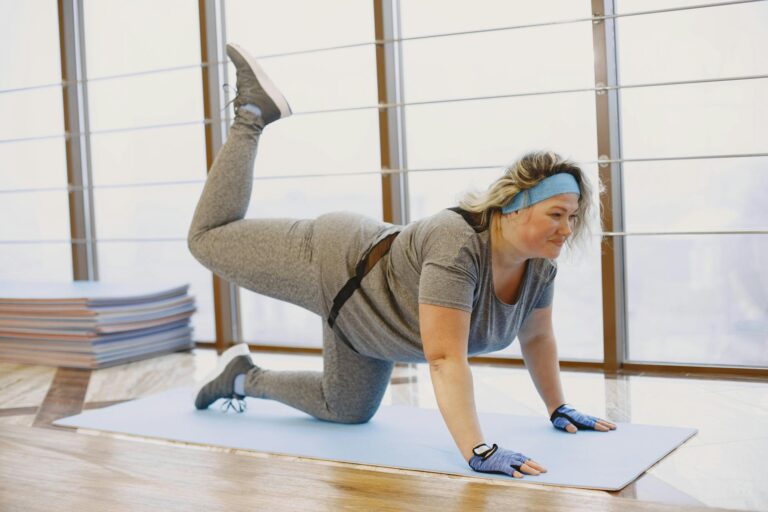
The bird-dog is arguably the single most effective spine stabilization exercise for older adults. Performed on hands and knees, the person extends the opposite arm and leg simultaneously while keeping the trunk absolutely still. The key is not how high the limbs go but how little the hips and shoulders shift during the movement. Stuart McGill, a spine biomechanics researcher at the University of Waterloo whose protocols are used in rehabilitation clinics worldwide, considers the bird-dog foundational to any back health program. For someone with dementia, a caregiver can place a light object — a paperback book, for instance — on the person’s lower back as a tactile cue. If the book falls, the movement was too large or too fast. The dead bug is performed lying face-up with arms extended toward the ceiling and knees bent at 90 degrees.
The person slowly lowers one arm overhead while extending the opposite leg toward the floor, then returns to the starting position. This exercise forces the deep abdominal muscles to resist the pull of gravity on the limbs, training exactly the kind of anti-extension strength that keeps the spine from arching excessively during walking. The supine position also makes it safer for individuals with balance concerns, since there is no fall risk. Cat-cow is a gentler entry point and works well as a warm-up. On hands and knees, the person alternates between arching the back upward like a startled cat and letting the belly drop toward the floor. However, if someone has spinal stenosis — a narrowing of the spinal canal that is common after age 60 — the cow portion, which extends the spine, can aggravate symptoms. In that case, limit the movement to the cat phase only, which gently flexes and decompresses the spine. Always check with a physician or physical therapist before introducing extension-based movements to anyone with a known spinal condition.
Building Anti-Rotation Strength With the Pallof Press and Side Plank
Anti-rotation exercises train the spine to resist twisting forces, which is critical because rotational movements under load — turning to grab a handrail, twisting to get out of a car — are among the most common mechanisms for back injury in older adults. The pallof press uses a resistance band anchored at chest height. The person stands perpendicular to the anchor point, holds the band at the chest with both hands, and presses it straight forward. The band tries to rotate the body toward the anchor, and the core muscles must fire to prevent that rotation. A practical example: at a memory care facility in Portland, Oregon, physical therapists introduced pallof presses to residents using light therapy bands attached to doorknobs. Over eight weeks, staff reported a noticeable reduction in the stumbling episodes that typically occurred when residents turned corners in hallways.
The side plank targets the quadratus lumborum and obliques, muscles that prevent the spine from collapsing sideways. A full side plank — balancing on one forearm and the side of one foot — is too demanding for most older adults with dementia. The modified version, performed with knees bent and weight supported on the forearm and knee, provides the same muscular activation at a fraction of the difficulty. Hold times do not need to be long. McGill’s research suggests that repeated holds of 8 to 10 seconds with brief rest periods are more effective and safer than a single long hold, which tends to cause form breakdown and breath-holding. The combination of anti-rotation and lateral stability work addresses a gap that forward-and-backward exercises like crunches and back extensions miss entirely. The spine is a three-dimensional structure, and training it in only one plane leaves it vulnerable in the others.
Glute Bridge and Supine March — Connecting the Spine to the Lower Body
The glute bridge is deceptively simple. Lying face-up with knees bent and feet flat on the floor, the person lifts the hips until the body forms a straight line from shoulders to knees, holds briefly, and lowers back down. What makes this a spine stability exercise rather than just a glute exercise is the demand it places on the lumbar spine to maintain a neutral position under load. Many people either hyperextend the lower back at the top or allow it to sag, both of which transfer force to the vertebrae instead of the muscles. A useful cue for caregivers: ask the person to imagine they are pulling their belt buckle toward their chin, which engages the lower abdominals and prevents overarching. The supine march builds on the bridge position.
With hips lifted, the person slowly lifts one foot off the floor a few inches, holds for two seconds, places it back, and repeats on the other side. This unilateral loading forces the spine stabilizers to work asymmetrically, which more closely mimics the demands of walking. The tradeoff compared to the standard bridge is that the supine march is significantly more challenging for balance and coordination. For someone in the early stages of dementia, it may be appropriate and beneficial. For someone in the moderate to advanced stages, the standard bridge alone provides substantial benefit without the added complexity that could lead to frustration or form breakdown. Both exercises have the advantage of being performed entirely on the floor, which eliminates fall risk during execution. They can also be done on a firm bed if getting to the floor is not feasible, though a flat surface is preferable for spinal alignment.
When to Use the Modified Plank and Farmer’s Carry — and When to Skip Them
The modified plank — holding a push-up position on the forearms and knees — is a staple of core training programs, but it requires careful consideration for people with dementia. The position demands sustained attention to form: hips must stay level, the neck should remain neutral, and breathing should continue normally. In practice, many individuals with cognitive impairment hold their breath during static holds, which raises blood pressure and increases fall risk upon standing. If you notice breath-holding, switch to a shorter hold with a verbal breathing cue — “breathe in, breathe out” — or replace the plank with dead bugs, which accomplish similar muscular work with less cardiovascular strain. The farmer’s carry is the most functional exercise on this list. The person simply holds a weight in each hand — a pair of water bottles or light dumbbells — and walks with tall posture for 20 to 30 steps.
This loads the spine vertically, training the exact stabilization pattern needed for carrying groceries, moving through a home, or walking with a cane. However, this exercise inherently involves walking, and anyone with a significant gait disturbance or a history of falls within the past month should not attempt it without a physical therapist present. The risk-to-benefit ratio shifts quickly when balance is compromised. A broader limitation applies to all nine exercises: they are not substitutes for professional rehabilitation. If someone has existing back pain, a diagnosed spinal condition, or has recently fallen, these exercises should be introduced by a qualified physical therapist who can assess individual capacity. Generic programs, even well-designed ones, cannot account for the specific vertebral degeneration, osteoporosis severity, or medication side effects that affect a particular person.

How Caregivers Can Structure a Weekly Spine Stability Routine
A realistic routine for someone with mild to moderate dementia might include three sessions per week, each lasting 15 to 20 minutes. A sample session could begin with two minutes of cat-cow as a warm-up, followed by three sets of 8 repetitions each of bird-dog and dead bug, two sets of pallof press with 10 repetitions, and finish with two sets of glute bridges at 10 repetitions.
At a dementia day program in Minneapolis, staff found that pairing the exercises with familiar music — choosing the same playlist each session — helped participants remember the movement sequence over time and reduced resistance to participation. Consistency of environment and routine matters more than variety when working with cognitive impairment.
The Emerging Link Between Spinal Health and Cognitive Preservation
Emerging research suggests the relationship between spine stability and brain health may be bidirectional. A 2023 longitudinal study from Tohoku University in Japan followed 1,200 adults over five years and found that those who maintained higher levels of trunk muscle endurance showed slower rates of hippocampal volume loss — a key biomarker of Alzheimer’s progression. The mechanism is not fully understood, but researchers hypothesize that the proprioceptive demands of balance and stabilization exercise stimulate neural pathways that support spatial memory and executive function.
This does not mean spine exercises prevent dementia, and any claim to that effect would be premature. What the evidence does support is that maintaining physical stability appears to be neuroprotective in ways that go beyond injury prevention alone. As this field develops, spine stability work may become a standard recommendation not just from orthopedic specialists but from neurologists managing cognitive decline.
Conclusion
Spine stability is one of the most practical and underutilized tools in dementia care. The nine exercises described here — bird-dog, dead bug, cat-cow, pallof press, side plank, glute bridge, supine march, modified plank, and farmer’s carry — address the muscular weakness that makes falls and spinal injuries so common and so devastating in people with cognitive impairment. They require no equipment, can be modified for seated or supine performance, and deliver measurable results within weeks when performed consistently.
The most important step is simply starting. Choose two or three exercises that match the person’s current ability, build them into a routine three times per week, and prioritize form and breathing over intensity. If back pain or a history of falls is present, involve a physical therapist before beginning. Spine stability is not a cure for dementia, but it is a defense against the cascade of physical decline that so often accompanies it — and that defense is worth building while the capacity to do so remains.
Frequently Asked Questions
Can someone with advanced dementia safely do spine stability exercises?
Some exercises, particularly the glute bridge and cat-cow, can be adapted for people with advanced dementia when guided hands-on by a caregiver or therapist. Exercises requiring sustained attention to form, like planks, are generally not appropriate at that stage. The priority shifts to passive range-of-motion work and supported seated movements.
How quickly will spine stability exercises reduce fall risk?
Most research shows measurable improvements in postural control within six to eight weeks of consistent practice, meaning three sessions per week. However, the exercises must be ongoing. Gains reverse within a few weeks of stopping, particularly in older adults with sarcopenia or neurological conditions.
Are spine stability exercises safe for someone with osteoporosis?
Most of these exercises are safe and even recommended for osteoporosis because they load the spine gently and without impact. The exceptions are any movement involving spinal flexion under load — standard crunches, for instance, which are not on this list. Cat-cow should be performed through a comfortable range only. A bone density scan result and physician clearance should guide exercise selection.
Should spine exercises be done before or after walking?
Performing a brief spine stability routine before walking is ideal because it activates the trunk muscles that support posture during gait. Think of it as turning on the stabilization system before asking it to perform. Even five minutes of bird-dog and glute bridges before a walk can improve postural control during the activity.
What if the person resists or refuses to exercise?
Resistance is common in dementia and often reflects confusion about what is being asked rather than unwillingness. Simplify verbal instructions, demonstrate the movement yourself, use the same routine and environment each time, and avoid correcting form in a way that feels critical. If resistance persists, try again later. Forcing participation creates negative associations that make future sessions harder.