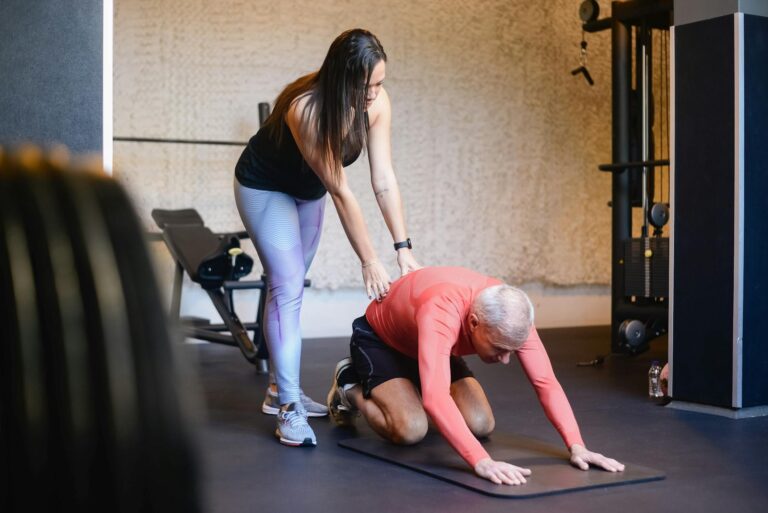
The eight most effective physical therapy exercises for strengthening the lumbar spine are the bird dog, plank, hip bridge, dead bug, supine isometric back extension, abdominal bracing, lumbar extension resistance work, and trunk coordination exercises. These aren’t arbitrary movements—clinical research shows that core stabilization exercises reduce low back pain by an average of 3.08 points on a standard pain scale compared to just 1.71 points with general physical therapy, producing effect sizes for pain relief and disability that range from moderate to large.
A person suffering from chronic lower back pain who performs a structured 8-week program of these exercises can expect meaningful, sustained improvement rather than temporary relief. This article explains each of the eight evidence-backed exercises, how they work at the muscle level, how long you need to do them to see results, and why spine strengthening is particularly important for maintaining independence and cognitive function as we age. We’ll cover the specific muscles each exercise targets, the research behind their effectiveness, and practical guidance on how to incorporate them into a sustainable routine.
Table of Contents
- What Happens When Your Lumbar Spine Weakens and Why These Exercises Work
- The Eight Core Strengthening Exercises and How Each One Works
- How Long You Need to Exercise for Lasting Results
- Why Core Stability Beats General Exercise for Spinal Pain
- Important Cautions and When These Exercises Might Not Be the Right Choice
- Why Spinal Strength Matters Beyond Pain Relief
- Building a Sustainable Practice and Moving Forward
- Conclusion
What Happens When Your Lumbar Spine Weakens and Why These Exercises Work
Your lumbar spine is a complex structure of bones, discs, ligaments, and muscles. The muscles that support this region—including the erector spinae, multifidus, quadratus lumborum, and abdominal muscles—act as shock absorbers and stability anchors. When these muscles weaken, the spine loses support, discs can slip, and pain develops. This is why eleven of fourteen clinical trials comparing exercise interventions to control treatment found that targeted exercise significantly outperformed doing nothing or receiving placebo treatment. Core stabilization exercises work by retraining these deep muscles to hold the spine in a neutral, protected position. Unlike general exercise, which builds overall fitness, core stabilization targets the specific muscles that prevent excess spinal movement.
Research published in major journals shows that programs emphasizing this approach produce greater pain reduction than traditional physical therapy approaches, with moderate-to-large effect sizes. The key difference is specificity: you’re not just moving; you’re training your deepest spinal muscles to do protective work. However, results depend heavily on consistency and duration. Short programs lasting two to four weeks may provide initial symptom relief but aren’t sufficient for long-term outcomes. Clinical guidelines recommend a minimum of four to six weeks, with optimal results appearing after eight to twelve weeks of regular practice. This matters for people with degenerative disc disease, arthritis, or chronic strain who need lasting improvement rather than temporary relief.

The Eight Core Strengthening Exercises and How Each One Works
The bird dog exercise stands as a foundational movement because it activates the erector spinae, back extensors, and gluteal muscles simultaneously—exactly the muscles that stabilize your spine when you stand or move. To perform it, you begin on hands and knees, extend your right arm forward while straightening your left leg backward, hold for a moment, then return to the starting position. Repeat on the opposite side. The bird dog is especially valuable because it trains coordination between your upper and lower back muscles, preventing the kind of asymmetrical weakness that leads to compensatory pain. The plank is deceptively simple but remarkably effective: you hold a push-up position while engaging your core, and this single isometric hold activates your back extensors, erector spinae, quadratus lumborum, and deep abdominal muscles. Unlike the bird dog, which involves movement, the plank creates sustained tension that builds endurance in these muscles. This matters because spinal stability isn’t just about strength; it’s about your muscles’ ability to maintain protective tension over time while you sit at a desk or stand in line. The hip bridge isolates the lower back extensors, erector spinae, gluteal muscles, and hamstrings. Lying on your back with knees bent and feet flat, you push through your heels to lift your hips toward the ceiling, creating a straight line from knees to shoulders. Hold, then lower slowly. This exercise is particularly valuable for people who spend hours sitting, because sitting inhibits glute activation, leaving your lower back to do all the work. The bridge reverses this pattern and reactivates the large muscles that should be carrying the load. The dead bug exercise involves lying on your back, raising your arms toward the ceiling, bending your knees to 90 degrees, and then slowly extending your right arm overhead while straightening your left leg—like doing the opposite of a sit-up. This motion activates the multifidus muscle, which is essential for spinal stabilization after injury or long periods of immobility.
Research on multifidus activation exercises shows they’re critical for preventing recurrent back pain and promoting healing in damaged discs. Supine isometric back extension involves lying on your stomach and tightening your back muscles without moving—essentially contracting your spinal extensors while remaining stationary. Studies show that supine isometric back extension combined with abdominal exercises led to greater pain reduction after just twenty days, demonstrating that even static holds produce measurable benefits. This is important for people in acute pain who cannot tolerate full-range movement. Abdominal bracing combines traditional core work with functional stability. Lying on your back with knees bent, you tighten your abdominal muscles as if bracing for a punch, then relax. Unlike sit-ups, bracing doesn’t involve spinal flexion, which can aggravate disc problems. This exercise is safer for people with degenerative conditions and more directly protective of your lumbar spine because it creates intra-abdominal pressure that supports the spine from the front. Lumbar extension resistance work involves strengthening your back muscles against resistance—either through resistance bands, light dumbbells, or specialized machines. Research published in Scientific Reports in 2025 found that lumbar extension resistance exercise significantly increases strength and decreases pain in chronic low back pain patients. This might involve lying face-down and lifting your upper body slightly, or using a machine at a physical therapy clinic where a therapist adjusts resistance to match your capacity. Trunk coordination exercises train the relationship between your back muscles, abdominals, and side muscles to move as an integrated unit. These might involve standing, rotating your trunk gently side to side, or reaching movements that require multiple muscle groups to stabilize your spine simultaneously. Clinical guidelines emphasize trunk coordination exercises for people with movement coordination impairments because they build the neuromuscular patterns you need for real-world activity.
How Long You Need to Exercise for Lasting Results
The research is clear: eight to twelve weeks of structured exercise produces highly effective, sustained pain relief and disability reduction. This doesn’t mean eight to twelve weeks of daily practice—it means a consistent program spanning that duration, typically three to four times weekly. During this window, your nervous system learns new movement patterns, your muscles develop endurance, and the protective effects become automatic rather than something you have to consciously think about. Minimum duration guidelines suggest four to six weeks before expecting meaningful improvement, but this is truly a floor, not a target.
Someone with advanced arthritis or chronic pain might need twelve weeks or longer to see durable change. The pattern is consistent across research: short programs provide temporary relief, but eight-to-twelve-week programs produce changes that persist months after the program ends. This matters because it means your investment of time compounds—you’re not paying for temporary relief; you’re building lasting capability. For people managing dementia-related mobility issues or cognitive decline, this timeline also offers a practical advantage: the exercises become automatic and don’t require remembering detailed instructions. After eight weeks of consistent practice, the movements become habitual, making them sustainable even if memory or attention span declines over time.

Why Core Stability Beats General Exercise for Spinal Pain
Generic exercise programs—the kind that tell you to just walk, swim, or do cardio—produce average pain reduction of about 1.71 points on a standard pain scale. Core stabilization exercises reduce pain by an average of 3.08 points, nearly twice as much. The difference comes down to targeting: your cardiovascular fitness doesn’t directly strengthen the specific muscles protecting your spine, but core stabilization exercises do exactly that, which is why research meta-analyses show effect sizes ranging from moderate to large compared to no treatment. This comparison matters because it means your time is better spent on structured spine-specific exercises than on hoping that general fitness will solve your back pain. Someone diagnosed with chronic low back pain or recovering from disc injury sees greater benefits from twenty minutes of purposeful core work three times weekly than from casually walking an hour daily.
This isn’t to say walking is bad—it’s just to say that if your goal is spinal pain reduction, core stabilization is more efficient. However, the comparison also reveals a limitation: core exercises work best when combined with basic activity. You can’t perform core exercises in isolation and expect full recovery if you’re otherwise sedentary. The exercises build capability; daily movement using that capability maintains it. Combining a consistent core strengthening program with general daily activity produces better outcomes than either approach alone.
Important Cautions and When These Exercises Might Not Be the Right Choice
While core stabilization exercises have moderate-to-large effect sizes for chronic low back pain, they may not be appropriate during acute injury. If you’ve just herniated a disc or suffered a spinal fracture, intense core exercise can worsen symptoms. During acute phases, gentler isometric work—like the supine back extension mentioned earlier—is safer, and you should progress to full strengthening exercises only as your acute pain subsides and a physical therapist gives clearance. Additionally, these exercises assume reasonable baseline mobility. Someone with severe spinal stenosis, advanced spondylolisthesis, or other structural problems might find certain movements impossible or aggravating.
The bird dog, for example, requires coordination that some people with severe neurological decline cannot manage. A physical therapist must assess your specific condition and modify exercises accordingly—these eight exercises are effective for the majority of people, but they’re not universally appropriate without professional assessment. Another limitation worth noting: exercise compliance drops significantly after the initial twelve weeks if people don’t build lasting habits. Research shows sustained benefit only when people continue some form of core maintenance work long-term. This means these exercises aren’t a one-time treatment but rather a skill you develop and maintain, similar to brushing your teeth or stretching. The initial eight-to-twelve-week intensive phase builds strength and establishes patterns, but ongoing lighter maintenance work preserves those benefits.

Why Spinal Strength Matters Beyond Pain Relief
Strengthening your lumbar spine reduces pain, but it also improves functional independence, balance, and your ability to lift, bend, and reach without fear of injury. For older adults or people managing cognitive decline, this translates to remaining capable of daily activities—dressing yourself, bathing, retrieving items from shelves—that directly affect quality of life and independence. A seventy-year-old who can safely bend to pick up a dropped item or lift a grandchild has preserved autonomy in a way that pain relief alone doesn’t capture.
Moreover, maintaining spinal stability involves trunk coordination and proprioceptive awareness—your sense of where your body is in space. These trunk coordination exercises improve that awareness, which reduces fall risk, another major factor in loss of independence. By strengthening your lumbar spine, you’re not just addressing pain; you’re preserving the physical capability that allows you to live the life you want.
Building a Sustainable Practice and Moving Forward
The research consensus is clear: core stabilization exercises, particularly those emphasizing multifidus activation and trunk coordination over eight to twelve weeks, produce significant pain relief and lasting improvement in spinal function. The eight exercises described above—bird dog, plank, hip bridge, dead bug, supine isometric back extension, abdominal bracing, lumbar extension resistance, and trunk coordination work—represent the most evidence-backed approaches available. Moving forward, the most important step is consistency.
One perfect workout followed by weeks of inactivity produces negligible benefit. Three sessions weekly of competently performed, purposeful core work produces sustained improvement. A physical therapist can initially assess your specific needs, teach proper form, and adjust intensity, but once you’ve learned the patterns, these exercises can be performed at home with minimal equipment. The eight-to-twelve-week intensive phase is the gateway to long-term spinal health and functional independence.
Conclusion
Physical therapy exercises that strengthen the lumbar spine work through targeted activation of specific muscles—the erector spinae, multifidus, quadratus lumborum, and abdominal muscles—that stabilize your spine during daily movement. The eight most effective exercises are the bird dog, plank, hip bridge, dead bug, supine isometric back extension, abdominal bracing, lumbar extension resistance work, and trunk coordination exercises.
Research consistently shows that eight-to-twelve-week programs of core stabilization exercise reduce pain nearly twice as much as general exercise and produce moderate-to-large improvements in both pain and disability. The pathway forward is straightforward: work with a physical therapist to ensure proper form, commit to a consistent program of three to four sessions weekly for at least eight to twelve weeks, and then maintain the benefits through ongoing lighter practice. This investment in spinal stability pays dividends in pain relief, functional independence, and the ability to engage fully in daily life regardless of age or cognitive status.