Eight physical therapy exercises come up again and again in clinical settings for lumbar spine strengthening: the pelvic tilt, glute bridge, bird dog, cat-cow stretch, dead bug, partial curl-up, superman, and side plank. These movements target the deep stabilizing muscles that wrap around and support the lower back, and research backs their effectiveness. A meta-analysis of 23 studies involving 1,132 participants found that stabilization exercise programs lasting 8 to 12 weeks produced the strongest effects on pain reduction, with a standardized mean difference of -0.88, along with meaningful improvements in disability scores. For the roughly 50 to 80 percent of adults who will experience low back pain at some point in their lives, these exercises represent some of the most accessible and well-studied interventions available. What makes this list particularly relevant to older adults and those managing cognitive decline is the overlap between spinal health and daily independence.
A person with early-stage dementia who also deals with chronic low back pain faces compounded challenges with mobility, balance, and the ability to perform basic tasks like getting dressed or standing from a chair. Strengthening the lumbar spine is not just about reducing pain. It is about preserving the physical foundation that allows someone to stay active, engaged, and safer on their feet. The American Physical Therapy Association’s 2021 Clinical Practice Guidelines broadly recommend exercise training interventions to reduce pain and disability for individuals with chronic low back pain, reinforcing the clinical consensus behind these approaches. This article walks through each of the eight exercises in detail, covers the evidence behind lumbar stabilization programs, discusses important limitations and safety considerations, and addresses how these movements can be adapted for people with varying levels of ability, including those navigating age-related conditions.
Table of Contents
- Why Are These 8 Exercises So Commonly Prescribed for the Lumbar Spine?
- The First Four Exercises and How They Work
- The Remaining Four Exercises and Their Specific Roles
- How to Structure a Lumbar Stabilization Program Using These Exercises
- When These Exercises May Not Be Enough or May Not Be Appropriate
- The Connection Between Lumbar Health and Fall Prevention in Older Adults
- What the Research Trajectory Looks Like Going Forward
- Conclusion
- Frequently Asked Questions
Why Are These 8 Exercises So Commonly Prescribed for the Lumbar Spine?
The lumbar spine bears more mechanical load than any other segment of the vertebral column. It absorbs the forces of walking, bending, lifting, and sitting, and when the muscles around it are weak or poorly coordinated, the result is often pain, stiffness, or injury. Low back pain affects the lumbar region in approximately 80 percent of cases, making it the dominant site of spinal complaints. Physical therapists focus on exercises that activate the transversus abdominis, multifidus, erector spinae, obliques, and gluteal muscles because these are the structures that provide dynamic stability to the lumbar vertebrae. Without adequate strength and endurance in these muscle groups, the spine relies too heavily on passive structures like ligaments and discs, which degrade over time. The eight exercises on this list are not random selections.
Three of them, the bird dog, the partial curl-up, and the side plank, come directly from Dr. Stuart McGill’s research at the University of Waterloo, where he identified them as movements that maximally challenge core musculature with minimal lumbar spine loading. The others, including the pelvic tilt, glute bridge, dead bug, cat-cow stretch, and superman, appear consistently across clinical protocols from institutions like the Mayo Clinic, the Hospital for Special Surgery, and various sports medicine programs. What unites them is a shared design principle: strengthen the muscles that protect the lower back without placing excessive flexion, extension, or rotational stress on the spine itself. By comparison, exercises like full sit-ups or heavy barbell deadlifts can strengthen similar muscles but carry substantially higher spinal loading. For someone recovering from an acute episode of low back pain, or for an older adult whose bone density and disc hydration have declined, the risk-to-benefit ratio of those heavier movements is often unfavorable. The eight exercises listed here occupy a middle ground, effective enough to produce measurable clinical improvements, yet gentle enough to be performed safely by most people with appropriate guidance.

The First Four Exercises and How They Work
The pelvic tilt is often the starting point in a lumbar rehabilitation program because it teaches a person to identify and control their neutral spine position. Lying on the back with knees bent and feet flat on the floor, the movement involves tightening the lower abdominal muscles and pulling the navel toward the floor without engaging the buttocks or legs. The typical protocol is 2 sets of 4 to 6 repetitions. It looks deceptively simple, but many people with chronic back pain have lost the ability to activate their transversus abdominis in isolation, and the pelvic tilt retrains that fundamental pattern. However, if someone has significant spinal stenosis or pain that worsens with lying flat, this position may need to be modified, for example by placing a pillow under the knees or performing the movement while seated. The glute bridge builds on the pelvic tilt by adding hip extension. From the same starting position, a person slowly raises the buttocks off the floor until the body forms a straight line from shoulders to knees, holding for 8 to 10 seconds. Two sets of 10 bridges is a common prescription. This exercise strengthens the gluteal muscles, hamstrings, and core simultaneously, and research from Physiopedia confirms its role in improving spinal stability.
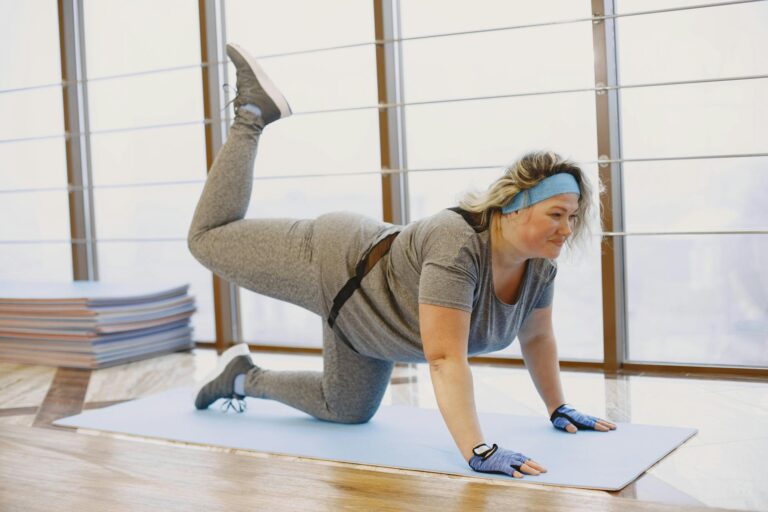
The glute bridge is particularly valuable because weak glutes are one of the most common contributors to lumbar pain. When the gluteal muscles fail to do their job during walking or stair climbing, the lower back compensates, and over months or years, that compensation becomes chronic strain. The bird dog is performed on all fours, bracing the abdominals and then extending one arm forward while extending the opposite leg backward, holding for 3 to 5 seconds. EMG studies confirm that this movement activates the lumbar erector spinae, multifidus, and gluteals. The standard protocol calls for 8 to 10 repetitions per side across 2 to 3 sets. The cat-cow stretch, also performed on all fours, moves the spine slowly through flexion and extension, arching the back downward and then rounding it upward. It is less about building strength and more about restoring range of motion and blood flow to the lumbar region. For someone who wakes up stiff every morning or has been sitting for hours, the cat-cow can serve as a low-barrier entry point into movement. One limitation worth noting: people with spondylolisthesis or other conditions involving vertebral instability should approach the extension phase of the cat-cow cautiously, as it can increase shear forces on an already vulnerable segment.
The Remaining Four Exercises and Their Specific Roles
The dead bug is a supine exercise that challenges core stability in a way many people initially find surprisingly difficult. Lying on the back with arms extended toward the ceiling and knees bent at 90 degrees, the person slowly extends one arm overhead while extending the opposite leg toward the floor, all while keeping the lower back pressed firmly against the ground. The key form cue is maintaining the natural lumbar curvature without flattening or over-arching, and continuing to breathe throughout. This exercise targets the transversus abdominis and internal obliques, the deep stabilizers that act like a muscular corset around the spine. For a 72-year-old with mild cognitive impairment who tends to lose balance when reaching for objects, strengthening these muscles directly supports the kind of reflexive stabilization the body needs during unpredictable daily movements. The partial curl-up, sometimes called an abdominal crunch, targets the rectus abdominis and obliques without the excessive lumbar flexion stress that comes with a full sit-up. Lying on the back with knees bent, the person lifts only the head and shoulders off the floor by engaging the abdominals, with hands either behind the head or crossed on the chest. This is the second of McGill’s Big 3.
It matters that this is a partial movement. Full sit-ups have been shown to generate compressive forces on the lumbar discs that can exceed safe thresholds, particularly for older adults or those with degenerative disc disease. The superman, or prone back extension, involves lying face-down and simultaneously lifting the arms, chest, and legs 3 to 6 inches off the floor. It strengthens the lumbar erector spinae and gluteals through a movement pattern that isolates the posterior chain. The side plank rounds out the list as McGill’s third Big 3 exercise. Performed by propping up on a forearm and lifting the hips to create a straight line from head to feet, it strengthens the obliques and gluteus medius. McGill’s research identified it as particularly valuable because it offsets compressive pressure on the lumbar spine while building lateral stability. For beginners or those with limited strength, performing the side plank from the knees rather than the feet is a valid and commonly recommended modification.

How to Structure a Lumbar Stabilization Program Using These Exercises
Knowing the individual exercises matters less than understanding how to sequence and dose them appropriately. A 10-session lumbar stabilization program studied in a randomized controlled trial reduced pain by 6 points on the Visual Analog Scale and disability by 32 points on the Modified Oswestry Disability Index, and it was superior to other forms of therapy tested in the same study. These are not trivial improvements. A 6-point drop on a 10-point pain scale represents the difference between constant, limiting pain and manageable discomfort that no longer dictates daily decisions. The tradeoff in programming comes down to frequency versus intensity. A program built around daily performance of 3 to 4 exercises at low intensity, say 2 sets of the pelvic tilt, glute bridge, and bird dog, may be more sustainable for an older adult than a three-times-per-week session incorporating all eight exercises at higher volume.
Research on acute low back pain patients showed mean pain scores dropping from 52 out of 100 at baseline to 23 at 6 weeks and down to just 6 at 52 weeks with consistent exercise therapy. The critical word is consistent. The gains came from sustained practice over a full year, not from a short burst of effort. For caregivers supporting someone with dementia, this means building these exercises into a daily routine rather than treating them as occasional interventions. One practical approach is to begin with the pelvic tilt, glute bridge, and cat-cow for the first two weeks, adding the bird dog and dead bug in weeks three and four, and then introducing the partial curl-up, superman, and side plank as the person demonstrates adequate control and comfort. This graduated approach mirrors how many physical therapists structure real-world programs, and it reduces the risk of soreness or discouragement from attempting too much too soon.
When These Exercises May Not Be Enough or May Not Be Appropriate
Lumbar strengthening exercises are not a universal solution. Adequate hip, hamstring, and thoracic mobility significantly reduces compensatory stress on the lumbar spine, and many low back pain cases originate from restrictions in adjacent joints rather than from lumbar weakness itself. A person who diligently performs all eight exercises but sits in a chair for 14 hours a day with tight hip flexors may see limited benefit because the root cause of their lumbar stress is not being addressed. A comprehensive approach includes mobility work for the hips and thoracic spine alongside the strengthening protocol. There are also conditions where some of these exercises are contraindicated or require significant modification. Acute disc herniations with radiculopathy, active spinal fractures, severe osteoporosis, and certain post-surgical states all demand individualized guidance from a qualified physical therapist rather than a self-directed program.
For people with dementia, an additional concern is the ability to follow instructions and maintain safe form. The bird dog and dead bug, for instance, require coordinating opposite limbs simultaneously, which can be confusing for someone with moderate cognitive impairment. In those cases, simpler exercises like the pelvic tilt and glute bridge, which involve straightforward single-plane movements, may be safer and more practical. It is also worth noting that pain during exercise is a signal, not an obstacle to push through. A common mistake is interpreting the clinical evidence as meaning that all back pain improves with more exercise. The evidence supports specific, controlled exercises performed with proper form. Performing a superman with excessive lumbar hyperextension, or a side plank with sagging hips, can aggravate the very structures these movements are meant to protect.

The Connection Between Lumbar Health and Fall Prevention in Older Adults
Falls are the leading cause of injury-related death among adults over 65, and lumbar spine weakness is an underappreciated contributor to fall risk. The core muscles targeted by these eight exercises are the same muscles responsible for postural adjustments during walking, turning, and recovering from a stumble. A person whose lumbar stabilizers fatigue quickly or fire too slowly is less able to correct a loss of balance in real time. For someone with dementia, where reaction time and spatial awareness are already compromised, this deficit can be the difference between catching a stumble and sustaining a hip fracture.
Incorporating even three or four of these exercises into a daily routine has practical implications beyond back pain. Improved glute and core strength translates directly to safer transfers in and out of bed, more stable gait, and greater confidence during activities of daily living. Caregivers who help a family member with these movements are not just managing back pain. They are investing in the kind of functional resilience that helps preserve independence longer.
What the Research Trajectory Looks Like Going Forward
The evidence base for lumbar stabilization exercises continues to grow, and the direction of current research is toward more personalized programming. Rather than prescribing the same eight exercises to every patient, the field is moving toward subgrouping based on specific movement impairments, pain patterns, and individual goals. The 2021 APTA Clinical Practice Guidelines already reflect this shift by recommending exercise training broadly while acknowledging that the optimal type, dose, and combination of exercises likely varies by patient profile.
For the aging population, and particularly for those managing concurrent cognitive decline, the next frontier is integrating lumbar strengthening with dual-task training, performing physical exercises while simultaneously engaging in a cognitive task like counting backward or naming objects. Early research suggests this approach may benefit both physical and cognitive function. The eight exercises described in this article remain a strong clinical foundation, but they are likely to become components of more integrated, individualized programs rather than standalone protocols.
Conclusion
The eight exercises covered here, pelvic tilt, glute bridge, bird dog, cat-cow stretch, dead bug, partial curl-up, superman, and side plank, represent the core of what most physical therapists prescribe for lumbar spine strengthening. The research supports their use. Stabilization programs built around these movements have demonstrated pain reductions from 52 to 6 on a 100-point scale over the course of a year, and structured programs as short as 10 sessions have shown superiority over other therapeutic approaches. Three of these exercises come from McGill’s Big 3, which were specifically designed to maximize core challenge while minimizing spinal load.
For older adults and for those caring for someone with dementia, the value of these exercises extends well beyond back pain management. Strong lumbar stabilizers contribute to safer mobility, better balance, and greater functional independence. The key is consistency over intensity, proper form over ambitious volume, and a willingness to start with simpler movements before progressing. Anyone beginning a new exercise program for back pain should consult with a physical therapist to ensure the exercises are appropriate for their specific condition, particularly if they are managing osteoporosis, disc disease, or cognitive impairment that may affect their ability to perform movements safely.
Frequently Asked Questions
How long does it take for lumbar stabilization exercises to reduce back pain?
Research on acute low back pain patients showed pain scores dropping from 52 out of 100 to 23 within six weeks, with continued improvement to a score of 6 at one year. A meta-analysis found that programs of 8 to 12 weeks produced the strongest measurable effects. Most people notice some improvement within the first few weeks, but lasting change requires months of consistent practice.
Can someone with dementia safely perform these exercises?
Many of these exercises can be adapted for people with cognitive impairment, but supervision is important. Simpler movements like the pelvic tilt and glute bridge involve single-plane motions that are easier to follow. More complex exercises like the bird dog and dead bug, which require coordinating opposite limbs, may need to be simplified or substituted. A physical therapist experienced with older adults can help design a safe, appropriate routine.
What is the difference between these exercises and doing full sit-ups or heavy lifting for back strength?
The eight exercises listed here are designed to strengthen the lumbar stabilizers while keeping spinal loading low. Full sit-ups generate high compressive forces on the lumbar discs, and heavy lifts like deadlifts increase both compressive and shear forces significantly. For people recovering from back pain, managing degenerative conditions, or dealing with reduced bone density, the lower-load exercises provide a better risk-to-benefit ratio.
Are McGill’s Big 3 exercises enough on their own?
The bird dog, partial curl-up, and side plank form a well-researched core stability foundation, but they do not address hip and thoracic mobility, glute activation, or spinal range of motion in the way that the full set of eight exercises does. Many low back pain cases involve restrictions in adjacent joints, so a more comprehensive program is generally more effective than relying on three exercises alone.
How often should these exercises be performed?
Most clinical protocols call for daily or near-daily practice, particularly during the first 8 to 12 weeks. The volume per session does not need to be high. Two to three sets of each exercise is typical. Consistency matters more than intensity. For older adults, a daily routine of 15 to 20 minutes covering four to six of these exercises is a reasonable and sustainable target.