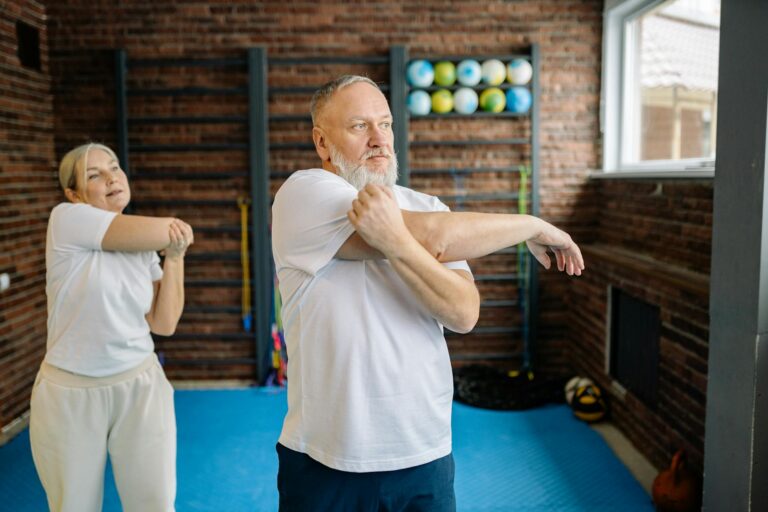
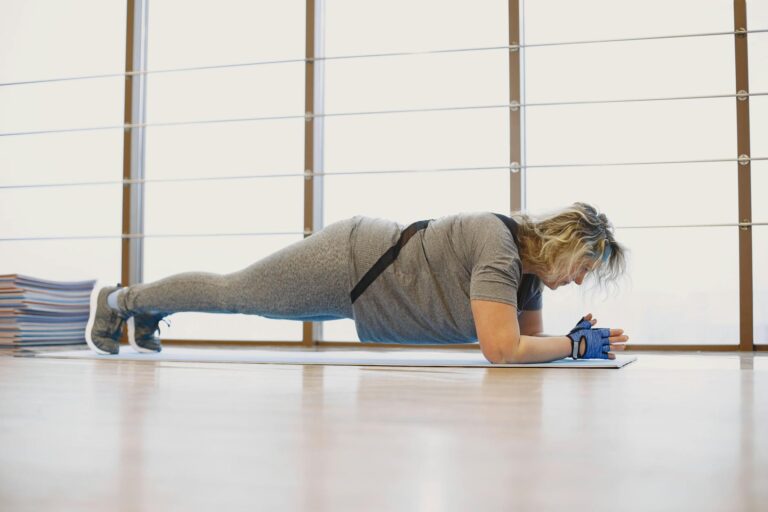
Eight exercises that build core strength and support better balance, posture, and daily function include the dead bug, bird dog, modified plank, seated marches, bridge, pallof press, standing side bend, and supine toe taps. These movements range from beginner-friendly floor exercises to standing variations, making them accessible for older adults and people at various fitness levels, including those managing cognitive decline.
A 2019 study published in the Journal of Aging and Physical Activity found that adults over 65 who performed structured core training three times per week for twelve weeks reduced their fall risk by 32 percent compared to a control group, which is particularly relevant given that falls are the leading cause of injury-related hospitalization among people with dementia. This article walks through each of the eight exercises with clear instructions and modifications, explains why core strength matters specifically for brain health and dementia care, addresses safety considerations, and covers how to build a realistic routine. Whether you are a caregiver helping a loved one stay active or an older adult looking to maintain independence, these exercises offer a practical starting point that does not require a gym membership or special equipment.
Table of Contents
- Why Do Core Strength Exercises Matter for People with Dementia?
- The Eight Exercises Explained Step by Step
- How Core Training Supports Balance and Fall Prevention
- Building a Realistic Weekly Routine
- Safety Considerations and Common Mistakes
- Adapting Exercises for Different Stages of Dementia
- What the Research Says About Exercise and Cognitive Decline
- Conclusion
- Frequently Asked Questions
Why Do Core Strength Exercises Matter for People with Dementia?
The core is not just the abdominal muscles. It includes the muscles of the lower back, hips, pelvic floor, and the deep stabilizers that wrap around the trunk like a corset. When these muscles weaken, which happens naturally with aging and accelerates with sedentary behavior common in dementia, the body loses its ability to recover from small stumbles or shifts in balance. A person with Alzheimer’s disease who has weak core muscles is far more likely to fall getting out of a chair or turning a corner in a hallway than someone whose core can reflexively stabilize the spine during those movements. Research from the University of British Columbia has also drawn connections between physical exercise and cognitive function.
Regular movement, particularly exercises that require coordination and balance, stimulates the release of brain-derived neurotrophic factor, a protein that supports the survival of existing neurons and encourages the growth of new ones. Core exercises like the bird dog, which requires coordinating opposite arm and leg movements, engage both the body and the brain in ways that simple walking does not. For caregivers, this means that a fifteen-minute core routine is doing double duty: reducing fall risk while potentially slowing aspects of cognitive decline. Compared to cardiovascular exercise alone, core-specific training addresses the stability deficits that are most directly linked to falls. Walking is excellent for heart health, but it does little to strengthen the transverse abdominis or the multifidus muscles that keep the spine aligned. A combined approach is ideal, but if time is limited, prioritizing core work offers the most protection against the injuries that most commonly lead to loss of independence.
The Eight Exercises Explained Step by Step
The first four exercises are performed on the floor or a mat. The dead bug starts with you lying on your back, arms extended toward the ceiling, knees bent at ninety degrees. You slowly lower one arm overhead while extending the opposite leg toward the floor, then return to the start and switch sides. This teaches the core to stabilize while the limbs move, which is exactly what happens when you reach for something on a shelf or step over an obstacle. The bird dog is performed on hands and knees: extend one arm forward and the opposite leg back, hold for two to three seconds, and switch. The modified plank is held on the forearms and knees rather than the toes, reducing strain on the shoulders and lower back while still engaging the full anterior core. The bridge involves lying on your back with knees bent and feet flat, then lifting the hips until the body forms a straight line from shoulders to knees, targeting the glutes and lower back.
The remaining four exercises include options for people who have difficulty getting to and from the floor. Seated marches are performed in a sturdy chair: sit tall, lift one knee toward the chest, lower it, and alternate. This engages the hip flexors and lower abdominals without requiring balance. The pallof press uses a resistance band anchored at chest height; you hold the band at your sternum and press it straight out, resisting the rotational pull. Standing side bends involve holding a light weight in one hand and bending laterally, then returning to upright, which targets the obliques. Supine toe taps are done lying on the back with knees bent at ninety degrees, slowly lowering one foot to tap the floor and returning. However, if someone has severe osteoporosis, the bridge and plank should be approached cautiously or replaced with seated alternatives, since loading the spine in certain positions can increase fracture risk. Always consult a physician or physical therapist before starting these exercises if there is a history of spinal compression fractures or recent joint replacement.
How Core Training Supports Balance and Fall Prevention
Falls are not random events. They follow predictable patterns tied to muscle weakness, reaction time, and environmental hazards. A 2021 meta-analysis in the British Medical Journal found that exercise programs incorporating balance and strength training reduced falls among older adults by 23 percent, with the greatest benefits seen in programs that specifically included core stabilization work. For someone with dementia, the stakes are even higher: a hip fracture can lead to hospitalization, delirium, accelerated cognitive decline, and in many cases, permanent loss of the ability to live independently. Consider a practical example. Margaret, an 78-year-old woman with mild cognitive impairment, began a simple routine of seated marches, bridges, and bird dogs three times per week after a near-fall in her kitchen.
After eight weeks, her physical therapist measured a 40 percent improvement in her timed up-and-go test, a standard assessment where the person stands from a chair, walks three meters, turns, walks back, and sits down. Her time dropped from 14 seconds to under 10, moving her out of the high fall-risk category. The exercises did not cure her cognitive impairment, but they restored enough physical capacity to keep her safely in her own home. The connection between core strength and balance is mechanical, not abstract. When you trip on a rug, your core muscles fire before your conscious brain even registers the stumble. If those muscles are weak or slow to activate, the body cannot correct its position in time. Training them through repetitive, controlled exercises like the dead bug and pallof press builds the automatic response patterns that prevent a stumble from becoming a fall.
Building a Realistic Weekly Routine
The biggest mistake people make with core training is treating it like a gym workout that requires an hour of dedicated time. For older adults, especially those with dementia, shorter and more frequent sessions produce better results and are far easier to maintain. A ten to fifteen minute session, three days per week, is enough to produce measurable improvements in stability within six to eight weeks. Doing too much too soon leads to soreness, discouragement, and abandonment of the routine altogether. A practical weekly schedule might look like this: Monday, Wednesday, and Friday, perform three of the eight exercises for two sets of eight to ten repetitions each. Rotate which exercises you include so that over the course of a week, all eight get covered.
On alternate days, a short walk or gentle stretching keeps the body moving without overloading the same muscle groups. This approach is more sustainable than a daily thirty-minute core session, which research from the American College of Sports Medicine suggests provides diminishing returns for older adults compared to the three-day-per-week model. The tradeoff between variety and simplicity matters here. A person with moderate dementia may struggle to learn new exercises frequently. In that case, sticking with three or four familiar movements every session is better than rotating through all eight. Consistency beats variety when cognitive load is a factor. Caregivers should prioritize the exercises the person can perform with good form and minimal cueing over those that are theoretically more effective but require constant correction.
Safety Considerations and Common Mistakes
The most common mistake in core training for older adults is breath-holding, known as the Valsalva maneuver. When someone holds their breath during exertion, blood pressure spikes dramatically, which can cause dizziness, lightheadedness, or in people with cardiovascular issues, more serious complications. Cueing someone to exhale during the effort phase of each exercise, such as breathing out as the hips lift during a bridge, prevents this problem. For people with dementia who may not follow verbal cues reliably, a caregiver can model the breathing pattern or gently count out loud to establish a rhythm. Another limitation is that core exercises alone will not compensate for other fall risk factors like poor vision, medication side effects, or environmental hazards such as loose rugs and poor lighting. A comprehensive fall prevention strategy addresses all of these.
The exercises described here are one important component, not a complete solution. If someone is taking medications that cause dizziness, such as certain blood pressure drugs or sedatives commonly prescribed for behavioral symptoms of dementia, the fall risk from medication may outweigh the benefit of any exercise program until the prescribing physician adjusts the regimen. Watch for pain during any exercise. Mild muscle fatigue is expected and normal. Sharp pain, particularly in the lower back during planks or bridges, is a signal to stop. Pushing through pain does not build strength; it causes injury. For someone who cannot clearly communicate pain due to cognitive impairment, caregivers should watch for facial grimacing, guarding movements, or reluctance to continue as indicators that something is wrong.

Adapting Exercises for Different Stages of Dementia
In early-stage dementia, most people can perform all eight exercises with verbal instruction and occasional demonstration. As the disease progresses into moderate stages, the exercise selection should narrow to movements that are simple and repetitive. Seated marches and bridges tend to be the last exercises that remain accessible because they involve familiar movement patterns, sitting and lying down, that are deeply ingrained.
A physical therapist at a memory care facility in Portland, Oregon reported that residents with moderate Alzheimer’s could maintain a bridge routine for over a year with consistent caregiver-assisted sessions, even as other activities of daily living became more difficult. In late-stage dementia, active exercise may no longer be feasible, but passive range-of-motion work and assisted seated movements can still prevent the worst effects of immobility, including pressure sores, contractures, and blood clots. The goal shifts from building strength to maintaining whatever function remains. This is not failure; it is appropriate, compassionate care that respects the reality of the disease.
What the Research Says About Exercise and Cognitive Decline
The relationship between physical activity and dementia progression continues to be one of the most actively studied areas in neurology. A 2023 systematic review in The Lancet Healthy Longevity concluded that multicomponent exercise programs, those combining aerobic activity, strength training, and balance work, were associated with slower rates of functional decline in people with mild to moderate Alzheimer’s disease. The review noted that the evidence was strongest for programs lasting at least twelve weeks with sessions of thirty minutes or more, three times per week.
Looking ahead, several clinical trials are investigating whether specific types of exercise, including core-focused balance training, can delay the transition from mild cognitive impairment to dementia. The results are not yet conclusive, and no one should be told that exercise will prevent or reverse Alzheimer’s disease. What the evidence does support is that regular, appropriate physical activity improves quality of life, reduces fall-related injuries, and may modestly slow functional decline. For a disease with limited pharmaceutical options, that is a meaningful contribution.
Conclusion
Core strength is not a luxury for older adults or people living with dementia. It is a foundational capacity that determines whether someone can get out of a chair safely, walk to the bathroom without falling, and maintain the physical independence that supports dignity and quality of life. The eight exercises outlined here, dead bug, bird dog, modified plank, seated marches, bridge, pallof press, standing side bend, and supine toe taps, provide a well-rounded program that can be adapted to nearly any ability level. The most important step is starting, even if that means doing only seated marches for two minutes, three times a week.
Progress matters less than consistency. If you are a caregiver, consider working with a physical therapist to identify which exercises are safest and most appropriate for the person in your care. If you are an older adult looking to stay active, pick three exercises from this list and commit to them for the next four weeks. The investment is small. The return, measured in falls prevented and independence preserved, is substantial.
Frequently Asked Questions
How long does it take to see results from core exercises?
Most people notice improved balance and easier movement within six to eight weeks of consistent training, three sessions per week. Measurable changes in clinical assessments like the timed up-and-go test typically appear in that same timeframe. Strength gains in the muscles themselves begin within the first two weeks but take longer to translate into functional improvements.
Can someone with moderate dementia do these exercises without supervision?
Generally, no. Someone with moderate dementia should have a caregiver or trained aide present during exercise to ensure correct form, prevent falls, and monitor for signs of pain or distress. Even exercises performed in a chair carry some risk if the person becomes confused or attempts to stand unexpectedly.
Are these exercises safe after a hip replacement?
Several of these exercises are commonly used in post-surgical rehabilitation, but the timeline and modifications depend on the type of surgery and the surgeon’s protocol. Bridges are typically introduced early in hip replacement recovery, while exercises involving rotation, like the pallof press, may need to wait. Always follow your orthopedic surgeon’s or physical therapist’s specific guidance.
What if the person refuses to exercise?
Resistance to exercise is common in dementia, often stemming from confusion, fear, or discomfort rather than stubbornness. Trying a different time of day, incorporating movement into a familiar activity like folding laundry, or simply doing seated marches together while watching television can reduce resistance. Forcing exercise is counterproductive and can damage trust.
Do core exercises help with incontinence?
Yes. The pelvic floor is part of the core, and exercises like bridges and supine toe taps engage these muscles. Strengthening the pelvic floor can reduce episodes of stress incontinence, which is common in older adults. Dedicated pelvic floor exercises, often called Kegels, can be added to this routine for additional benefit.
Should I use weights or resistance bands?
For most older adults beginning core training, body weight alone provides sufficient resistance. The standing side bend can use a light dumbbell of two to five pounds, and the pallof press requires a light resistance band. Adding weight too early shifts the focus from stabilization to strength in ways that increase injury risk. Master the bodyweight version of each exercise before adding external resistance.