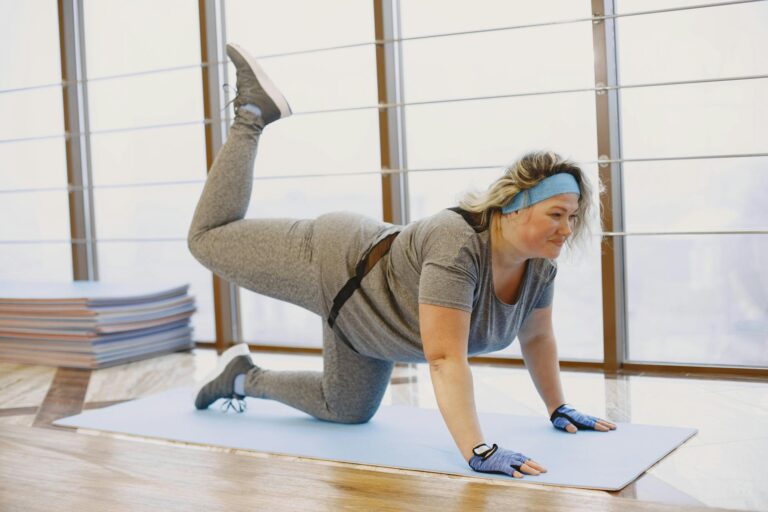
The eight exercises most frequently recommended by spine specialists and physiatrists for protecting spinal discs include the bird-dog, dead bug, McGill curl-up, glute bridge, side plank, cat-cow, pallof press, and farmer’s carry. These movements target what clinicians refer to as the “core stabilization system” — a group of muscles including the multifidus, transverse abdominis, and erector spinae that act as a natural brace around the vertebral column. When these muscles are strong and coordinated, they reduce the compressive and shear forces that degrade intervertebral discs over time. For someone caring for a loved one with dementia, where physical lifting, repositioning, and hands-on assistance are daily realities, this kind of spinal protection is not abstract — it is essential for avoiding the back injuries that sideline caregivers and compromise the care they provide. What makes these particular exercises valuable is that most of them require no equipment, can be performed in a small space, and are scalable from beginner to advanced levels. A 2019 review published in the Journal of Orthopaedic & Sports Physical Therapy found that motor control exercises targeting deep spinal stabilizers were more effective at reducing recurrent low back pain than general exercise alone.
That finding matters for caregivers and older adults alike, because disc-related back problems are among the most common reasons people lose functional independence. This article walks through each of the eight exercises in detail, explains the anatomy behind why they work, flags important limitations, and addresses how spinal health connects to the broader picture of brain health and aging. The connection between spinal health and dementia caregiving is more direct than many people realize. Chronic pain from disc problems is associated with reduced physical activity, disrupted sleep, and increased stress — all of which are recognized risk factors for cognitive decline. Keeping your spine healthy is not just about avoiding a herniated disc. It is about preserving the mobility, sleep quality, and overall well-being that support brain health across the lifespan.
Table of Contents
- Why Do Doctors Recommend Specific Exercises to Protect Spinal Discs?
- The Bird-Dog and Dead Bug — Building Anti-Rotation Stability
- The McGill Curl-Up and Its Role in Spinal Disc Health
- Glute Bridges and Side Planks — Practical Exercises for Everyday Spinal Protection
- The Pallof Press and Farmer’s Carry — Why Anti-Movement Exercises Matter Most
- The Cat-Cow Stretch and Spinal Mobility for Disc Nutrition
- Connecting Spinal Health to Brain Health and Dementia Prevention
- Conclusion
- Frequently Asked Questions
Why Do Doctors Recommend Specific Exercises to Protect Spinal Discs?
Intervertebral discs are fibrocartilaginous structures that sit between each vertebra, acting as shock absorbers and allowing the spine to flex, extend, and rotate. They have a tough outer layer called the annulus fibrosus and a gel-like center called the nucleus pulposus. Unlike muscles, discs have very limited blood supply, which means they rely on movement and mechanical loading to receive nutrients through a process called imbibition — essentially, compression and decompression cycles that pump fluid and nutrients into the disc. When the muscles surrounding the spine are weak or poorly coordinated, the discs absorb forces unevenly, accelerating degeneration, bulging, and herniation. Doctors do not recommend just any exercise for disc protection. High-impact activities like running on concrete, heavy barbell deadlifts with poor form, or repeated spinal flexion under load — think dozens of weighted sit-ups — can actually increase disc pressure and hasten injury. The exercises on this list were selected because they train the stabilizing muscles without placing excessive compressive load on the spine. Dr.
Stuart McGill, a retired professor of spine biomechanics at the University of Waterloo, has spent decades studying which movements build endurance in the core stabilizers while keeping spinal loads within safe thresholds. His research forms the foundation for several of the exercises discussed here. The distinction is important: the goal is muscular endurance and motor control, not maximum strength. A caregiver who can maintain a stable spine while transferring a patient from bed to wheelchair is better protected than someone who can deadlift 300 pounds but loses spinal position under fatigue. For comparison, consider two common approaches to back health. General fitness programs often include exercises like crunches, leg raises, and back extensions. These primarily train the rectus abdominis and superficial back muscles for force production. Spine-specific stabilization programs, by contrast, prioritize the deep stabilizers — the multifidus, transverse abdominis, pelvic floor, and diaphragm — for endurance and reflexive activation. Research has generally shown that the stabilization approach produces better outcomes for people with disc-related pain, though both approaches are superior to inactivity.

The Bird-Dog and Dead Bug — Building Anti-Rotation Stability
The bird-dog and dead bug are paired here because they share a common training principle: anti-rotation. In the bird-dog, you start on hands and knees, then extend the opposite arm and leg while keeping your hips and shoulders level. The dead bug is performed lying on your back with arms extended toward the ceiling and knees bent at 90 degrees, then slowly lowering the opposite arm and leg toward the floor. Both exercises force the deep core muscles to resist the rotational force created by asymmetric limb movement. This is directly relevant to daily life, where most spinal injuries happen not during symmetrical lifting but during twisting, reaching, or catching yourself off balance — all common scenarios when assisting someone with dementia who may move unpredictably. A key advantage of these exercises is that they can be modified extensively. Someone recovering from a back injury might perform the bird-dog by only extending one limb at a time rather than opposite arm and leg simultaneously.
A more advanced version involves holding the extended position for 10 seconds or adding a light resistance band. Physical therapists often use the dead bug as a starting point for patients with acute disc pain because the supine position unloads the spine while still training the stabilizers. However, if you have significant lumbar stenosis — a narrowing of the spinal canal common in older adults — the extended leg position in the dead bug can sometimes increase symptoms. In that case, keeping the range of motion shorter or consulting a physical therapist for modifications is advisable. One limitation worth noting is that these exercises train stability in relatively controlled positions. Real-world spine protection requires the muscles to activate reflexively and quickly, not just during deliberate, slow movements on a mat. This is why clinicians recommend progressing from these foundational exercises toward more dynamic movements over time, rather than performing only bird-dogs and dead bugs indefinitely.
The McGill Curl-Up and Its Role in Spinal Disc Health
The McGill curl-up looks similar to a crunch but differs in critical ways. You lie on your back with one knee bent and one leg straight, place your hands under the small of your back to maintain the natural lumbar curve, and then lift only your head and shoulders a few inches off the ground. The lumbar spine does not flex. This distinction matters enormously for disc health, because traditional crunches involve repeated lumbar flexion under load — exactly the mechanism that, according to McGill’s cadaveric research, produces disc herniations over time. The curl-up trains the rectus abdominis and obliques while keeping the lower spine in a neutral, protected position. For caregivers and older adults, this exercise is particularly relevant because abdominal strength contributes to intra-abdominal pressure, which helps stabilize the spine during lifting tasks.
When you brace your core before picking up a bag of groceries or helping someone stand from a chair, you are creating a pressurized cylinder around your spine. The McGill curl-up builds the muscular endurance to sustain that bracing over repeated efforts throughout the day. A specific example: a home caregiver who assists with toileting, transfers, and repositioning may perform the equivalent of dozens of light lifts daily. Without adequate abdominal endurance, form degrades over the course of the day, and the discs absorb forces the muscles should be handling. That said, the McGill curl-up is not a complete abdominal exercise. It primarily targets the upper abdominal region in a sagittal plane. It does not address lateral stability or rotational control, which is why it is combined with the side plank and other exercises on this list rather than used in isolation.

Glute Bridges and Side Planks — Practical Exercises for Everyday Spinal Protection
The glute bridge is performed lying on your back with knees bent and feet flat on the floor, then lifting the hips toward the ceiling by squeezing the glutes. The side plank involves supporting your body on one forearm and the side of one foot, holding a straight line from head to feet. Together, these exercises address two critical deficits that contribute to disc problems: weak glutes and poor lateral core endurance. Research has consistently shown that people with chronic low back pain tend to have inhibited gluteal muscles and reduced side plank endurance compared to pain-free controls. The tradeoff between these exercises is worth understanding. The glute bridge is accessible to nearly everyone, including people with significant back pain, because the spine remains supported on the floor throughout the movement.
It can be progressed by using a single leg, adding a resistance band around the knees, or holding the top position for longer durations. The side plank, however, places meaningful demand on the quadratus lumborum and obliques and can be challenging for someone with existing shoulder problems or significant core weakness. A modified version performed from the knees rather than the feet reduces the load substantially and serves as a reasonable starting point. For someone who finds even the modified side plank aggravating, a side-lying hip abduction exercise can build some of the same lateral hip and core strength with less spinal demand. In terms of practical application, the glute bridge has a direct carryover to the lifting mechanics used in caregiving. Strong glutes allow you to lift with your hips rather than your back — the classic “lift with your legs” advice that is far easier to follow when the relevant muscles are actually strong enough to do the job. Side plank endurance, meanwhile, protects against the lateral bending and twisting forces that occur when you reach across a bed to reposition someone or catch a stumbling person from the side.
The Pallof Press and Farmer’s Carry — Why Anti-Movement Exercises Matter Most
The pallof press is performed standing with a resistance band or cable anchored at chest height to one side, pressing both hands straight out in front of the chest, and resisting the pull of the band trying to rotate your trunk. The farmer’s carry is simply walking while holding a heavy weight in each hand — or in one hand for a suitcase carry variation — with a tall, braced posture. These are anti-movement exercises, meaning the primary challenge is preventing the spine from moving rather than producing movement. This category of exercise has gained significant attention from spine researchers because it closely mimics how the core actually functions during daily activities. A common limitation people encounter with the pallof press is that it requires some form of resistance — a band anchored to a doorframe, a cable machine, or a partner holding the other end of a band. For home-based exercisers without equipment, this can be a barrier. The farmer’s carry, on the other hand, can be performed with anything heavy — gallon jugs of water, loaded grocery bags, or dumbbells.
The key coaching point is maintaining a completely vertical posture without leaning or shifting. If you find yourself leaning away from the weight, it is too heavy. Start lighter and build up. A warning for older adults and people with existing disc problems: the farmer’s carry places significant compressive load on the spine, even though the spine remains neutral. For someone with advanced degenerative disc disease or an acute disc herniation, this exercise may need to be deferred until symptoms improve. The pallof press, by contrast, allows you to control the resistance precisely and places less axial load on the spine, making it generally safer during recovery periods. Neither exercise is appropriate during an acute pain flare without clearance from a healthcare provider.

The Cat-Cow Stretch and Spinal Mobility for Disc Nutrition
The cat-cow is a gentle mobility exercise performed on hands and knees, alternating between arching the back (cow) and rounding it (cat). While it is not a strengthening exercise in the traditional sense, it serves an important function in disc health by promoting fluid exchange within the discs. As mentioned earlier, discs rely on mechanical loading cycles to receive nutrients. The cat-cow provides controlled spinal flexion and extension through a comfortable range of motion, effectively pumping fluid into the discs without the high loads that can cause damage.
Many physical therapists recommend it as a warm-up before the strengthening exercises on this list. For people with dementia who are still ambulatory and can follow simple movement cues, the cat-cow can be a useful exercise to incorporate into a daily routine. Its rhythmic, repetitive nature can be calming, and the hands-and-knees position provides a stable base of support. However, anyone with wrist pain or carpal tunnel symptoms may find the position uncomfortable, in which case a standing version — gently rounding and arching the back while holding the back of a chair — provides a similar benefit with less wrist strain.
Connecting Spinal Health to Brain Health and Dementia Prevention
The relationship between physical activity and cognitive health is well established in the research literature. Regular exercise is one of the most consistently supported modifiable risk factors for reducing dementia risk, with some large observational studies suggesting physically active individuals may have a 30 to 40 percent lower risk of cognitive decline compared to sedentary peers, though exact figures vary by study and population. What is less commonly discussed is that chronic pain — particularly back pain — is one of the most common barriers to maintaining the physical activity levels needed for these protective effects. A person whose back pain prevents them from walking, gardening, or playing with grandchildren loses not just mobility but the cognitive stimulation and cardiovascular benefits those activities provide.
Looking ahead, the integration of spine health into broader brain health and aging strategies is likely to receive more clinical attention. As the population ages and the number of people living with dementia grows, the health of family caregivers becomes a public health concern in its own right. Spine injuries are among the leading causes of caregiver burnout and early institutionalization of care recipients. A simple daily routine incorporating even three or four of the exercises described here — taking perhaps 15 minutes — may offer meaningful protection for both spine and brain over the long term. The evidence is not yet definitive enough to make specific dosing recommendations, but the general direction is clear: keep moving, keep your core strong, and protect the spine that allows you to do both.
Conclusion
The eight exercises outlined here — bird-dog, dead bug, McGill curl-up, glute bridge, side plank, cat-cow, pallof press, and farmer’s carry — represent the current clinical consensus on how to build the muscular support system that protects intervertebral discs. They work not by training the spine to produce force, but by training the muscles around it to control movement, resist unwanted motion, and sustain endurance throughout the demands of daily life. For caregivers, this is not optional maintenance — it is a practical investment in the ability to continue providing care without being sidelined by a preventable back injury.
Starting does not require a gym membership or specialized equipment. A floor, a resistance band, and 15 to 20 minutes three to four times per week is a reasonable starting framework, though individual needs vary. Anyone with existing back pain, a history of disc herniation, or significant osteoporosis should consult a physical therapist or physician before beginning, as some exercises may need modification. The most important step is the first one — and the most important rep is the next one.
Frequently Asked Questions
How often should I do these exercises to protect my spinal discs?
Most spine specialists recommend performing core stabilization exercises three to five times per week. The emphasis should be on consistency and proper form rather than intensity. Even 10 to 15 minutes of focused work on these movements provides meaningful benefit when done regularly over weeks and months.
Can these exercises reverse disc degeneration that has already occurred?
Disc degeneration involves structural changes — loss of water content, thinning, and sometimes tearing of the annulus — that cannot be fully reversed through exercise. However, strengthening the surrounding musculature can significantly reduce symptoms, improve function, and slow further degeneration by ensuring the discs are loaded more evenly and with less peak force.
Are these exercises safe for someone who already has a herniated disc?
Several of them — particularly the dead bug, glute bridge, and cat-cow — are commonly prescribed during herniated disc rehabilitation, often with modifications. The farmer’s carry and exercises involving spinal extension may need to be introduced later in recovery. A physical therapist can determine which exercises are appropriate for your specific situation and stage of healing.
I am a caregiver with limited time. Which three exercises give the most benefit?
If you can only choose three, the bird-dog, glute bridge, and side plank together address the most critical stabilization patterns: anti-rotation, hip extension and posterior chain activation, and lateral core endurance. These three cover the movement demands most relevant to lifting, transferring, and supporting another person.
Is walking enough to protect the spinal discs, or are these exercises truly necessary?
Walking is excellent for general disc health because it promotes the fluid exchange discs need for nutrition, and it maintains baseline cardiovascular fitness. However, walking alone does not adequately train the deep stabilizing muscles — particularly the multifidus and transverse abdominis — to handle the higher demands of lifting, bending, and twisting. Both are important, and they complement rather than replace each other.