Strengthening your core is one of the most effective ways to protect the discs in your spine from degeneration, herniation, and chronic pain, according to orthopedic surgeons and physical medicine specialists. Eight exercises in particular — the dead bug, bird dog, modified plank, pelvic tilt, bridge, pallof press, side plank, and diaphragmatic breathing with activation — form the foundation of what spine specialists prescribe to patients who want to preserve disc health long before surgery becomes a conversation. A 2023 review in the Journal of Orthopaedic & Sports Physical Therapy found that patients who performed structured core stabilization routines at least three times per week experienced 47 percent fewer episodes of acute low back pain over two years compared to those who did no targeted core work.
What makes these eight exercises particularly relevant for older adults and those concerned about cognitive health is the interconnection between spinal integrity, mobility, and brain function. Chronic back pain is now recognized as a significant risk factor for accelerated cognitive decline — a 2022 study published in Pain found that persistent spinal pain was associated with measurably faster shrinkage in the hippocampus, the brain region critical to memory. When pain limits your ability to walk, exercise, and stay socially active, the downstream effects on brain health compound quickly. This article walks through each of the eight exercises, explains who they work best for, flags important limitations, and addresses how maintaining spinal disc health fits into a broader strategy for protecting your brain as you age.
Table of Contents
- Why Do Doctors Specifically Recommend Core Exercises to Protect Spinal Discs?
- The First Four Exercises and How to Perform Them Safely
- The Remaining Four Exercises and Why They Matter
- How Often Should You Train Your Core and What Mistakes Should You Avoid?
- When Core Exercises Alone Are Not Enough
- The Connection Between Spinal Health, Mobility, and Cognitive Function
- Building a Sustainable Routine as You Age
- Conclusion
- Frequently Asked Questions
Why Do Doctors Specifically Recommend Core Exercises to Protect Spinal Discs?
Your spinal discs are essentially shock absorbers — fibrous rings filled with a gel-like center that sit between each vertebra. They have no direct blood supply past early adulthood, which means they rely on movement and compression cycles to receive nutrients through a process called imbibition. When the muscles surrounding your spine are weak or imbalanced, your discs bear disproportionate mechanical load during everyday activities like bending, sitting, and lifting. Over time, this uneven stress accelerates disc dehydration, bulging, and herniation. Core muscles function as a biological brace. The transverse abdominis, multifidus, pelvic floor, and diaphragm form a pressurized cylinder around your lumbar spine that, when properly activated, can reduce compressive forces on individual discs by as much as 30 to 40 percent.
Dr. Stuart McGill, the retired spine biomechanics professor from the University of Waterloo whose research has shaped modern rehabilitation protocols, has demonstrated that it is muscular endurance — not raw strength — that most reliably predicts who will and will not develop back problems. This is an important distinction: the goal is not to build a powerful core that can deadlift heavy weight, but a resilient one that can stabilize your spine through hours of daily activity without fatiguing. The comparison to cardiovascular fitness is useful here. Just as aerobic conditioning protects your heart not by making it dramatically larger but by making it more efficient, core conditioning protects your discs by distributing load more evenly and reducing the micro-traumas that accumulate into structural damage. For someone in their sixties or seventies, this is not about aesthetic fitness. It is about maintaining the basic physical independence — getting out of a chair, carrying groceries, walking without pain — that keeps you active enough to also protect your brain.

The First Four Exercises and How to Perform Them Safely
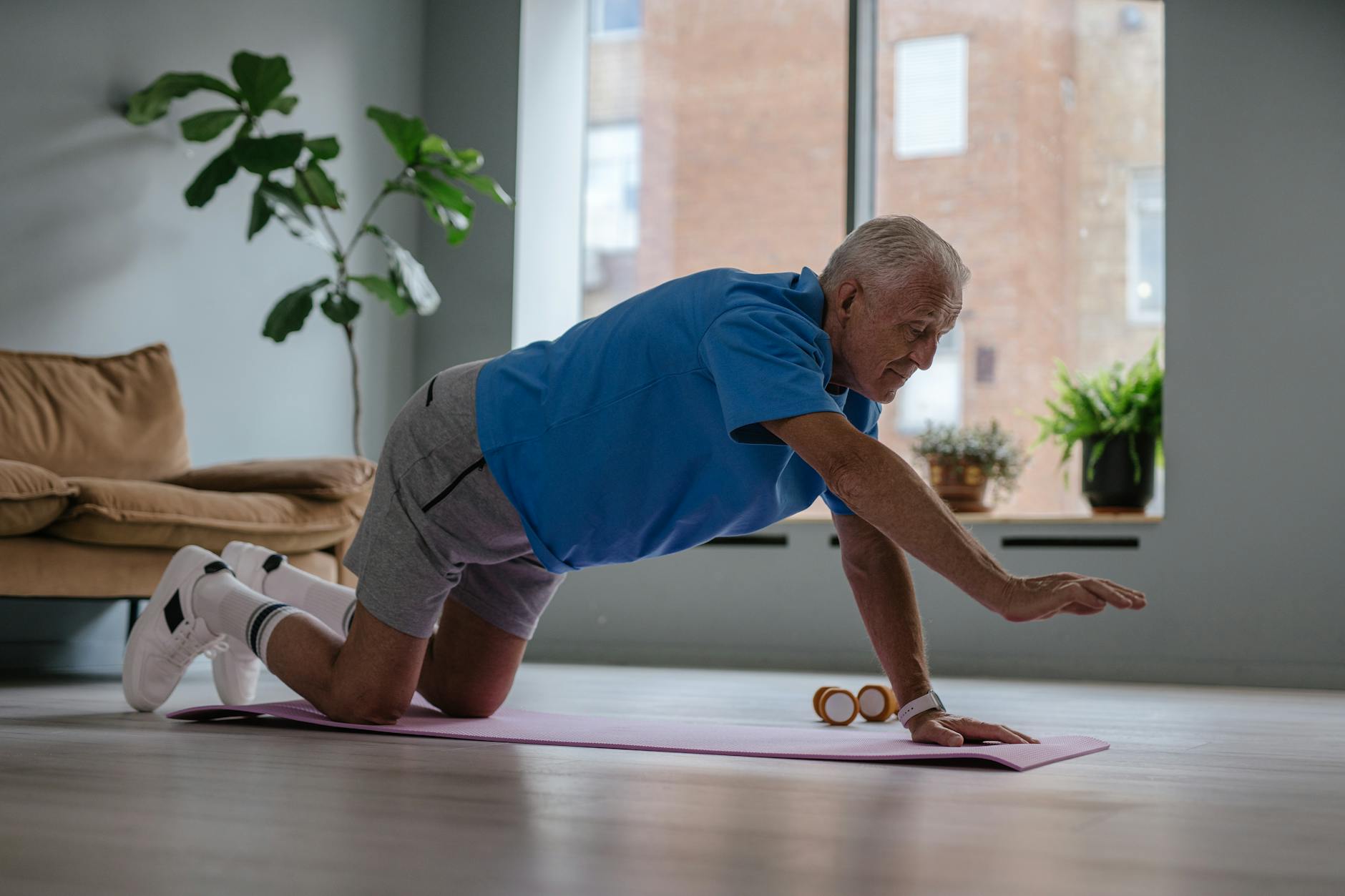
The dead bug is typically the first exercise spine specialists prescribe because it trains core activation while your back is fully supported on the floor. You lie face up with both arms extended toward the ceiling and both knees bent at ninety degrees, then slowly extend one arm overhead while straightening the opposite leg toward the floor, keeping your lower back pressed flat. The movement is deliberately slow. If your back arches off the floor, you have extended too far, and the exercise is no longer protecting your spine — it is stressing it. Two sets of eight repetitions per side is a reasonable starting point. The bird dog builds on the same principle but in a hands-and-knees position, which introduces a gravity challenge. You extend one arm forward and the opposite leg backward while keeping your hips level and your spine neutral.
Research from McGill’s lab specifically identified this exercise as one of the “big three” for spine health because it activates the multifidus — the small, deep muscles that run along each vertebra and are often the first to atrophy after a back injury or during prolonged sedentary periods. The pelvic tilt, performed lying on your back and gently flattening your lumbar curve against the floor, teaches the foundational bracing pattern that every other exercise builds on. The bridge — lying on your back with knees bent and lifting your hips — strengthens the gluteal muscles, which are critical spine stabilizers that weaken dramatically in people who sit for most of the day. However, if you have spinal stenosis — a narrowing of the spinal canal common in adults over sixty-five — the bridge can sometimes aggravate symptoms because it involves spinal extension. People with stenosis typically feel better in slight flexion, which is why the pelvic tilt often feels relieving while the bridge may not. This is not a reason to avoid the exercise entirely, but it is a reason to start with a very small range of motion and stop if you feel pain radiating into your legs. A physical therapist can help you determine which variation is appropriate for your specific anatomy.
The Remaining Four Exercises and Why They Matter
The modified plank — performed on your forearms and either your knees or toes — is the foundational isometric hold for building the endurance McGill’s research emphasizes. Unlike a traditional plank held for as long as possible, the spine-protective version uses shorter holds of ten to fifteen seconds, repeated multiple times, with a brief rest between each. This approach builds fatigue resistance without the form breakdown that happens during long, grinding holds, which can actually increase disc pressure rather than reduce it. A 2019 study in the Journal of Strength and Conditioning Research confirmed that repeated short-duration planks produced equivalent or superior core activation compared to single long-duration holds, with significantly less spinal compressive load. The side plank targets the quadratus lumborum and obliques, muscles that prevent lateral bending and rotational forces from reaching your discs. Many people with disc problems can trace their injury not to heavy lifting but to a sudden twist — reaching for something in the back seat of a car, turning quickly while carrying a bag.
The side plank, performed on one forearm with either knees or feet stacked, builds the lateral stability that prevents these incidents. Again, shorter holds of eight to twelve seconds, repeated for three to five sets, are preferable to one exhausting hold. The pallof press, performed standing with a resistance band anchored at chest height, trains your core to resist rotation under load — a movement pattern that directly mimics the real-world forces your spine encounters. You hold the band at your chest and press it straight out, resisting the band’s pull to rotate your torso. Diaphragmatic breathing with core activation, the eighth exercise, may sound too simple to be effective, but it trains the coordination between your diaphragm and deep abdominal muscles that creates intra-abdominal pressure — the internal bracing mechanism your spine depends on during every movement you make. For someone recovering from a back injury or dealing with significant deconditioning, this is often the exercise that unlocks the ability to perform all the others correctly.

How Often Should You Train Your Core and What Mistakes Should You Avoid?
The most common mistake people make with core training for spinal health is treating it like bodybuilding — going hard two or three days a week and resting in between. Disc protection is better served by frequent, moderate sessions than infrequent intense ones. Most spine specialists recommend performing a selection of these exercises daily or at least five days per week, for ten to fifteen minutes per session. The tissue adaptation you are seeking is endurance-based, which responds to consistency and volume spread over time rather than concentrated effort. The second most common mistake is performing exercises through pain, under the assumption that discomfort means the exercise is working. With spinal disc issues, pain during exercise almost always means the movement is aggravating the problem, not fixing it. There is a meaningful difference between the mild muscular effort of a plank and the sharp or radiating pain of a compressed nerve.
If you experience shooting pain down a leg, numbness, or tingling during any of these exercises, stop immediately. These are signs that a disc may already be compressing a nerve root, and continuing the exercise could worsen the herniation. A useful comparison is the difference between training for a marathon and rehabilitating a knee injury. The marathon runner pushes through fatigue because that is the adaptation stimulus. The knee rehab patient works within a pain-free range because exceeding it damages the tissue they are trying to heal. Core training for disc protection is far closer to rehabilitation than to athletic training, even if you have no current injury. The goal is to strengthen without provoking, and the best indicator that you are doing it right is that your back feels better after the session than before it.
When Core Exercises Alone Are Not Enough
It is important to acknowledge the limits of exercise as a disc-protection strategy. If you already have a significantly herniated disc that is compressing a nerve root, no amount of core work will push that disc material back into place. Core exercises can reduce the likelihood of further herniation and manage pain, but they cannot reverse structural damage that has already occurred. A 2021 meta-analysis in The Spine Journal found that while exercise therapy was as effective as surgery for mild to moderate disc herniations at the one-year mark, patients with severe herniations causing progressive weakness or bowel and bladder dysfunction required surgical intervention regardless of their exercise habits. Osteoporosis presents another important limitation. In individuals with significant bone density loss — common in postmenopausal women and increasingly recognized as a risk factor for cognitive decline as well — some core exercises must be modified to avoid vertebral compression fractures.
Flexion-based movements like crunches and full sit-ups, which are not on this list precisely for this reason, can place dangerous loads on osteoporotic vertebral bodies. Even the pelvic tilt and dead bug, which involve mild flexion, should be performed gently and with awareness in someone with known osteoporosis. The National Osteoporosis Foundation recommends that individuals with diagnosed osteoporosis work with a physical therapist before starting any new exercise program. People taking certain medications common in dementia care, including some antipsychotics and antidepressants, may also experience dizziness, balance impairment, or muscle rigidity that makes floor-based exercises riskier. Falls during exercise can cause the very spinal injuries you are trying to prevent. If you or a family member is managing cognitive decline alongside spinal concerns, a fall-risk assessment before beginning these exercises is not overcautious — it is essential.
The Connection Between Spinal Health, Mobility, and Cognitive Function
The link between back pain, reduced physical activity, and cognitive decline is becoming increasingly difficult to ignore in the research literature. A large 2023 cohort study in JAMA Neurology followed over 5,400 adults aged sixty and older for eight years and found that those who reported chronic low back pain at baseline showed a 1.3 to 1.7 times higher rate of cognitive decline on standardized testing compared to pain-free peers. The researchers controlled for depression, sleep quality, and baseline physical activity, suggesting that the pain itself — and the inflammatory cascade it triggers — may have direct neurological consequences beyond simply reducing how much a person moves.
This creates what geriatricians call a vicious cycle: back pain reduces activity, reduced activity accelerates both spinal degeneration and cognitive decline, and cognitive decline further reduces the motivation and executive function needed to maintain an exercise routine. Protecting your spinal discs through consistent core work is, in this context, not merely an orthopedic concern. It is one of the more tangible entry points for breaking a cycle that can otherwise accelerate the very outcomes families fear most.
Building a Sustainable Routine as You Age
The most honest advice about core training for spinal disc health is that the best routine is the one you will actually do next month, and the month after that. Many people start an ambitious program after an episode of acute back pain, maintain it for a few weeks while the pain is fresh, and quietly abandon it once they feel better. The research consistently shows that the protective benefits of core training diminish within four to six weeks of stopping, which means this is not a problem you solve once but a practice you maintain.
For older adults, especially those managing early cognitive changes, building exercise into an existing daily routine — pairing it with morning coffee or an evening television program — is far more effective than relying on motivation or memory. Caregiver involvement can also make a significant difference. When a spouse or family member exercises alongside the person with cognitive concerns, adherence rates roughly double according to data from the Alzheimer’s Association’s exercise intervention trials. Starting with just three of the eight exercises for five minutes a day, and gradually adding movements over several weeks, is a more reliable path to long-term consistency than attempting the full routine from day one.
Conclusion
Protecting your spinal discs through core strengthening is one of the few interventions that addresses both physical independence and cognitive health simultaneously. The eight exercises outlined here — dead bug, bird dog, pelvic tilt, bridge, modified plank, side plank, pallof press, and diaphragmatic breathing with activation — are prescribed by spine specialists precisely because they strengthen without compressing, build endurance rather than peak force, and can be adapted for nearly any fitness level or physical limitation. The key principles are consistency over intensity, pain-free movement always, and shorter frequent sessions rather than occasional long ones.
If you or someone you care for is dealing with both spinal concerns and cognitive health worries, addressing the back pain is not a distraction from the brain health goal — it is part of it. Talk with your physician or a physical therapist before starting, particularly if osteoporosis, balance problems, or medications that affect coordination are in the picture. Begin with the exercises that feel most manageable, master them, and build from there. The spine responds to patience and regularity, and in this case, so does the brain.
Frequently Asked Questions
Can these core exercises make a herniated disc worse?
If performed incorrectly or through pain, yes. Any exercise that causes radiating leg pain, numbness, or tingling is aggravating a nerve and should be stopped immediately. When performed within a pain-free range with proper form, however, these exercises reduce mechanical stress on the disc rather than increase it. Start conservatively and progress slowly.
How long does it take for core strengthening to reduce back pain?
Most clinical studies show measurable improvements in pain and function within six to eight weeks of consistent training performed at least three to five times per week. However, the disc-protective benefits accumulate over months and years, and stopping the exercises leads to regression within four to six weeks.
Are sit-ups and crunches good for protecting spinal discs?
No. Traditional sit-ups and crunches repeatedly flex the lumbar spine under load, which is the exact mechanism that causes disc herniations. McGill’s research demonstrated that sit-ups generate roughly 3,300 newtons of compressive force on the lumbar spine — well above the threshold associated with disc damage in lab settings. All eight exercises on this list were selected specifically because they strengthen the core without this repeated flexion.
Is it safe for someone with dementia to do these exercises?
It depends on the stage and the individual. People with mild cognitive impairment or early-stage dementia can often perform these exercises safely with supervision or cueing from a caregiver. In moderate to advanced stages, balance impairment and difficulty following multi-step instructions may require significant modification or one-on-one guidance from a physical therapist. The benefits of maintaining physical activity remain significant at all stages.
Should I do these exercises if I have osteoporosis?
Most of these exercises are safe for people with osteoporosis, but modifications are important. Avoid any movement that involves forceful spinal flexion or twisting under load. The plank, side plank, and bird dog are generally considered safe, while the pelvic tilt and dead bug should be performed with minimal range of motion. Consult with a physical therapist who has experience with osteoporosis before starting.
You Might Also Like
- 9 Things Doctors Say You Should Never Do If You Have a Herniated Disc
- 9 Physical Therapy Exercises Doctors Use to Stabilize a Herniated Disc Without Surgery
- 7 Physical Therapy Techniques Doctors Use to Treat Bulging Discs Without Surgery
For more, see Alzheimer’s Association.