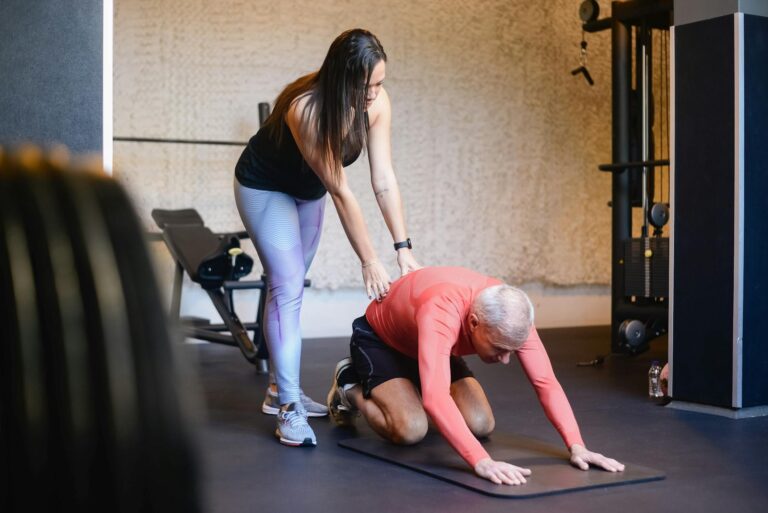
The seven exercises most commonly prescribed in lower back physical therapy programs are pelvic tilts, knee-to-chest stretches, glute bridges, cat-cow stretches, bird-dog exercises, dead bugs, and squats. Physical therapists recommend these specific movements because research consistently shows they work—people doing exercise therapy rated their pain 15 points better on a 0-100 scale and disability 7 points better after just three months compared to those who didn’t exercise at all. For example, a person with chronic lower back pain might spend just 20 minutes performing glute bridges and bird-dogs twice a week and experience meaningful relief where passive approaches like rest alone had failed.
Physical therapists don’t use these seven exercises arbitrarily. Evidence from network meta-analyses shows that Pilates-based and core-strengthening approaches have a 93% likelihood of reducing pain and a 98% likelihood of reducing disability in chronic lower back pain cases. This article covers how each of these seven exercises works, why physical therapists prescribe them in sequence, what the research says about their effectiveness, and how to distinguish between exercises that truly help and the emerging techniques gaining attention in 2026. We’ll also address why some approaches that feel effective in the moment—like passive treatments—can actually make long-term back problems worse.
Table of Contents
- What Are the Most Effective Core Stabilization Exercises?
- Why Hip and Glute Strength Matters for Lower Back Health
- Spinal Mobility Exercises That Reduce Stiffness and Pain
- Getting Started: Basic Strengthening and Postural Exercises
- Common Pitfalls and How to Progress Your Exercises Safely
- Emerging Techniques: EMS and Blood Flow Restriction Training
- Why Active Exercise Beats Passive Treatment for Lasting Relief
- Conclusion
What Are the Most Effective Core Stabilization Exercises?
Core stabilization exercises form the foundation of nearly every lower back physical therapy program because the core muscles act as a dynamic corset for your spine. The two most essential core exercises are the bird-dog and the dead bug, both of which teach your body to stabilize your spine while moving individual limbs. The bird-dog involves kneeling on all fours, then extending one arm forward and the opposite leg back while maintaining a perfectly level spine—a motion that might seem simple but requires precise coordination between your deep abdominal muscles, back extensors, and glute stabilizers.
The dead bug exercise follows a similar principle but from a supine position: you lie on your back with arms extended toward the ceiling and knees bent at 90 degrees, then slowly lower one arm and the opposite leg toward the floor while keeping your lower back pressed into the ground. What makes these exercises particularly valuable is that they teach motor control rather than just strength—your nervous system learns how to recruit stabilizer muscles before larger movement muscles, which is precisely what prevents reinjury. However, if you perform these exercises with poor form or progress too quickly, you’ll train poor movement patterns into your nervous system instead, so it’s worth having a therapist watch your technique initially.

Why Hip and Glute Strength Matters for Lower Back Health
Physical therapists increasingly recognize that tight or weak hips force the lower back to compensate, leading to pain and dysfunction. This is why glute bridges—an exercise where you lie on your back with knees bent, feet flat, and press your hips upward—appear in virtually every PT program and have become a particular focus in 2026 as evidence mounts that hip mobility deficits are underdiagnosed. When your glutes are weak or inactive, the muscles in your lower back have to work overtime to maintain posture and control movement, essentially being asked to do a job they weren’t designed for.
A glute bridge properly performed activates not just the gluteus maximus but also the posterior chain all the way up through the thoracic spine. The challenge with hip-focused exercises is that they require patience—the gluteal muscles tend to “wake up” slowly after periods of inactivity or sitting, and rushing the strengthening process won’t speed recovery. If someone has been sedentary for months, their glutes may be so underactive that they need to spend the first week or two simply practicing the mind-muscle connection of a glute bridge before adding load or increasing repetitions. Therapists also watch carefully for substitution patterns, where people use their lower back extensors instead of their glutes, which perpetuates the very problem they’re trying to fix.
Spinal Mobility Exercises That Reduce Stiffness and Pain
While stabilization and strength form one pillar of back pain recovery, mobility forms another. The cat-cow stretch and the knee-to-chest stretch address different aspects of spinal health: cat-cow teaches controlled, segmented spinal movement and gentle mobilization through the entire vertebral chain, while knee-to-chest stretches target both the erector spinae muscles along the spine and the thoracolumbar fascia that can become painfully tight with lower back issues. Cat-cow, performed by alternating between arched and rounded spine positions on hands and knees, helps restore natural spinal extension and flexion patterns that sedentary living suppresses.
For someone whose lower back pain stems from facet joint stiffness—a common presentation in people who spend long hours sitting—knee-to-chest stretches provide direct relief by gently flattening the lumbar curve and decompressing the posterior structures of the spine. A patient might experience noticeable pain reduction within two to three repetitions of knee-to-chest stretches, which makes them psychologically reinforcing in a way that core stabilization exercises aren’t. However, if someone has significant spinal stenosis or instability, aggressive stretching can paradoxically worsen symptoms, which is why these exercises require proper screening and often professional guidance.

Getting Started: Basic Strengthening and Postural Exercises
Before diving into complex movement patterns, physical therapists often start patients with the pelvic tilt, a foundational exercise that teaches the basic mechanics of spinal stability and postural awareness. Lying on your back with knees bent, a pelvic tilt involves rocking your pelvis so your lower back flattens against the floor, then releasing—a subtle movement that nonetheless activates the deep abdominal muscles and begins retraining your brain’s sense of neutral spine position. This exercise serves as a bridge between passive rest and more demanding movements, making it ideal for people in acute pain or returning from injury.
Squats represent the other end of the foundational spectrum—a more complex, weight-bearing exercise that integrates core stability, hip strength, and leg power into a functional movement. A properly performed bodyweight squat requires the entire posterior chain to work in concert, which is why it appears in intermediate-to-advanced PT programs. The advantage of building a program around pelvic tilts and squats is that they progress naturally: pelvic tilts teach the pattern, core exercises like bird-dogs and dead bugs build stability, and squats integrate that stability into realistic movement. The typical recommendation is 1-2 sessions per week with sessions lasting less than 60 minutes, which prevents overtraining while still allowing adaptation.
Common Pitfalls and How to Progress Your Exercises Safely
One of the most counterintuitive aspects of physical therapy is that doing more isn’t always better—in fact, overdoing exercises is a leading reason people’s back pain plateaus or worsens. Many people approach their PT exercises with the mindset that if one set of 10 bird-dogs is good, three sets of 20 must be three times better, but this ignores the principle of progressive overload within the context of pain-sensitive tissue. The nervous system in someone with back pain is often hypersensitive, meaning that too much volume or intensity too quickly can trigger protective pain responses that reinforce the pain cycle rather than breaking it.
A safer progression follows a 50-30-20 rule: increase frequency for the first 2-3 weeks, then increase repetitions, then increase difficulty or load. This gradual approach gives tissues time to adapt and your nervous system time to recalibrate its threat detection. If you reach a plateau where exercises no longer produce improvements, the solution isn’t typically more volume—it’s changing the exercise itself, adjusting body position to increase demand, or consulting your therapist about whether movement patterns need refinement. Many people also underestimate the importance of consistency; research shows that regular exercise, even at moderate intensity, produces better outcomes than sporadic high-intensity bursts.

Emerging Techniques: EMS and Blood Flow Restriction Training
Beyond the classical exercises that have formed the backbone of PT for decades, emerging techniques are expanding the toolkit. Electrical muscle stimulation (EMS) and blood flow restriction (BFR) training represent two complementary approaches gaining traction in 2026. EMS involves applying electrical current to muscles to stimulate contraction without voluntary effort, which can be useful for reactivating inhibited muscles like the gluteus maximus that stop firing properly after injury or prolonged inactivity. BFR training uses partial occlusion of blood flow to create a metabolic stress that allows muscle growth and strength gains with lower external loads, potentially reducing pain during the loading phase of recovery.
The important caveat is that these emerging techniques should augment, not replace, the foundational exercise program. Someone cannot do 15 minutes of EMS and skip the active, volitional strengthening work that teaches motor control and builds true functional stability. EMS works best as an adjunct after the acute pain phase has passed, sometimes helping muscles “remember” how to activate properly. BFR training similarly works best for intermediate patients who have mastered basic movements but need more stimulus without tolerating the external load that produces greater pain. The research base for these emerging techniques is growing but remains limited compared to the decades of evidence supporting traditional exercise.
Why Active Exercise Beats Passive Treatment for Lasting Relief
Research makes a striking distinction between active and passive approaches to back pain: active exercise strategies are related to decreased disability over time, while passive methods—rest, medications, manual therapy alone—are actually associated with worsening disability. This doesn’t mean that medications or manual therapy have no role in initial pain management, but it does mean that the road to long-term relief runs through movement, not around it. Someone in acute pain might reasonably use passive methods to make those first days tolerable, but staying in that phase indefinitely converts what started as an injury into a chronic condition. The psychological component of this finding deserves emphasis: passive approaches inadvertently reinforce the belief that your body is fragile and that pain means further damage is occurring, both of which are usually false.
Active exercise conveys a different message—that your body is resilient, that controlled movement is safe, and that you have agency in your recovery. This shift in mindset, combined with the neurophysiological adaptations that come from moving, often produces pain relief that exceeds what passive treatments could achieve alone. The question isn’t whether to add exercise to your treatment—modern clinical guidelines make clear that exercise is first-line treatment for chronic lower back pain. The question is when to start, how much to progress, and how to maintain gains long-term.
Conclusion
The seven exercises most commonly prescribed in physical therapy programs—pelvic tilts, knee-to-chest stretches, glute bridges, cat-cow stretches, bird-dogs, dead bugs, and squats—work because they address the actual biomechanical and neurological drivers of lower back pain. Research demonstrates that this approach produces meaningful outcomes: people following well-designed exercise programs show pain reduction of 15 points on a 0-100 scale and disability reduction of 7 points within three months, with Pilates and core-based approaches showing a 93% likelihood of reducing pain. These aren’t random exercises—they progress logically from foundational stability work through mobility to integrated strength, and they work at both the tissue level and the nervous system level.
If you’re dealing with lower back pain, the key next step is not searching for the perfect single exercise or the newest emerging technique, but rather committing to a structured program of active exercise, starting conservatively and progressing systematically under professional guidance. Ideally, this program should include sessions 1-2 times per week, less than 60 minutes per session, with particular attention to proper form in the early stages. The goal isn’t perfection—it’s consistent, intelligent movement that signals to your nervous system that your back is resilient enough for the demands of living, and that the pain, while it may linger briefly, is not a sign that further damage is occurring.