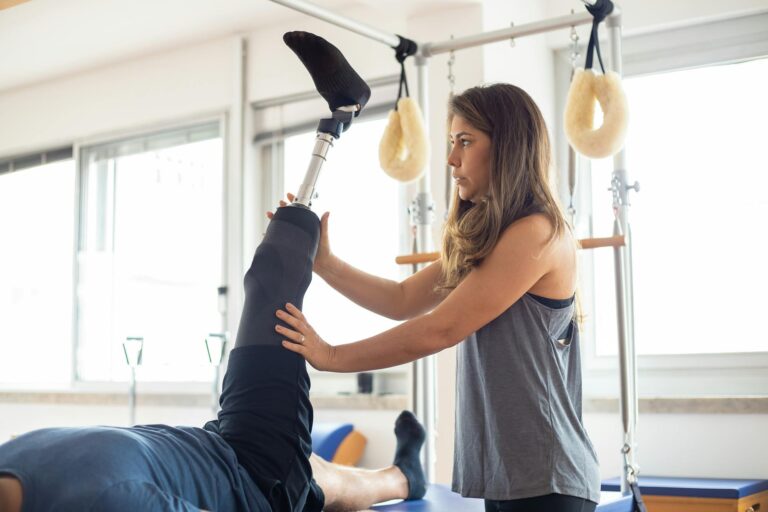
The seven exercises doctors most commonly recommend for spine stability are: cat-cow stretches, bird dogs, planks, dead bugs, bridges, Superman holds, and pallof presses. These movements strengthen the deep abdominal muscles and back stabilizers that hold your spine in proper alignment, which is particularly important if you have concerns about balance, fall risk, or maintaining mobility as you age. For people with dementia or cognitive decline, spine stability becomes even more critical because a strong core helps prevent falls that can lead to serious injuries—and maintains the muscle memory for walking, standing, and daily movements even as other cognitive functions change. This article explores each exercise in detail, explains why stability matters for brain health, and shows you how to start safely.
The connection between spine health and cognitive function isn’t widely understood, but your spine does far more than hold you upright. When your core muscles are weak, your nervous system works harder to maintain balance, diverting resources from other functions. A stable spine also preserves proprioception—your body’s sense of where it is in space—which depends partly on signals from your spine and core. For older adults or those experiencing memory loss, maintaining this proprioceptive feedback loop helps prevent the cascade of falls and injuries that accelerate decline.
Table of Contents
- Why Does Spine Stability Matter More as We Age?
- How Do These Seven Exercises Actually Strengthen Your Spine?
- How to Assess Your Starting Point Before Beginning
- The First Exercise—Cat-Cow: Teaching Your Spine to Move Safely
- Building Deep Stability with Dead Bug and Bird Dog
- Sustained Strength with Planks and Bridges
- Advanced Control with Pallof Presses and Superman Holds
- Conclusion
Why Does Spine Stability Matter More as We Age?
Your spine is supported by layers of muscle: large ones you can see (like your rectus abdominis) and deeper ones you cannot (like your transverse abdominis and multifidus). The deeper stabilizers are where spine problems actually originate. When these muscles weaken—a nearly universal part of aging—your spine relies increasingly on joints and ligaments to stay in place, which they are not designed to do long-term. This creates a vicious cycle: weak stabilizers lead to unequal stress on joints, joints begin to degenerate, the pain or instability gets worse, and you move even less, weakening the muscles further. For someone with dementia or cognitive changes, this cycle accelerates. Cognitive decline often leads to reduced activity, which speeds muscle loss.
Additionally, balance problems are very common in dementia—both as a direct symptom and from medications used to manage behavior—so the margin for error shrinks. A person with strong spinal stabilizers can recover from a misstep. Someone with weak core muscles and poor proprioception cannot, and that single fall can trigger a serious injury, hospitalization, and rapid decline. This is why doctors specifically recommend spine stability work for this population—it’s not optional strength training, it’s injury prevention. The good news is that spine stability is remarkably responsive to exercise. Studies of older adults show that eight weeks of targeted stability training can reduce fall risk by 20–30 percent, and the gains persist for months after stopping if you maintain some baseline activity. For dementia specifically, the cognitive load of learning these exercises is low—many are rhythmic and can become automatic—whereas the safety benefits are immediate and measurable.
How Do These Seven Exercises Actually Strengthen Your Spine?
The seven core exercises work on different layers and aspects of spinal stability. Cat-cow and bird dog are dynamic (moving) exercises that teach your nervous system to coordinate multiple muscles at once and maintain stability through a range of motion. Dead bugs and bridges are semi-dynamic, controlling movement at multiple joints. Planks, Superman holds, and pallof presses demand sustained stabilization against a challenge—your body weight, gravity, or resistance. Together, they address the front, back, sides, and rotational aspects of core control. One critical point: these are not abdominal exercises in the old-fashioned sense. Crunches and sit-ups actually shorten your abdominal muscles and train the wrong movement pattern for spine stability.
A crunch bends your spine forward and engages primarily the surface layer (rectus abdominis); it does almost nothing for the deep stabilizers that actually prevent injury. The seven exercises here, by contrast, train stability in neutral spine—maintaining your natural curves while muscles resist unwanted movement. This is biomechanically what you need to prevent falls, herniated discs, and chronic back pain. However, if you have existing spine problems—significant arthritis, a prior fusion, or severe stenosis—some of these exercises may need modification. This is crucial: stability training should not cause pain. Discomfort in the muscles being worked is normal, but sharp pain in the spine, shooting pain down a leg, or pain that lingers for hours afterward means you need guidance from a physical therapist before proceeding. A PT can assess whether your particular anatomy requires different variations and can ensure you’re not inadvertently loading an unstable segment.
How to Assess Your Starting Point Before Beginning
Before starting any spine stability program, an honest assessment of your current movement patterns is essential. Stand in front of a mirror and observe your posture. Do you stand with a significant forward head posture (your ear not over your shoulder)? Do your shoulders round forward? Does your lower back sag when you stand still? These patterns indicate where your stabilizers are weakest and will guide which exercises to prioritize. A second assessment is functional: can you stand on one leg for 30 seconds without holding onto anything? Can you walk in a straight line heel-to-toe? Can you sit down in a chair without using your arms? These simple tests reveal your current proprioceptive and stability baseline. If any feels shaky or impossible, that’s your signal that stability work is urgent and should start very gently.
For people with dementia, a family member or caregiver observing these movements can help track progress over weeks—sometimes the person themselves won’t remember they’re doing the exercises, but a caregiver will notice they’re not grabbing furniture when they walk anymore. The comparison to consider: starting these exercises is similar to learning to type. Initially, you move slowly and must think about each action. Over 4–6 weeks, the movements become more automatic, and you can eventually do them while watching television or having a conversation. This automaticity is actually the goal—you want spine stability to become a background function, not something requiring conscious effort. This is especially valuable for people with cognitive decline, because automatic movements persist longer than consciously learned ones.

The First Exercise—Cat-Cow: Teaching Your Spine to Move Safely
Cat-cow is the starting exercise for most people because it’s familiar, low-impact, and teaches coordination without high demands on strength. Here’s how: get on your hands and knees, shoulders over hands, hips over knees. Inhale, let your belly sag toward the floor while looking slightly upward—this is “cow.” Exhale, draw your belly in toward your spine, round your back, and tuck your chin—this is “cat.” Move slowly, synchronizing the motion with your breath, for eight to ten repetitions. Why cat-cow? It mobilizes your spine through its natural range, warms up the deep stabilizers, and trains coordination. Crucially, it also teaches you to distinguish between a neutral spine and exaggerated curves.
Many people with poor posture have lost the ability to feel where their spine actually is; cat-cow makes that awareness conscious again. Repeat three times per week, and after two weeks you’ll notice you naturally stand a bit straighter because your spine has re-learned what alignment feels like. The limitation worth knowing: cat-cow is a mobility exercise, not primarily a strengthening one. It prepares you for the more challenging stability exercises but doesn’t build the muscle endurance you ultimately need. People sometimes get stuck doing cat-cow alone and wonder why they still fall or feel unstable—the reason is that you also need sustained tension work (planks, bridges, dead bugs) to build the endurance that prevents injury during daily life.
Building Deep Stability with Dead Bug and Bird Dog
Dead bug and bird dog are the real workhorses of spinal stability, because they challenge your stabilizers while you’re moving limbs in different directions. Dead bug: lie on your back, knees bent at 90 degrees, hips at 90 degrees, arms reaching toward the ceiling. Slowly extend one leg straight while reaching the opposite arm overhead, then return. Alternate sides, moving slowly and keeping your lower back flat against the floor throughout. This teaches your core to stabilize your spine against the pull of moving limbs—exactly what happens when you walk, reach, or bend. Bird dog: start on hands and knees. Extend one leg straight back while reaching the opposite arm forward, hold for two seconds, return.
The bird dog is harder than dead bug because you’re supporting your body weight on three limbs while the fourth moves, which demands more stabilizer activation. After three weeks of dead bug, adding bird dog increases the challenge appropriately. Do 10–15 repetitions per side, three times per week. People often report within four weeks that they feel steadier on their feet and less likely to stumble when they misstep. However, if you feel your lower back arching or your hips tilting during these exercises, you’re losing the stability benefit and training an unstable pattern instead. This is the moment to slow down, reduce the range of motion (don’t extend the leg as far), or regress to a simpler variation like dead bug with one leg extended while the other stays bent. The quality of the movement matters far more than the difficulty. For someone with dementia, a caregiver watching for proper form is invaluable, because the person may not feel it when they’re doing the movement wrong.

Sustained Strength with Planks and Bridges
Once you’ve done cat-cow and dead bug for 3–4 weeks, planks and bridges introduce sustained stabilization—holding a challenging position for time rather than moving through a range. A forearm plank: lie face-down, elbows under shoulders, forearms forward, feet together. Lift your hips so your body forms a straight line from head to heels, and hold. Start with 20–30 seconds; over weeks, progress to 60+ seconds. A plank demands that your deep abdominal muscles contract continuously to prevent your hips from sagging—exactly what they need to do during daily life when you’re standing or walking. The bridge: lie on your back, knees bent, feet flat, arms at your sides. Push through your heels to lift your hips toward the ceiling until your knees, hips, and shoulders form a straight line.
Hold for 20–30 seconds, rest, repeat for three to five repetitions. Bridges are excellent for strengthening the posterior chain (glutes and back stabilizers), which is critical because most people are stronger in front (chest, abdominals) than in back, creating imbalance. Many falls happen because the back muscles are too weak to counteract forward momentum. A practical comparison: planks and bridges feel like “nothing” at first—many people think they’re too easy. But by week three of holding them regularly, people realize they’re very hard and very effective. Unlike dynamic exercises, you cannot cheat a plank by moving quickly; the effort becomes obvious within 10–15 seconds. For someone with dementia, this is actually helpful: a caregiver can watch the plank and see when the hips start to sag (a sign of fatigue), and you stop the exercise at that point. The exercise “tells you” when you’ve done enough.
Advanced Control with Pallof Presses and Superman Holds
As your stability improves, pallof presses introduce rotational control—resisting your spine’s desire to rotate against a force. You need a resistance band or cable machine for this. Stand sideways to the anchor point, the band at chest height and anchored to one side. Hold the band at your chest with both hands; the tension of the band will try to twist your torso. Press the band straight ahead while resisting that twisting force. This teaches your oblique stabilizers to protect your spine during real-world movements like reaching, carrying groceries, or turning to look at something. Superman holds: lie face-down, arms overhead, legs extended.
Simultaneously lift your arms, chest, and legs a few inches off the ground, creating a gentle backbend, and hold. This strengthens the back stabilizers (erector spinae and multifidus) that most people neglect. Where planks and dead bugs emphasize front and rotational control, Superman holds address the posterior chain. After six weeks of planks and bridges, adding Superman holds provides comprehensive coverage. The limitation here is that pallof presses and Superman holds are not beginner exercises. If you attempt them before your basic stabilizers are conditioned, you risk either not feeling the correct muscles working or putting excessive stress on an unstable spine. The progression matters: cat-cow and dead bug first (weeks 1–3), then add bridges and planks (weeks 3–6), then progress to pallof presses and Superman holds (week 6 onward). Skipping early steps to rush to harder exercises is how people end up injured or discouraged.
Conclusion
The seven exercises—cat-cow, dead bug, bird dog, plank, bridge, Superman hold, and pallof press—form a complete spine stability program that progresses from mobility and coordination to strength and advanced control. For people concerned about balance, fall risk, or maintaining independence during cognitive changes, spine stability work is one of the highest-return interventions available. The exercises are low-cost, require no equipment (or minimal equipment), and produce measurable results—improved posture, steadier walking, fewer falls—within four to six weeks.
The most important step is to begin, and to progress gradually while maintaining proper form. A physical therapist can provide in-person assessment and ensure your particular anatomy and medical history are accommodated. Even 15 minutes three times per week of consistent, properly-done spine stability work will reduce your injury risk and help you maintain the mobility and independence that quality of life depends on. For caregivers supporting someone with dementia, these exercises also provide a concrete, evidence-based activity that helps protect their loved one’s safety and maintains a sense of capability and strength.