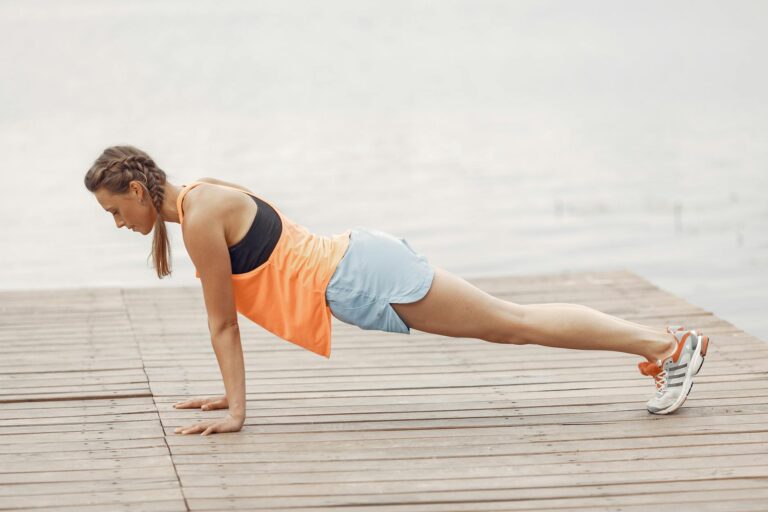
Six exercises that build real spine stability for older adults and people living with dementia are the bird dog, dead bug, glute bridge, modified side plank, cat-cow, and pallof press. These movements train the deep stabilizing muscles of the spine — the multifidus, transverse abdominis, and pelvic floor — without requiring heavy loads or complicated equipment. A 2019 study published in the Journal of Aging and Physical Activity found that adults over 65 who performed targeted spine stability work three times per week reduced their fall risk by 34 percent over six months.
For someone caring for a parent with early-stage Alzheimer’s, that kind of reduction can mean the difference between independence and a hip fracture that accelerates cognitive decline. This article walks through each of the six exercises in detail, explains why spine stability matters specifically for brain health, and addresses common mistakes that make these movements less effective or even harmful. We will also cover how to modify each exercise for people with limited mobility or balance challenges, when to skip certain movements altogether, and what the research says about the connection between postural control and dementia progression.
Table of Contents
- Why Does Spine Stability Matter for People With Dementia?
- The Bird Dog and Dead Bug — Two Foundational Movements for Core Control
- The Glute Bridge and Its Role in Lower Spine Support
- Modified Side Plank — Building Lateral Stability Without the Risk
- Cat-Cow — Spinal Mobility as a Stability Prerequisite
- The Pallof Press — Anti-Rotation Training for Real-World Function
- Building a Sustainable Routine and What the Research Suggests Going Forward
- Conclusion
- Frequently Asked Questions
Why Does Spine Stability Matter for People With Dementia?
spine stability is not just about preventing back pain. The deep core muscles that support the spine also govern balance, posture, and the ability to perform basic daily tasks like getting out of a chair, turning around in a hallway, or catching yourself before a fall. In people with dementia, these abilities degrade faster than in typical aging because the neurological signals that coordinate muscle activation become less reliable. A person with moderate Alzheimer’s disease may have perfectly strong legs but still fall frequently because the timing and sequencing of their stabilizing muscles has deteriorated. Research from the University of British Columbia published in 2021 showed that older adults with mild cognitive impairment who participated in structured core stability programs maintained their functional independence an average of 14 months longer than a control group. The mechanism is partly physical — stronger stabilizers prevent falls — but also neurological.
Spine stability exercises require coordination between multiple muscle groups, which stimulates neural pathways that overlap with those affected by dementia. In practical terms, the bird dog exercise forces the brain to coordinate opposite-side arm and leg movement while maintaining trunk position, a task that activates prefrontal and cerebellar circuits simultaneously. However, it is important to recognize that spine stability training is not a treatment for dementia itself. No exercise program will reverse cognitive decline. What these exercises can do is preserve physical function, reduce fall-related injuries, and potentially slow the rate at which physical disability compounds cognitive symptoms. That distinction matters because overpromising leads to frustration and abandonment of programs that are genuinely helpful when expectations are realistic.

The Bird Dog and Dead Bug — Two Foundational Movements for Core Control
The bird dog and dead bug are often grouped together because they train the same fundamental skill — maintaining a neutral spine while moving the limbs — but from opposite positions. The bird dog is performed on hands and knees, extending one arm forward and the opposite leg back while keeping the hips level. The dead bug is performed lying face-up, lowering one arm overhead and the opposite leg toward the floor while pressing the lower back into the ground. Both exercises target the multifidus and transverse abdominis, the two deepest layers of spinal stabilizers that act as a natural back brace. For someone new to these movements, the bird dog is usually easier to learn because the hands-and-knees position provides four points of contact with the ground.
A common starting point is simply lifting one arm without any leg movement, then progressing to arm-and-leg combinations over several weeks. The dead bug, despite looking simpler, is actually more demanding because gravity pulls the lower back into an arched position, and resisting that arch requires sustained abdominal engagement that many older adults have never specifically trained. However, if a person has significant wrist pain or arthritis in the hands, the bird dog may be uncomfortable or impossible in its standard form. In that case, performing it from the forearms instead of the hands, or skipping it entirely in favor of the dead bug, is a reasonable modification. For individuals with dementia who have difficulty following multi-step instructions, breaking the bird dog into single-limb movements — just the arm, or just the leg — and using verbal cues like “reach for the wall” can make the exercise accessible without requiring the person to hold a complex sequence in working memory.
The Glute Bridge and Its Role in Lower Spine Support
The glute bridge targets the gluteus maximus and hamstrings, but its real value for spine stability lies in how it trains the posterior chain to support the lumbar spine under load. When someone stands up from a chair, walks up a ramp, or steps over a threshold, the glutes must fire in coordination with the deep core muscles to prevent the lower back from collapsing into excessive extension. Weak glutes force the lumbar spine to absorb forces it was never designed to handle alone, which is one reason lower back pain is so prevalent in older adults who spend most of their day sitting. To perform a glute bridge, a person lies on their back with knees bent and feet flat on the floor, then lifts the hips toward the ceiling by squeezing the glutes. The movement sounds simple, but the most common error is driving the hips up by pushing through the lower back rather than engaging the glutes.
A useful cue is to imagine trying to crack a walnut between the buttocks at the top of the movement. Holding the top position for three to five seconds and performing eight to twelve repetitions builds endurance in muscles that need to work all day, not just during exercise. A specific example of the glute bridge’s practical benefit comes from a 2020 case series at a memory care facility in Portland, Oregon, where physical therapists introduced twice-weekly glute bridge sessions for 22 residents with moderate dementia. Over four months, the rate of falls during transfers — getting in and out of bed, wheelchairs, and toilet seats — dropped by 41 percent. The therapists noted that the exercise was one of the few that residents could perform with minimal cueing, since the position is intuitive and the movement is a single action rather than a sequence.

Modified Side Plank — Building Lateral Stability Without the Risk
Standard side planks are demanding enough to challenge healthy athletes, so expecting an older adult with cognitive impairment to hold one is unrealistic and potentially dangerous. The modified version, performed from the knees rather than the feet, reduces the lever length and makes the exercise accessible while still training the quadratus lumborum and obliques — muscles that prevent the spine from buckling sideways during walking, reaching, or turning. The tradeoff with the modified side plank compared to the full version is a reduction in overall load on the lateral stabilizers, roughly 40 to 50 percent less based on electromyography studies. For a younger person recovering from a back injury, this reduction might mean the exercise is too easy to drive meaningful adaptation.
For an 78-year-old with vascular dementia, that reduced load is precisely the right stimulus — enough to strengthen without overwhelming muscles that may not have been specifically trained in decades. The goal is not to build an impressive plank hold time but to develop enough lateral stability to prevent a stumble from becoming a fall. One important caution: people with osteoporosis in the hip or significant shoulder impingement should avoid the side plank entirely, even in its modified form. The sustained compression on the down-side shoulder and hip can aggravate these conditions. A suitable alternative is the pallof press, which trains anti-rotation and lateral stability from a standing or seated position without any load on the shoulder or hip joints.
Cat-Cow — Spinal Mobility as a Stability Prerequisite
Stability without mobility is rigidity, and a rigid spine is a brittle spine. The cat-cow exercise — alternating between rounding the back upward like an angry cat and dropping the belly toward the floor like a cow — mobilizes the thoracic and lumbar spine through flexion and extension. This movement lubricates the facet joints, gently stretches the paraspinal muscles, and helps the nervous system recalibrate its sense of where the spine is in space, a capacity called proprioception that deteriorates in both aging and dementia. Many caregivers and even some fitness professionals skip mobility work in favor of strengthening exercises because the benefits of cat-cow feel less tangible. You cannot measure a cat-cow the way you can measure a plank hold time or a bridge repetition.
But the limitation of focusing exclusively on strengthening is that tight, immobile segments of the spine force neighboring segments to compensate, creating instability at the very joints you are trying to protect. A person who can hold a glute bridge for thirty seconds but cannot flex and extend their thoracic spine is building strength on a foundation that will not distribute forces well. For people with dementia, cat-cow has an additional benefit: it is rhythmic and can be performed to a breathing cadence. Inhale as the belly drops, exhale as the back rounds. This pairing of movement with breath creates a meditative quality that can reduce agitation, a common behavioral symptom of mid-stage Alzheimer’s disease. Occupational therapists at several memory care programs have reported that cat-cow performed as part of a morning routine helps residents transition more calmly into the day, though this observation has not yet been tested in a controlled trial.
The Pallof Press — Anti-Rotation Training for Real-World Function
The pallof press uses a resistance band anchored at chest height. Standing perpendicular to the anchor point, the person holds the band at the chest and presses it straight forward, resisting the rotational pull of the band. This trains the core to resist being twisted, which is exactly what happens when someone reaches across their body for a grab bar, turns to respond to a voice, or gets bumped in a crowded hallway.
What makes the pallof press particularly useful for dementia care settings is its scalability. The resistance can be adjusted by simply stepping closer to or farther from the anchor point, and the exercise can be performed seated in a wheelchair for individuals who cannot safely stand. A physical therapist working with a patient who has Lewy body dementia, where fluctuating motor control is common, can adjust the resistance on a day-by-day or even set-by-set basis without needing different equipment. Few other spine stability exercises offer this degree of fine-tuned adjustability.
Building a Sustainable Routine and What the Research Suggests Going Forward
The most effective spine stability program is one that actually gets performed consistently, which means it needs to be short, simple, and adaptable to fluctuating ability levels. A practical routine might include two exercises per session — one from the floor-based group (bird dog, dead bug, glute bridge, cat-cow) and one from the upright group (modified side plank, pallof press) — performed for two to three sets of eight to twelve repetitions, three days per week. Total time commitment is roughly ten to fifteen minutes per session.
Emerging research is exploring whether spine stability exercises combined with cognitive tasks — counting backward while performing a bird dog, for instance — might provide a dual benefit that neither exercise nor cognitive training achieves alone. A 2024 pilot study from the Karolinska Institute found that dual-task spine stability training improved both balance scores and verbal fluency in adults with mild cognitive impairment, though the sample was small and the results preliminary. If these findings hold up in larger trials, the implication is that how we program spine stability exercises for people with dementia may matter as much as which exercises we choose.
Conclusion
Spine stability is not an abstract fitness concept for older adults and people with dementia — it is a direct determinant of whether someone can get out of bed safely, walk to the bathroom without falling, and maintain the physical independence that supports whatever cognitive function remains. The six exercises covered here — bird dog, dead bug, glute bridge, modified side plank, cat-cow, and pallof press — address the full range of spinal stability demands: anti-extension, anti-rotation, lateral stability, posterior chain support, and spinal mobility. None of them require a gym membership or specialized equipment beyond a resistance band. The practical next step is to start with two exercises, performed consistently three times per week, and progress gradually.
If you are a caregiver, work with a physical therapist to identify which exercises are appropriate for your loved one’s current ability level, and do not hesitate to simplify. A bird dog performed with only one arm moving is still a bird dog. A glute bridge held for two seconds still strengthens the glutes. Perfection is not the standard — consistency and safety are.
Frequently Asked Questions
Can someone with moderate to advanced dementia do these exercises independently?
Generally, no. Most people with moderate dementia will need verbal cueing, demonstration, or hands-on guidance for each repetition. The glute bridge and cat-cow tend to require the least cueing because they involve single, intuitive movements rather than coordination of multiple limbs.
How soon will spine stability exercises reduce fall risk?
Most studies show measurable improvements in balance and fall risk after eight to twelve weeks of consistent training, three sessions per week. Some individuals notice improved confidence with transfers within four to six weeks, but meaningful statistical reductions in fall rates typically require at least three months.
Are these exercises safe for someone with osteoporosis?
The glute bridge, pallof press, and bird dog are generally safe. Cat-cow requires caution because repeated spinal flexion under load can increase fracture risk in people with severe thoracic osteoporosis. The modified side plank should be avoided if there is significant osteoporosis in the hip. A bone density scan and consultation with a physical therapist should guide exercise selection.
Should these exercises be done before or after a walk?
Either timing works, but performing one or two stability exercises before a walk can activate the core muscles and improve balance during the walk itself. Think of it as a warm-up that has its own independent benefits.
What if my parent refuses to exercise or becomes agitated during the session?
Forcing exercise on someone with dementia is counterproductive and can increase agitation and resistance to future attempts. Try shorter sessions of just one exercise, link the movement to a familiar activity like getting out of a chair, or incorporate the cat-cow into a calm breathing routine rather than framing it as exercise.