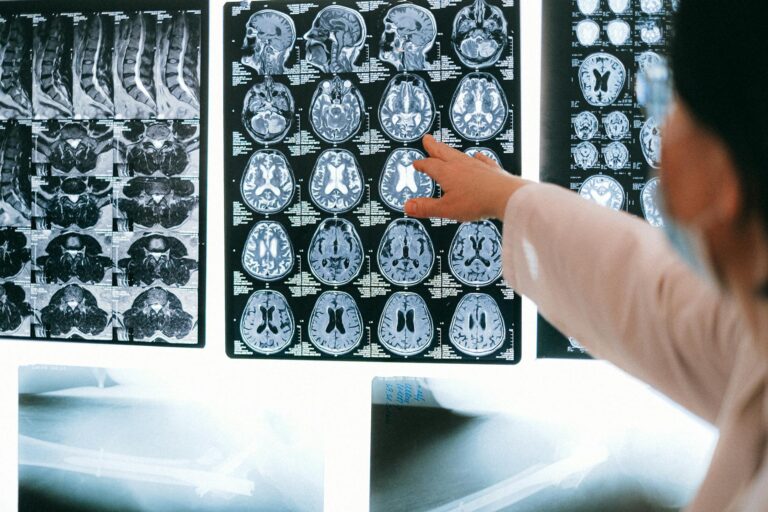
Scheuermann’s disease is a condition that affects the spine, causing it to develop an abnormal, exaggerated forward curve, particularly in the upper back, known as kyphosis. This disease typically emerges during adolescence, a critical period when the spine is still growing and developing. The exact cause of Scheuermann’s disease is not completely understood, but several factors contribute to its development.
At its core, Scheuermann’s disease involves a problem with the growth of the vertebrae, the small bones that make up the spine. Normally, these vertebrae grow evenly, maintaining a smooth curve of the spine. In Scheuermann’s disease, the front part of the vertebrae grows slower than the back part, causing the vertebrae to become wedge-shaped instead of rectangular. This uneven growth leads to the spine bending forward more than usual, creating the characteristic hump or rounded back appearance.
One of the main suspected causes is a genetic predisposition. Many cases show a family history, suggesting that certain inherited traits may make some individuals more likely to develop the disease. This genetic factor might influence how the vertebrae grow or how the cartilage between the vertebrae develops during childhood and adolescence.
Mechanical stress on the spine during growth is another important factor. The spine is subjected to various forces as a child grows, including those from posture, physical activity, and even minor injuries. If the vertebrae are weakened or stressed unevenly, this can disrupt normal growth patterns. For example, repetitive strain or poor posture during the rapid growth phase might contribute to the vertebrae developing abnormally.
The cartilage that forms the growth plates of the vertebrae also plays a crucial role. In Scheuermann’s disease, the cartilage may not develop or ossify (turn into bone) properly. This abnormal ossification can cause the vertebrae to become misshapen. Additionally, the discs between the vertebrae may herniate or bulge into the vertebral bodies, creating small indentations called Schmorl’s nodes, which are often seen in affected individuals.
Some researchers have suggested that Scheuermann’s disease could be linked to mild skeletal dysplasia, a condition where bones develop abnormally but not severely enough to be classified as a major bone disorder. This could explain why the vertebrae, as well as other bones like those in the pelvis or skull, sometimes show subtle abnormalities in people with the disease.
While trauma, infections, or tumors can cause angular kyphosis (a sharp forward bend of the spine), these are not typical causes of Scheuermann’s disease. Instead, the disease is more about a developmental issue during growth rather than an injury or infection.
In rare cases, other spinal conditions like ossification of ligaments or progressive kyphoscoliosis (a combination of kyphosis and scoliosis) may coexist or mimic Scheuermann’s disease, complicating diagnosis and treatment. However, these conditions have different underlying causes and mechanisms.
In summary, Scheuermann’s disease arises from a combination of genetic factors, abnormal growth of vertebral cartilage, mechanical stresses during adolescence, and possibly mild skeletal developmental issues. These factors lead to the uneven growth of vertebrae, causing the spine to curve forward excessively and resulting in the characteristic kyphotic deformity seen in affected individuals.