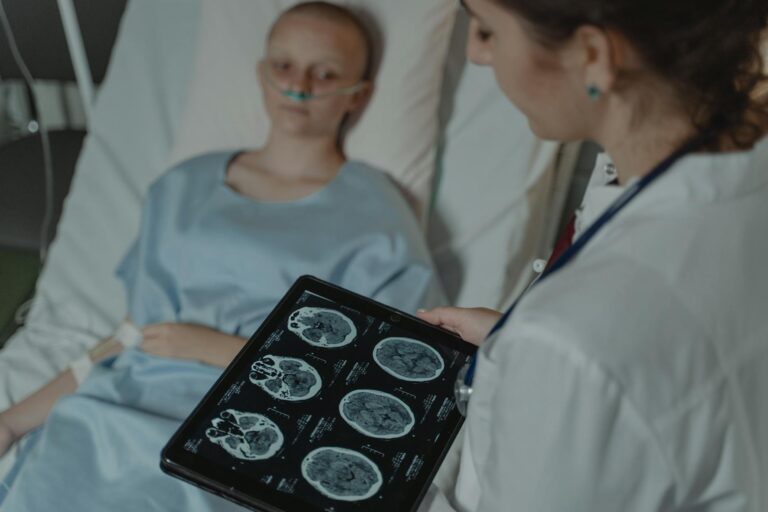
Some Parkinson’s patients benefit from deep brain stimulation (DBS) because it directly targets and modulates abnormal brain activity that causes their motor symptoms, such as tremors, rigidity, and slow movements. DBS involves implanting electrodes into specific brain regions involved in movement control—most commonly the subthalamic nucleus or globus pallidus—and delivering controlled electrical impulses to regulate dysfunctional neural circuits. This can restore more normal signaling patterns in the brain areas affected by Parkinson’s disease, leading to improved motor function and quality of life.
Parkinson’s disease is characterized by the loss of dopamine-producing neurons in a part of the brain called the substantia nigra. This loss disrupts communication within a network known as the basal ganglia circuit, which plays a crucial role in coordinating smooth and purposeful movements. The disruption results in excessive or irregular activity in certain parts of this circuit, causing symptoms like tremor at rest, muscle stiffness (rigidity), slowness of movement (bradykinesia), and difficulty with balance.
Medications such as levodopa initially help replenish dopamine levels or mimic its effects but often become less effective over time or cause side effects like involuntary movements (dyskinesias). For patients whose symptoms are not adequately controlled by medication alone—or who suffer intolerable side effects—DBS offers an alternative approach that does not rely on drugs.
The implanted electrodes deliver continuous electrical pulses that interfere with abnormal neural firing patterns. By “jamming” these pathological signals or restoring more balanced activity within key nodes of the basal ganglia circuitry, DBS reduces motor symptoms significantly for many patients. It essentially acts like a pacemaker for the brain: just as cardiac pacemakers regulate heart rhythms electrically when natural pacing fails, DBS regulates faulty motor circuits electrically when chemical signaling is impaired.
Not all Parkinson’s patients respond equally well to DBS because several factors influence its effectiveness:
– **Symptom profile:** Patients with prominent tremor often see dramatic improvement; those with severe gait problems or cognitive decline may benefit less.
– **Disease stage:** Candidates typically have moderate to advanced Parkinson’s where medication response fluctuates but cognition remains intact.
– **Target selection:** Different brain targets can be chosen depending on symptom predominance; subthalamic nucleus stimulation tends to allow medication reduction while globus pallidus stimulation may better control dyskinesias.
– **Programming optimization:** After implantation, neurologists carefully adjust stimulation parameters—frequency, amplitude, pulse width—to maximize benefits while minimizing side effects like speech difficulties or balance issues.
Recent advances include *adaptive* deep brain stimulation systems that dynamically adjust stimulation based on real-time feedback from neural signals associated with symptom severity. These systems aim to provide more precise control tailored moment-to-moment according to patient needs rather than constant fixed settings.
Patients who benefit from DBS often experience:
– Significant reduction in tremors
– Decreased rigidity allowing easier movement
– Improved walking speed and coordination
– Reduced “off” periods when medications wear off
– Lower doses of dopaminergic drugs needed
This translates into enhanced independence and quality of life for many individuals who had struggled despite optimal medical therapy.
However, DBS is not a cure—it does not stop disease progression—and it carries surgical risks such as infection or bleeding. Careful patient selection through multidisciplinary evaluation ensures candidates have realistic expectations about outcomes based on their unique clinical picture.
In summary: some Parkinson’s patients gain substantial relief from deep brain stimulation because it directly corrects dysfunctional electrical activity within critical motor circuits disrupted by dopamine loss. By restoring more normal signaling patterns through targeted electrical impulses delivered via implanted electrodes controlled externally by programmable devices under expert guidance, these individuals regain better control over their movements when medications alone no longer suffice. Advances like adaptive closed-loop systems promise even greater personalization and efficacy going forward for selected candidates living with this complex neurodegenerative disorder.